
Income & Leftover Money Calculator
Enter your monthly financial details below to see exactly how much money you have "left over" in the strictest financial sense.
Summary
- Gross Income: €0.00
- Less Taxes: - €0.00
- = Disposable Income: €0.00
- Less Essentials: - €0.00
- = Discretionary Income: €0.00
You just finished paying your rent, your electricity bill, and maybe that unexpected vet visit for the cat. You look at your bank account, and there’s still some cash sitting there. It feels good, right? But if you try to explain this to a friend or an accountant, you might hit a wall. Leftover money isn’t really a formal financial term, which causes confusion when people try to categorize their finances.
The truth is, what you call "leftover" depends entirely on what it was left over from. Is it money remaining after taxes? Or is it money remaining after all your essential bills are paid? These two concepts are vastly different, and mixing them up can ruin your budget. Let’s clear up the terminology so you know exactly what you’re dealing with and how to use it wisely.
The Big Distinction: Disposable vs. Discretionary Income
Most of the time, when people ask about leftover money, they are actually asking about one of two specific economic concepts: Disposable Income or Discretionary Income. While they sound similar, they represent completely different stages of your financial life.
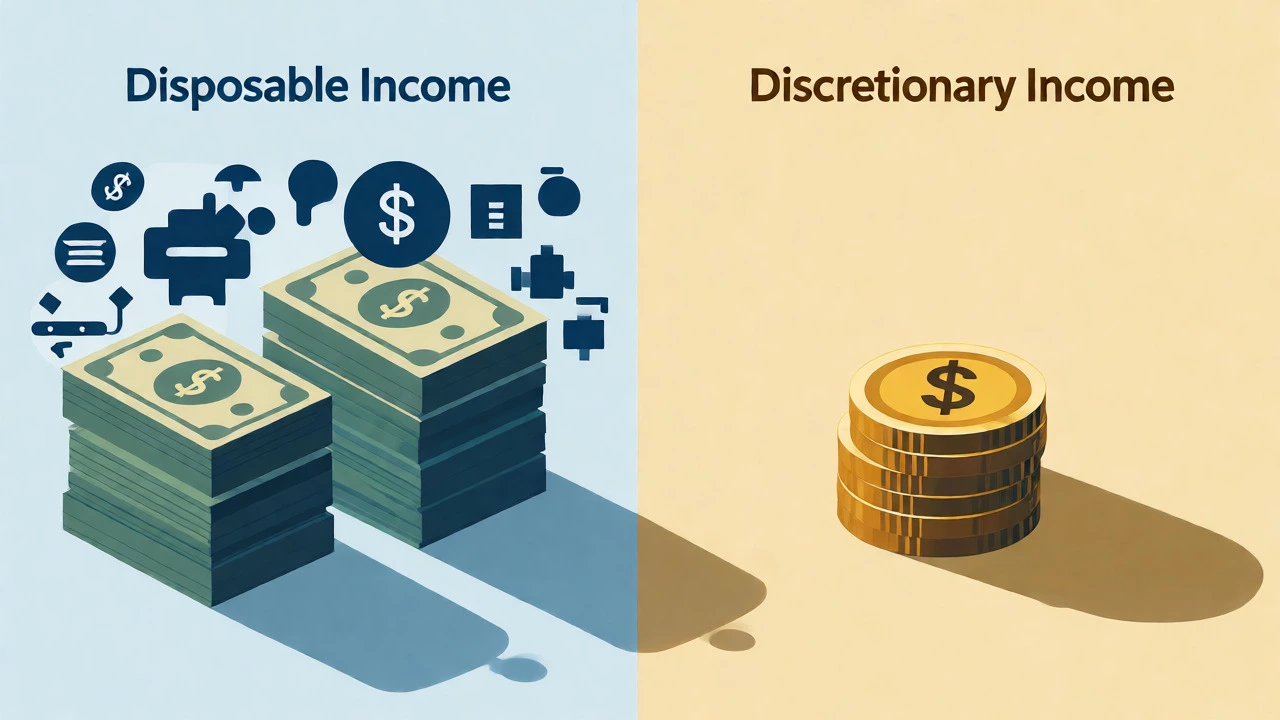
Disposable Income is simply what’s left in your pocket after the government takes its cut. It’s your gross pay minus direct taxes like income tax and social insurance contributions. Think of it as the total pool of money available to you before you decide where it goes. If you earn €3,000 a month and pay €600 in taxes, your disposable income is €2,400. That’s it. It doesn’t matter if you spend every cent of it on groceries; it’s still your disposable income.
Discretionary Income, on the other hand, is the true "leftover" money most people care about. This is what remains after you’ve paid your taxes and covered all your non-negotiable living expenses-rent, utilities, food, transport, and minimum debt payments. If that same €2,400 disposable income gets eaten up by €1,800 in bills, you have €600 in discretionary income. This is the money you can choose to save, invest, or blow on a weekend trip to Barcelona. Understanding this difference is critical because you can’t budget effectively if you think your disposable income is free to spend.
| Term | Definition | Calculation | Use Case |
|---|---|---|---|
| Gross Income | Total earnings before deductions | Salary + Bonuses | Tax calculations |
| Disposable Income | Income after taxes | Gross - Taxes | Budgeting baseline |
| Discretionary Income | Income after taxes and essentials | Disposable - Essentials | Savings & Investing |
Other Names You Might Hear
Outside of strict economics, everyday language uses various terms for that cash sitting in your checking account. Knowing these helps when you’re reading financial blogs or talking to advisors.
Surplus is a common term used in business and household budgeting. If your income exceeds your expenses for the month, you have a surplus. In personal finance, having a monthly surplus is the goal. It’s not necessarily "free" money yet, but it’s the raw material for building wealth. A deficit is the opposite-when you spend more than you make.
Cash Flow refers to the net amount of cash being transferred into and out of a business or personal account. When people say they have "positive cash flow," they mean money is coming in faster than it’s going out. However, positive cash flow doesn’t always mean you have extra money to spend; it could just mean you haven’t paid your annual insurance premium yet. Be careful confusing timing differences with actual profit.
Residual Income is often used in investing contexts. It’s the income generated by an asset after all operating expenses are paid. For example, if you own a rental property, the residual income is the rent collected minus mortgage, repairs, and management fees. Unlike salary, which stops when you stop working, residual income can keep flowing, making it a powerful tool for long-term wealth.
Why Terminology Matters for Your Wallet
You might wonder why we’re splitting hairs over words. Here’s the reality: mislabeling your money leads to bad decisions. If you treat your disposable income as if it were discretionary income, you’ll likely overspend. You’ll feel rich because you see €2,400 in your account, forgetting that €1,800 of it is already spoken for by your landlord and the electric company.
Consider a scenario involving Emergency Funds. Many people dip into their "leftover" money for small treats, leaving them vulnerable when a car breaks down. If you correctly identify your true discretionary income (the real leftover), you can automate transfers to an emergency fund. The rule of thumb here is simple: allocate 50% of your true leftover money to savings or investments before you allow yourself any spending. This prevents lifestyle creep, where your spending rises to match your income.
Another pitfall is ignoring Inflation. Leftover money loses value if it sits idle. If you have €500 left over each month, keeping it in a current account earning 0.1% interest means you’re losing purchasing power. Calling it "spare change" encourages laziness. Calling it "investable capital" changes your mindset. You start looking for high-yield savings accounts or low-cost index funds rather than letting it evaporate on impulse buys.

How to Manage Your Leftover Money Effectively
Now that you know what to call it, let’s talk about what to do with it. Managing leftover money requires a system, not just willpower.
- Automate First: Set up automatic transfers the day after payday. Move your calculated discretionary income directly into a separate savings or investment account. Out of sight, out of mind.
- Define "Essentials" Strictly: One person’s luxury is another’s necessity. To calculate true leftover money, be honest about your fixed costs. Does your Netflix subscription count as essential? Probably not. Include only non-negotiables in your expense calculation.
- Use the 50/30/20 Rule as a Check: If your leftover money (discretionary) is less than 20% of your disposable income, your budget might be too tight. If it’s more than 50%, you might be under-spending on quality of life or missing opportunities to invest more aggressively.
- Review Quarterly: Life changes. Rent goes up, salaries increase, kids come along. Re-calculate your discretionary income every three months to ensure your budget reflects reality.
A common mistake in Ireland, specifically, is failing to account for irregular bills. Utilities and insurance often come in lump sums twice a year. If you don’t set aside a portion of your monthly leftover money for these, you’ll end up with a negative balance in January. Use a sinking fund strategy: create sub-accounts or envelopes labeled "Car Tax," "Home Insurance," etc., and feed them with your monthly surplus.
When "Leftover" Isn’t Actually Free
Sometimes, what looks like leftover money is actually hidden debt. Credit card statements often show a "minimum payment due." If you only pay the minimum, the rest of the balance rolls over with interest. That €200 left in your account might technically be yours, but if you carry a €5,000 balance at 18% APR, you’re borrowing expensive money while holding cheap cash.
Before you celebrate your surplus, check your liabilities. High-interest debt should consume your leftover money immediately. Paying off a credit card with 20% interest is a guaranteed 20% return on your money. No stock market investment guarantees that. Once high-interest debt is gone, then you can focus on growing your discretionary income through Compound Interest.
Finally, remember that taxes aren’t just taken at source. If you’re self-employed, your "leftover" money isn’t fully yours until you’ve set aside 20-40% for future tax bills. Failing to reserve this creates a false sense of security. Always calculate your net-after-tax projection before deciding how much you can truly spend or save.
Is disposable income the same as take-home pay?
Yes, generally speaking. Disposable income is your gross income minus mandatory taxes and social security contributions. Take-home pay is the amount deposited into your bank account, which is essentially the same figure unless you have pre-tax deductions like pension contributions, which reduce taxable income further.
Can I live on my discretionary income alone?
No, because discretionary income is what’s left *after* living expenses. Living on it alone would mean you have no money for rent, food, or bills. You need your full disposable income to cover essentials, and discretionary income is what remains for savings and wants.
What is a "surplus" in a household budget?
A surplus occurs when your total income exceeds your total expenses for a specific period. It is the amount of money left over that can be allocated to savings, debt repayment, or investments. Consistent surpluses are key to building financial stability.
Why is it important to distinguish between disposable and discretionary income?
Confusing the two leads to overspending. Disposable income includes money needed for survival (rent, food). Discretionary income is truly optional. Treating disposable income as free-to-spend ignores essential obligations, leading to debt and financial stress.
How does inflation affect my leftover money?
Inflation reduces the purchasing power of money over time. If your leftover money sits in a low-interest account, it buys less next year than it does today. Investing or saving in higher-yield instruments helps combat this erosion of value.