
Home Equity Cost Calculator
Your Details
Key Considerations
Home Equity Loan: Best for those with good credit and steady income. Rates start around 4.5%.
Cash-Out Refinance: Low rates similar to mortgage rates (3.8%-5.2%). Extends your mortgage term.
Reverse Mortgage: No monthly payments until you move or pass away. Interest compounds over time.
Lifetime Mortgage: Most common in Ireland. Interest rolls up over time but has no-negative-equity guarantee.
Results
Your Borrowing Capacity
You can access approximately in equity based on your home value and mortgage.
Home Equity Loan
Cash-Out Refinance
Lifetime Mortgage
Recommended Option
Most homeowners in Ireland don’t realize they can unlock thousands of euros tied up in their property without selling it. If you’re over 55 and own your home outright or have a small mortgage left, you might be sitting on a goldmine. But not all ways to access that equity are created equal. Some cost more in fees, interest, or future control than others. The cheapest way isn’t always the most advertised one.
Home Equity Loan: Low Rates, Fixed Payments
A home equity loan is often the most straightforward and affordable option if you have good credit and a steady income. You borrow a lump sum based on your home’s value minus what you still owe. In Ireland, rates for these loans typically start around 4.5% for borrowers with strong credit histories. You get the money upfront and pay it back in fixed monthly installments over 5 to 15 years.
For example, if your home is worth €400,000 and you owe €100,000, you might qualify for a €120,000 loan. Banks usually lend up to 80% of your home’s value, so you’d have room to borrow €220,000 total - meaning you could access €120,000 after paying off your existing mortgage.
Why it’s cheap: Interest rates are lower than personal loans. You only pay interest on the amount you borrow. There are no ongoing fees after setup. If you use the money to renovate or improve energy efficiency, you might even get tax relief under the Home Renovation Incentive scheme.
Cash-Out Refinance: Swap Your Mortgage for More Cash
This option works if you still have a mortgage. Instead of keeping your current loan, you refinance for more than you owe and pocket the difference. Say you owe €150,000 on a €400,000 home. You refinance for €250,000. You pay off your old mortgage with €150,000 and walk away with €100,000 in cash.
Interest rates on cash-out refinances are usually the same as standard mortgage rates - often between 3.8% and 5.2% in 2026. That’s cheaper than any personal loan or credit card. Plus, you extend your repayment term, lowering monthly payments.
Downside: You’re resetting your mortgage clock. If you had 10 years left, you might now have 25. That means paying more interest over time, even if the rate is lower. But if you plan to stay in your home long-term, this can still be the cheapest option.
Reverse Mortgage: No Payments Until You Move or Pass Away
Reverse mortgages are designed for homeowners aged 62 and older. You don’t make monthly payments. Instead, the lender pays you - either as a lump sum, monthly income, or line of credit. The loan balance grows over time and is repaid when you sell the home, move out, or pass away.
In Ireland, reverse mortgages are rare but growing. Providers like Irish Home Equity Release offer them with fixed rates around 5.5% to 6.8%. The amount you can borrow depends on your age, home value, and health. Someone aged 70 might access up to 45% of their home’s value.
Is it cheap? In terms of monthly cash flow - yes. You pay nothing until the end. But the total cost over 10 or 20 years can be high because interest compounds. It’s not the cheapest in absolute terms, but it’s the only option if you have no income or poor credit.
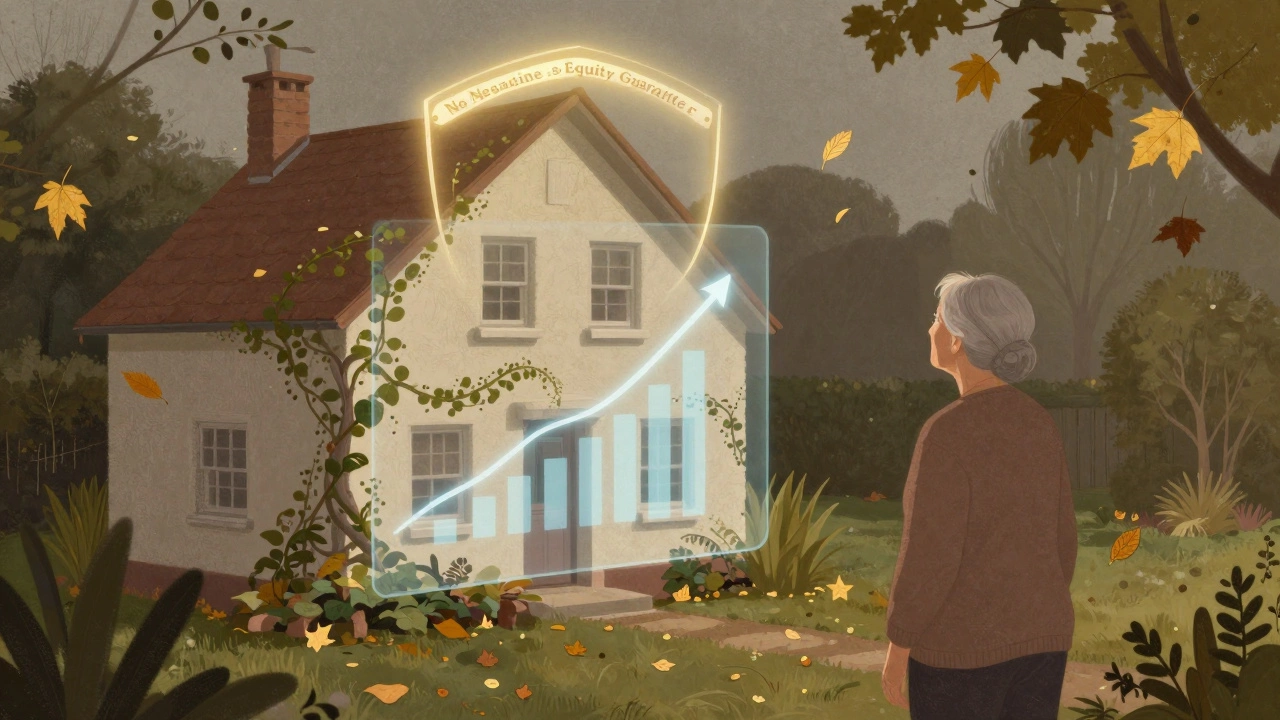
Equity Release Through a Lifetime Mortgage: The Irish Version
Lifetime mortgages are the most common type of reverse mortgage in Ireland. You keep ownership of your home, and the loan is secured against it. You can choose to make interest payments to stop the debt from growing, or let it roll up. Most people choose the roll-up option - meaning interest is added to the loan each month.
Here’s the catch: The longer you live, the more the debt grows. If you take out €100,000 at age 70 and live another 20 years at 6% compounded interest, the total owed could hit €320,000. That leaves less for your heirs.
But here’s what most people miss: Many providers now offer a no-negative-equity guarantee. That means your estate will never owe more than the home’s sale price. If the debt hits €320,000 but your house sells for €280,000, your family pays nothing extra.
Why Selling Isn’t the Cheapest Option
Some people think selling and downsizing is the best way to free up equity. But it’s not cheap. Estate agent fees in Ireland average 2.5% to 3%. Legal fees add another €1,500 to €3,000. Moving costs, stamp duty on your new home, and renovation expenses can push total costs over €20,000.
Plus, you’re leaving your neighborhood. Your community, doctors, friends, routines - all gone. And if housing prices rise after you sell, you might end up paying more to buy back in.
Equity release keeps you in your home. You avoid those costs. You keep your life intact. And if you’re not planning to move, it’s almost always cheaper than selling.
What to Avoid: High-Cost Alternatives
Don’t fall for payday lenders or unregulated equity schemes. Some companies promise quick cash but charge 20%+ interest or take ownership of part of your home. These are predatory and often illegal.
Personal loans might seem easy, but interest rates range from 8% to 15%. Credit cards? Even worse - 18% to 22%. These might be fine for small, short-term needs, but not for tapping into €50,000+ of equity.
Also avoid unregulated “equity partnerships.” These companies buy a share of your home in exchange for cash. They might promise you can buy back your share later, but the terms are usually stacked against you. They charge high fees, lock you into long contracts, and demand a large cut when you sell.

How to Pick the Right Option
Ask yourself three questions:
- Do you need cash now, or can you wait?
- Do you have a steady income to make monthly payments?
- Do you want to leave something to your family?
If you answer yes to #2 and no to #3 - go for a home equity loan or cash-out refinance. Lowest cost. Most control.
If you answer no to #2 and yes to #3 - consider a lifetime mortgage with interest payments. You control the debt growth and still pass on most of the equity.
If you answer no to #2 and no to #3 - a reverse mortgage with roll-up interest might be your only realistic option. It’s not cheap in total cost, but it’s the only one that doesn’t require income.
Real Example: Mary, 68, from Cork
Mary owned her home outright. It was worth €380,000. She needed €80,000 to fix her roof, replace windows, and pay off medical bills. She didn’t work anymore.
She got a lifetime mortgage for €80,000 at 6.2%. No monthly payments. She chose to let interest roll up. After 8 years, her loan balance was €128,000. Her home sold for €420,000. After paying off the loan, her daughter inherited €292,000. The no-negative-equity guarantee meant she never owed more than the house was worth.
She stayed in her home. She didn’t stress about bills. She didn’t sell. And she didn’t burden her daughter with debt.
Final Tip: Get Independent Advice
Irish law requires you to get advice from a qualified financial advisor before signing any equity release product. Don’t skip this. Advisors are regulated by the Central Bank of Ireland and must act in your best interest.
Ask them: “What’s the total cost over 10 years? What happens if I live longer than expected? How much will my family inherit?”
There’s no one-size-fits-all answer. But the cheapest way to take equity out of your home is almost always the one that matches your life - not the one that sounds easiest.
Can I get equity release if I still have a mortgage?
Yes, but you’ll need to pay off your existing mortgage with the new funds. Most lenders require you to have at least 25% to 40% equity in your home after the loan. So if your home is worth €400,000 and you owe €200,000, you likely qualify for a cash-out refinance or home equity loan. Reverse mortgages usually require you to be mortgage-free.
Is equity release safe in Ireland?
Yes, if you use a regulated provider. All lifetime mortgages and reverse mortgages in Ireland must follow Central Bank rules. You must get advice from an independent financial advisor. You also get a no-negative-equity guarantee - meaning your estate will never owe more than the home sells for. Avoid unregulated companies that promise quick cash without paperwork.
How much can I borrow with equity release?
It depends on your age, home value, and health. Most providers let you borrow between 20% and 50% of your home’s value. A 65-year-old might get up to 35%, while someone 80 could access 45% or more. If your home is worth €350,000 and you’re 72, you could qualify for €150,000 or more. Lenders use actuarial tables to calculate this - not just your age.
Will equity release affect my state pension or benefits?
It depends on how you use the money. If you take a lump sum and keep it in savings, it could reduce your eligibility for income-related benefits like the Fuel Allowance or Household Benefits Package. But if you use it to pay bills or fix your home, it usually doesn’t count as income. Always check with the Department of Social Protection before taking money out.
Can I change my mind after signing up?
Yes. Irish law gives you a 14-day cooling-off period after signing any equity release contract. During that time, you can cancel without penalty. You’ll also have the right to speak with your advisor again and ask questions before the deal closes. Never feel pressured to sign on the spot.