
ISA vs. Pension Strategy Calculator
Your Financial Profile
You’ve probably heard the hype. "Tax-free returns!" "Grow your wealth without paying a penny in tax!" It sounds too good to be true, doesn’t it? For many people in the UK, an Individual Savings Account (ISA) is a tax-efficient wrapper that allows you to save or invest money without paying income tax or capital gains tax on the profits. It’s the gold standard for retail investing here.
But let’s pop the bubble for a second. While ISAs are fantastic tools, they aren’t perfect. In fact, relying on them blindly can cost you thousands over time if you don’t understand the limitations. There are hidden traps, rigid rules, and opportunity costs that most financial advisors won’t lead with. If you’re planning your finances for 2026, you need to know exactly where these accounts fall short so you don’t make expensive mistakes.
The Annual Allowance Trap: Hitting the Ceiling Too Early
The biggest disadvantage of an ISA is simple: there’s a cap. As of the 2025/2026 tax year, the annual allowance is £20,000. That means you can only put £20,000 into any combination of ISAs per tax year (April 6 to April 5). Once you hit that limit, the door slams shut until next April.
Why is this a problem? Because life moves fast. Maybe you get a bonus at work, sell a property, or inherit some money. If you’ve already maxed out your ISA allowance earlier in the year, you can’t just shove that extra cash into another ISA to keep it tax-free. You have to look elsewhere, which often means dealing with Capital Gains Tax (CGT) or Income Tax on your returns.
For high earners or those with significant lump sums, this ceiling feels like a tight squeeze. Imagine earning £100,000 a year. Your taxable income is already high. You want to shelter as much growth as possible from HMRC. But with an ISA, you’re capped at protecting the growth of just £20,000 of new contributions each year. Any investment growth beyond that within the same account structure isn’t shielded if you move to taxable wrappers later.
- The "Use It or Lose It" Pressure: Unlike pension allowances, you can’t carry forward unused ISA space. If you only contribute £5,000 this year, that remaining £15,000 vanishes forever.
- Liquidity vs. Tax Efficiency: You might be tempted to dump all your spare cash into an ISA early in the tax year to secure the tax break, but what if you need that money for an emergency in June? With Cash ISAs, you can access it, but with Stocks and Shares ISAs, selling assets might trigger market timing risks.
Inflation Eats Away at Cash ISA Returns
If you’re risk-averse, you’ll likely choose a Cash ISA is an interest-bearing savings account where the interest earned is free from UK income tax. It’s safe. Your principal is protected by the Financial Services Compensation Scheme (FSCS) up to £85,000. But safety has a price: inflation.
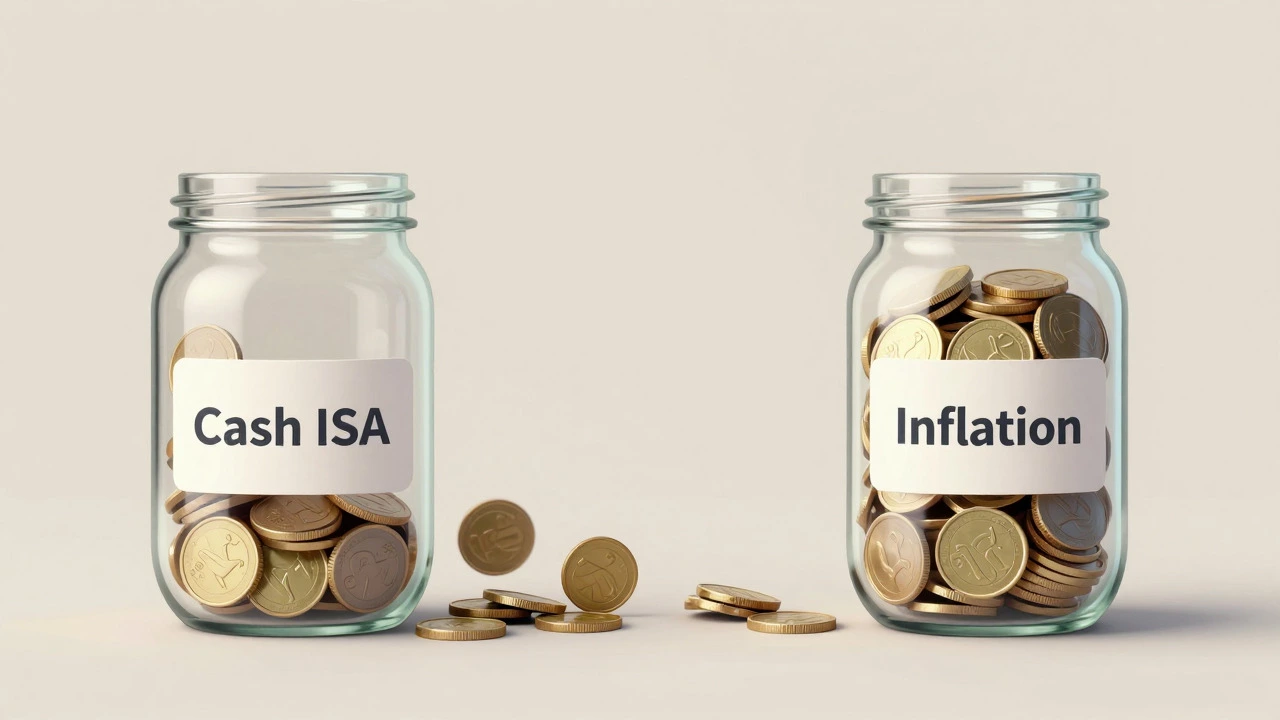
In 2026, while interest rates have stabilized compared to the volatility of previous years, they still struggle to beat long-term inflation consistently. Let’s say you get 4% interest on your Cash ISA. Sounds decent, right? But if inflation runs at 3.5%, your real return is only 0.5%. Over ten years, that tiny margin compounds negatively. Your money grows in nominal terms, but its purchasing power shrinks.
This is the silent killer of wealth building. By parking large sums in a Cash ISA for decades, you’re guaranteeing that your money will buy less in the future. For long-term goals like retirement, a Cash ISA is often a poor choice because it lacks the growth potential needed to outpace the rising cost of living.
| Factor | Cash ISA (4% Interest) | Inflation (3.5% Average) | Real Growth |
|---|---|---|---|
| Nominal Value after 10 Years (£10k start) | £14,802 | N/A | N/A |
| Purchasing Power Equivalent | N/A | £14,106 | N/A |
| Net Real Gain | £696 (Approximately 0.7% total real gain) | ||
Hidden Fees and Charges in Stocks and Shares ISAs
Many people assume that because an ISA is tax-free, it’s also fee-free. This is a dangerous misconception. A Stocks and Shares ISA is an investment account allowing you to hold shares, funds, and other securities with tax-free growth. While you don’t pay tax to the government, you do pay fees to the providers.
These fees can eat into your returns significantly. Here’s what you need to watch out for:
- Platform Fees: Many brokerages charge an annual platform fee, either a flat rate (e.g., £50/year) or a percentage of your assets (e.g., 0.25%). If you have a small balance, a flat fee can represent a huge chunk of your portfolio.
- Fund Ongoing Charges (OCF): If you invest in mutual funds or ETFs through your ISA, those funds have their own management fees. An OCF of 0.5% might sound small, but over 20 years, it can reduce your final pot by tens of thousands of pounds due to compound interest working against you.
- Dealing Charges: Some platforms charge every time you buy or sell a stock. If you trade frequently, these transaction costs add up quickly.
Compare this to a low-cost direct index fund outside an ISA, where fees might be lower, though you’d then face tax implications. The key is to read the fine print. Not all ISAs are created equal when it comes to cost.
Lack of Flexibility: The One-Provider Rule
Here’s a rule that catches many people off guard: you can subscribe to more than one type of ISA in a tax year, but you can only contribute to one provider per ISA type. For example, you can have a Cash ISA with Bank A and a Stocks and Shares ISA with Broker B. But you cannot split your £20,000 allowance between two different Stocks and Shares ISAs.
Why does this matter? Because it locks you into a single provider’s ecosystem. If you find a better deal, lower fees, or superior customer service elsewhere, moving your existing ISA is easy (it’s called a transfer). But transferring *new* contributions mid-year is administratively messy. You have to close your old subscription and open a new one, ensuring you don’t accidentally breach the annual limit during the transition.
This lack of flexibility reduces competition among providers for your ongoing business. Once you’re in, switching costs-both in time and potential missed investment opportunities-can be high.
Tax-Free Doesn’t Mean Risk-Free
A common mistake is confusing tax efficiency with capital preservation. Just because your gains are tax-free doesn’t mean you won’t lose money. In a Stocks and Shares ISA, your capital is at risk. If the market crashes, your ISA balance drops. And since you’re not paying tax on the losses, you also don’t get tax relief on them.
Consider this scenario: You invest £20,000 in a volatile tech sector fund inside your ISA. The market dips 20%. You now have £16,000. No tax was saved because there were no gains. But if you had invested in a taxable account, you could have offset those losses against other gains to reduce your overall tax bill. Inside an ISA, losses are just... losses. They disappear without providing any fiscal benefit.
This asymmetry means ISAs are best suited for investments you believe will grow steadily over time, not for speculative bets where downside protection matters.
Opportunity Cost: Missing Out on Better Tax Reliefs
For higher-rate taxpayers, an ISA might not be the most efficient vehicle for every pound. Pensions, for instance, offer immediate tax relief. If you’re a 40% taxpayer, contributing £100 to a pension costs you only £60 after basic rate relief, and potentially even less if you claim higher rate relief back from HMRC.
An ISA gives you tax-free growth, but no upfront deduction. So, if you’re already paying high income tax, prioritizing pension contributions over ISA top-ups can be smarter. You get an instant 20-45% discount on your investment, whereas an ISA only saves you on the exit side.
Additionally, pensions allow unlimited contributions (subject to lifetime allowances and money purchase annual allowance rules), whereas ISAs are strictly capped. If you have surplus income above the £20,000 ISA limit, a pension offers a larger tax-sheltered bucket.

Complexity with Lifetime ISAs and Property Rules
If you’re under 40, you might be considering a Lifetime ISA (LISA) is a specialized ISA for first-time home buyers or retirement, offering a 25% government bonus on contributions. It sounds amazing-a free 25% boost! But the restrictions are severe.
You can only withdraw the money for buying your first home (up to £450,000) or after age 60. Withdraw it for anything else before 60, and you face a 25% penalty. This effectively takes back the entire government bonus plus a slice of your own contributions. It’s a punitive measure that makes LISAs incredibly illiquid.
Furthermore, the definition of "first-time buyer" is strict. If you ever owned property anywhere in the world, even jointly with a partner who still owns theirs, you might be disqualified. These bureaucratic hurdles turn a seemingly beneficial product into a trap for many.
Global Mobility Limitations
ISAs are a UK-specific product. If you plan to move abroad permanently, your ISA status changes. You remain eligible to contribute as long as you’re UK resident for tax purposes. But once you leave, you can’t add more money. More importantly, the tax-free status may not be recognized in your new country of residence.
Some countries have double taxation treaties with the UK that protect ISA status, but others don’t. You could end up paying local taxes on your previously tax-free UK gains. If you’re a digital nomad or planning an expat life, an ISA might not be the most portable solution for your wealth.
Summary of Key Disadvantages
To recap, while ISAs are powerful tools, they come with clear downsides:
- Annual Cap: Limited to £20,000 per tax year, restricting high savers.
- Inflation Risk: Cash ISAs often fail to beat inflation, eroding real value.
- Hidden Fees: Platform and fund charges can drag down performance.
- Lack of Flexibility: One-provider rule per ISA type limits choice.
- No Loss Relief: Investment losses provide no tax benefits.
- Illiquidity in LISAs: Heavy penalties for early withdrawal.
- Geographic Limits: Poor portability for non-UK residents.
Understanding these drawbacks helps you use ISAs strategically rather than habitually. Pair them with pensions for tax relief, use taxable accounts for flexible, high-growth speculation, and keep emergency funds in accessible, low-risk savings. Don’t let the "tax-free" label blind you to the structural limitations.
Can I lose money in an ISA?
Yes. While Cash ISAs protect your capital (up to £85,000 via FSCS), Stocks and Shares ISAs expose you to market risk. If the value of your investments falls, your ISA balance decreases. The "tax-free" label applies to gains, not capital preservation.
What happens if I exceed the ISA allowance?
If you accidentally contribute more than £20,000 in a tax year, your provider must report it to HMRC. You may face penalties, and the excess amount might be treated as a taxable distribution, meaning you could owe tax on it immediately.
Is an ISA better than a pension?
It depends on your goals. Pensions offer immediate tax relief and higher contribution limits, making them better for tax reduction and retirement. ISAs offer liquidity and tax-free access at any age, making them better for medium-term goals or flexible retirement income. Most experts recommend using both.
Do I pay tax on ISA withdrawals?
No. Withdrawals from Cash ISAs, Stocks and Shares ISAs, and Innovative Finance ISAs are completely tax-free. This includes both your original contributions and any interest, dividends, or capital gains generated.
Can I open multiple ISAs in one year?
You can open multiple ISAs, but you can only *subscribe* (add new money) to one of each type per tax year. For example, you can have one Cash ISA and one Stocks and Shares ISA active for contributions. You can transfer old balances between providers freely.