ISA vs Roth IRA Eligibility & Limits Checker
Your Details
You might have heard both terms thrown around in financial circles and assumed they are just different names for the same thing. After all, both ISAs and Roth IRAs promise one golden benefit: you pay no tax on your withdrawals. But if you are planning to move between countries or simply trying to understand global finance, assuming they are identical could lead to serious confusion. They are not the same product. In fact, they belong to two completely different financial ecosystems with distinct rules, limits, and purposes.
While I usually stick to discussing local options here in Dublin, understanding these international differences is crucial for expats and digital nomads. For instance, if you find yourself traveling extensively and need reliable resources while abroad, knowing where to look can be just as important as managing your portfolio; take a moment to check out this directory if you ever find yourself navigating the social scene in Dubai, but let's get back to the money matters at hand.
The Core Difference: Geography Defines the Account
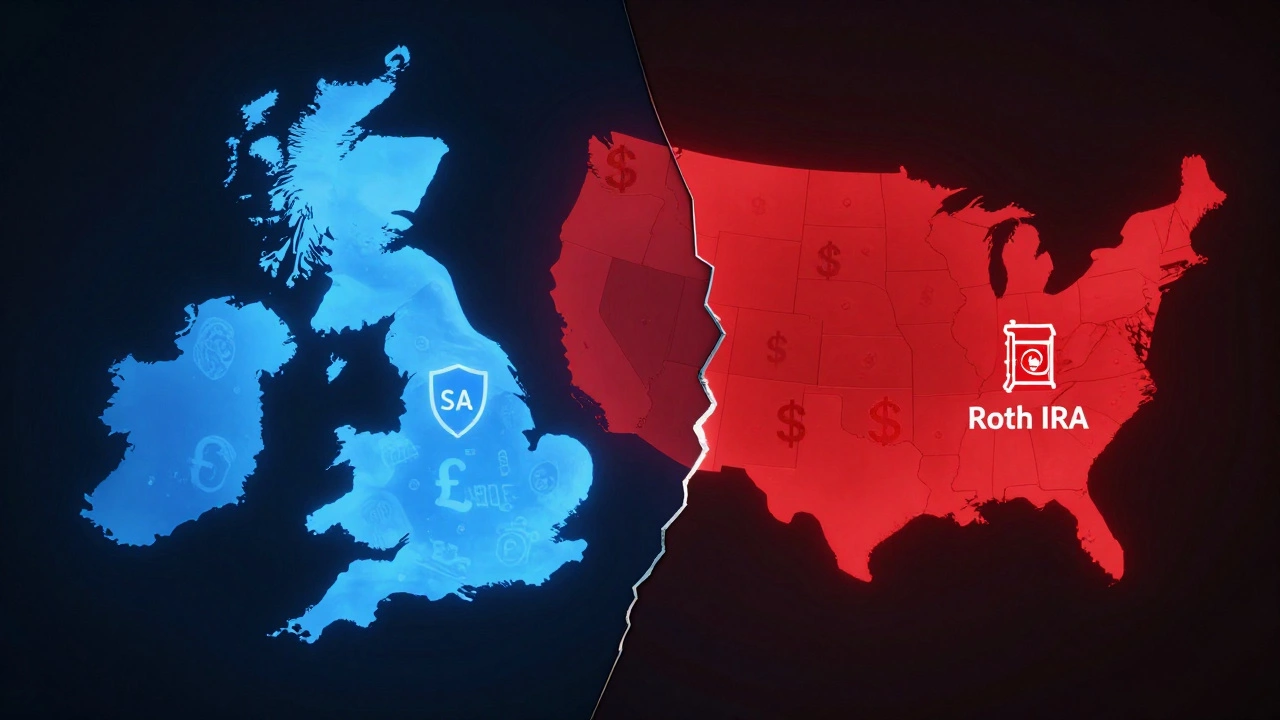
The most immediate difference is jurisdiction. An Individual Savings Account (ISA) is a UK-based tax wrapper designed to shield investments from income tax and capital gains tax. It is strictly available to residents of the United Kingdom. You cannot open an ISA if you live in Ireland, the US, or anywhere else outside the UK tax system. The HM Revenue & Customs (HMRC) regulates these accounts, and the benefits apply only under UK law.
A Roth Individual Retirement Account (Roth IRA) is a US-based retirement savings vehicle that allows after-tax contributions and tax-free growth. It is governed by the Internal Revenue Service (IRS). Only individuals with US taxable income-typically US citizens, resident aliens, or non-resident aliens with earned income from US sources-are eligible to contribute. If you do not have a Social Security Number or valid US taxpayer identification, you generally cannot open one.
This geographic lock-in means you never really "choose" between them based on preference alone. You choose based on where you live and work. A person living in London will use an ISA. A person living in New York will use a Roth IRA. Trying to force one into the wrong jurisdiction usually results in disqualification or severe tax penalties.
Tax Treatment: How the Money Grows
Both accounts share the "tax-free withdrawal" feature, but how they get there differs significantly in structure and flexibility.
With a Roth IRA, you contribute money that has already been taxed. Let's say you earn $100 and pay $25 in income tax. You put the remaining $75 into the Roth IRA. Over the next thirty years, that $75 grows into $10,000 through stock market returns. When you retire and withdraw that $10,000, you pay zero taxes on it. The IRS does not touch your gains because you paid up front. This makes it incredibly powerful for long-term compounding, especially if you expect your tax rate to be higher in retirement than it is now.
An ISA works similarly regarding the end result-you don't pay tax on withdrawals-but the internal mechanics vary by type. There are four main types of ISAs in the UK:
- Cash ISA: Functions like a high-interest savings account. Interest earned is tax-free.
- Stocks and Shares ISA: Allows you to invest in stocks, bonds, and funds. Capital gains and dividends are tax-free.
- Lifetime ISA: Specifically for buying a first home or retirement, with a government bonus of 25% on contributions.
- Innovative Finance ISA: Covers peer-to-peer lending and crowdfunding investments.
The key takeaway is that the ISA is a flexible wrapper. You can switch between cash and shares within the same annual allowance, whereas a Roth IRA is primarily an investment account focused on retirement assets like mutual funds, ETFs, and individual stocks.

Contribution Limits and Annual Allowances
If you are comparing the raw numbers, the limits differ vastly due to currency exchange rates and policy goals. As of the 2024-2025 tax year, the total ISA allowance in the UK is £20,000 per adult. This means you can put up to £20,000 across any combination of ISA types without paying tax. For example, you could put £5,000 in a Cash ISA and £15,000 in a Stocks and Shares ISA.
In contrast, the Roth IRA contribution limit for 2024 is $7,000 for individuals under age 50, and $8,000 for those 50 and older. While the dollar amount seems lower, the purchasing power and investment horizon often make the Roth IRA more aggressive in its growth potential. However, the Roth IRA has income limits. If you earn too much money, you are phased out of eligibility entirely. Single filers making over $161,000 (in 2024) cannot contribute directly to a Roth IRA. ISAs, on the other hand, have no income cap. Whether you earn £15,000 or £15 million, you can still max out your £20,000 ISA allowance.
| Feature | UK ISA | US Roth IRA |
|---|---|---|
| Jurisdiction | United Kingdom | United States |
| Annual Limit (2024) | £20,000 | $7,000 ($8,000 if 50+) |
| Income Cap | None | Yes (phases out above ~$161k single) |
| Tax on Withdrawals | Tax-free | Tax-free (if qualified) |
| Primary Purpose | Savings, First Home, Retirement | Retirement |
| Penalty for Early Withdrawal | Generally none (except Lifetime ISA) | 10% penalty + income tax on earnings (before age 59½) |
Flexibility and Access to Funds
One area where the ISA shines is accessibility. With a standard Cash or Stocks and Shares ISA, you can withdraw your money at any time without penalty. You lose the tax wrapper for that specific amount for the rest of the tax year (unless you use a Flexible ISA introduced in 2016), but you won't face a fine from the government. This makes ISAs excellent for medium-term goals, such as saving for a house deposit or an emergency fund.
The Roth IRA is stricter. While you can always withdraw your *contributions* (the money you put in) tax-free and penalty-free at any time, withdrawing *earnings* before age 59½ triggers a 10% early withdrawal penalty plus ordinary income tax. There are exceptions-for example, buying your first home (up to $10,000 lifetime limit) or paying for qualified education expenses-but the default rule is that this money stays put until retirement. This discipline helps prevent people from raiding their nest egg during mid-life crises.

What Happens If You Move Countries?
This is where things get tricky for expats. If you are an Irish citizen living in the UK, you can open an ISA. But if you move back to Ireland, you must close it or transfer it, as you are no longer a UK tax resident. Keeping an ISA open while living abroad can sometimes void the tax benefits, depending on double taxation treaties.
Similarly, US citizens living in Ireland can maintain their Roth IRAs. The IRS follows you wherever you go. You still report contributions and distributions on your US tax return, even if you file locally in Ireland. Many expats use tools like the Foreign Earned Income Exclusion to manage their US tax liability, but the Roth IRA remains a viable tool for reducing overall tax burden if managed correctly.
Which One Should You Use?
The answer isn't about which is "better," but which is "available." If you are a UK resident, prioritize filling your ISA allowance. It is one of the most efficient tax shelters in the world. If you are a US taxpayer, max out your Roth IRA if you qualify. The ability to grow millions of dollars tax-free over decades is unmatched.
If you are neither a UK nor US resident, neither account applies to you. Instead, look for your country's equivalent. In Ireland, for example, you would look at Personal Retirement Savings Accounts (PRSAs) or Approved Minimum Retirement Benefit (AMRB) schemes. These offer tax relief on contributions and tax-free lump sums upon retirement, serving a similar function to the Roth IRA but under Irish Revenue rules.
Understanding these distinctions prevents costly mistakes. Don't try to open a Roth IRA from Dublin unless you have US source income. Don't assume your UK ISA will protect your assets if you relocate to California. Know your residency status, know your local tax laws, and choose the vehicle that fits your legal reality.
Can I have both an ISA and a Roth IRA?
Yes, but only if you meet the residency and income requirements for both. For example, a British citizen working in the US might be able to contribute to a Roth IRA based on US income while maintaining an ISA if they retain UK tax residency. However, most people fall into one category or the other. Dual contributors must carefully track foreign tax credits to avoid double taxation.
Is an ISA better than a Roth IRA for retirement?
It depends on your location. For UK residents, the ISA offers more flexibility because you can access funds without penalty. For US residents, the Roth IRA provides stronger protection against future tax hikes and encourages long-term saving through penalties on early withdrawal. Neither is universally "better"; they are optimized for their respective tax systems.
What happens to my ISA if I move to Ireland?
You should close or transfer your ISA once you cease to be a UK tax resident. Continuing to hold it may invalidate the tax-free status of future gains. Consult a cross-border tax advisor to ensure you comply with both HMRC and Irish Revenue regulations during the transition.
Do I pay tax on ISA withdrawals in the US?
If you are a US citizen holding a UK ISA, the US does not recognize the ISA's tax-exempt status. You may owe US taxes on the interest or capital gains generated inside the ISA, even though the UK considers them tax-free. This creates a complex reporting requirement involving Form 8621 for PFICs (Passive Foreign Investment Companies).
Can I convert a Traditional IRA to a Roth IRA?
Yes, this is known as a Roth Conversion. You pay income tax on the converted amount in the year of conversion, but future growth and withdrawals are tax-free. This strategy is popular for people who expect higher tax rates in the future or want to eliminate Required Minimum Distributions (RMDs) in retirement.