
Crypto Investment Calculator
How much should you invest?
Based on the article's recommendation: Never invest more than 5% of your total investable assets in crypto.
The 5% Rule
As recommended in the article: Allocate no more than 5% of your total investable assets to crypto. This is the safety net that prevents financial hardship while learning.
Starting with crypto can feel overwhelming. You see headlines about people turning $500 into $50,000-and then you hear about others losing everything. So what’s the real answer to how much should I put into crypto as a beginner? The truth isn’t about chasing moonshots. It’s about protecting your financial stability while learning. Here’s the straightforward guide you actually need.
Start with what you can afford to lose
Never invest money you’ll need in the next 12 to 24 months. That means no emergency fund, no rent money, no savings for a car or medical bills. Crypto is volatile. Prices can swing 20% in a day. If you panic-sell during a dip, you’re not investing-you’re gambling.
Think of crypto like a high-risk side bet, not your main portfolio. A common rule among experienced investors: allocate no more than 5% of your total investable assets to crypto. If you have $20,000 saved for investing, that’s $1,000. If you’re just starting out with $5,000 total, that’s $250. This isn’t a rule set in stone-it’s a safety net.
Why 5%? Because history shows it works
In 2021, Bitcoin hit $69,000. Ethereum soared past $4,800. People who put 10%, 20%, even 50% of their savings into crypto saw huge gains. But then came 2022. Bitcoin dropped 65%. Ethereum fell 70%. Many who went all-in lost half their life savings. Those who stuck to 5%? They lost $50 on a $1,000 investment. Still painful, but survivable.
A 2023 study by the University of Edinburgh tracked 1,200 retail crypto investors over three years. Those who kept crypto under 5% of their portfolio were 3.7 times more likely to still be investing after 24 months. Those over 10%? Most quit after one big loss.
Start small. Test the waters
You don’t need to buy Bitcoin or Ethereum right away. Start with $20 or $50. Use a trusted app like Coinbase, Kraken, or a local Irish platform like Bit2Me. Buy a fraction of a coin. Watch what happens when the price moves. Notice how you feel when it drops 10%. Do you sleep? Do you check your app every hour? If you’re stressed, you’re investing too much.
This isn’t about making money yet. It’s about learning your own reaction. Crypto isn’t like stocks. There’s no earnings report, no dividend, no CEO interview. You’re betting on technology, adoption, and belief. That’s harder to judge. Start tiny so you can learn without risking your peace of mind.

Don’t chase trends
Every week, a new meme coin pops up. Dogecoin 2.0. Shiba Inu Killer. A guy on TikTok says it’ll 100x. Ignore it. These aren’t investments-they’re lottery tickets. In 2025, over 80% of new crypto tokens launched that year were abandoned within six months. The ones that survive? Usually the big ones: Bitcoin, Ethereum, sometimes Solana or Polygon.
If you want to explore altcoins, wait until you’ve held Bitcoin and Ethereum for at least six months. Understand how they work. Know why people use them. Then, if you still want to try something new, put 1% of your crypto budget into one altcoin. Not five. Not ten. One.
Set limits. Stick to them
Here’s a simple system that works:
- Decide your max crypto budget: $500? $1,000? $2,500?
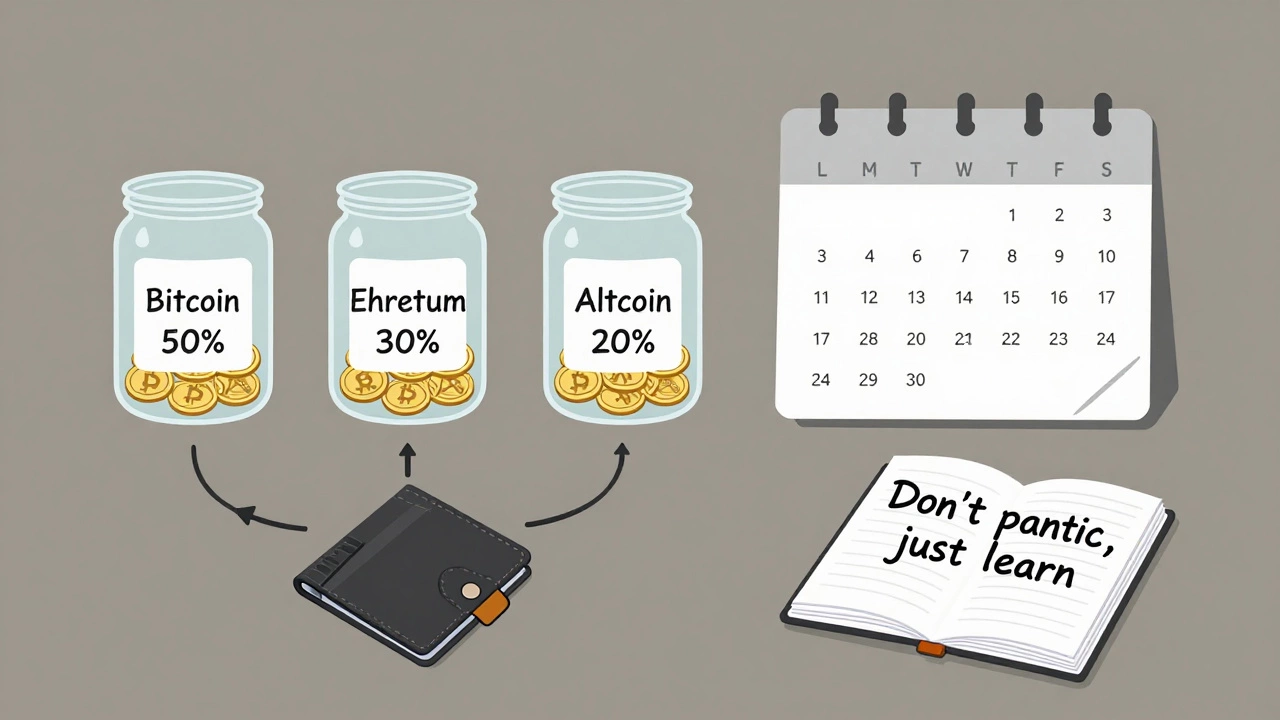
- Divide it into three parts: 50% Bitcoin, 30% Ethereum, 20% one other coin (like Solana or Cardano).
- Buy in over time. Don’t dump it all on day one. Buy $100 a month for five months. This is called dollar-cost averaging. It smooths out price swings.
- Set a rule: if your crypto portfolio grows to more than 10% of your total savings, sell enough to bring it back to 5%.
Why? Because success can be dangerous. If crypto doubles, and you didn’t plan for it, you might get greedy. You might start borrowing money to buy more. That’s how people get in trouble.
Keep it separate
Don’t mix crypto with your everyday banking. Use a separate bank account just for crypto. Even better-use a hardware wallet like Ledger or Trezor. Store your coins offline. If you leave them on an exchange, you’re trusting someone else to keep them safe. And exchanges get hacked. In 2024, over $1.2 billion in crypto was stolen from platforms worldwide.
Keep your passwords, recovery phrases, and wallet details in a locked drawer. Not on your phone. Not in the cloud. Not in a Google Doc titled “My Crypto Secrets.”
What if you lose it all?
It’s possible. Crypto isn’t regulated like stocks. There’s no FDIC insurance. If a coin crashes to zero, it’s gone. If you lose your private key? Gone. If you fall for a scam? Gone.
So ask yourself: if I lose this money, will I be okay? Can I still pay my bills? Will I be stressed for months? If the answer is yes, you’re investing too much.
Remember: crypto is not a path to wealth. It’s a way to participate in a new financial system. If you’re lucky, you’ll make money. If you’re smart, you’ll learn something valuable-without wrecking your finances.
Real example: Sarah from Dublin
Sarah, 28, works as a graphic designer. She had €8,000 saved. She decided to put €400 (5%) into crypto. She bought €200 in Bitcoin, €120 in Ethereum, and €80 in Polygon. She set up a hardware wallet and didn’t touch it for a year. During that time, Bitcoin dropped 30%, then rose 120%. She didn’t panic. She didn’t buy more. She just watched. At the end of the year, her crypto was worth €720. She sold €200 to cover a laptop repair and left the rest. She didn’t make a fortune. But she didn’t lose sleep. And she learned more about money than she ever did in school.
Final rule: You’re not behind
You don’t need to buy today. You don’t need to catch the next big thing. Crypto won’t disappear tomorrow. The market moves slowly for beginners. There’s no deadline. The best time to start was years ago. The second best time is now. But only if you’re ready to do it safely.
Start small. Stay patient. Keep learning. And never, ever risk money you can’t afford to lose.
How much crypto should a beginner buy with $1,000 total savings?
If you have $1,000 total savings, aim for $50 in crypto-that’s 5%. Put $25 in Bitcoin, $15 in Ethereum, and $10 in one other coin like Solana. Buy it in small amounts over a few months. This keeps you from getting caught in a price spike or crash. Your goal isn’t to get rich fast. It’s to learn how crypto behaves without risking your financial safety.
Is it smart to put 10% of my income into crypto?
No-not as a beginner. Putting 10% into crypto is high risk. Most financial advisors recommend keeping crypto under 5% of your total investments. At 10%, a single market crash could wipe out a significant part of your savings. You’re not gaining enough extra return to justify the risk, especially when you’re still learning. Wait until you’ve held crypto for over a year and understand how it reacts to news, regulations, and market sentiment.
Should I buy Bitcoin or altcoins first?
Start with Bitcoin and Ethereum. They’re the most stable, widely used, and least likely to disappear. Bitcoin is digital gold. Ethereum runs apps and smart contracts. Together, they make up over 60% of the entire crypto market. Altcoins like Shiba Inu or Dogecoin are speculative. They can go to zero overnight. Only consider altcoins after you’ve held Bitcoin and Ethereum for at least six months and understand how blockchain technology works.
Can I use my credit card to buy crypto?
Technically, yes-but don’t. Credit cards charge high interest rates, often over 18%. If crypto drops in value, you’ll still owe the bank the full amount plus interest. You’re turning a risky investment into a debt trap. Always use money you already have-cash from your bank account or savings. Never borrow to invest in crypto.
What if crypto crashes again like in 2022?
If you followed the 5% rule, a crash won’t ruin you. In 2022, Bitcoin fell 65%. If you had $1,000 in crypto, you lost $650. But if that was 5% of your $20,000 savings, you still had $19,350 left. That’s enough to cover emergencies, bills, and future investments. The key is keeping crypto small. If you lost 100% of your crypto, you’d still be financially okay. That’s the goal.