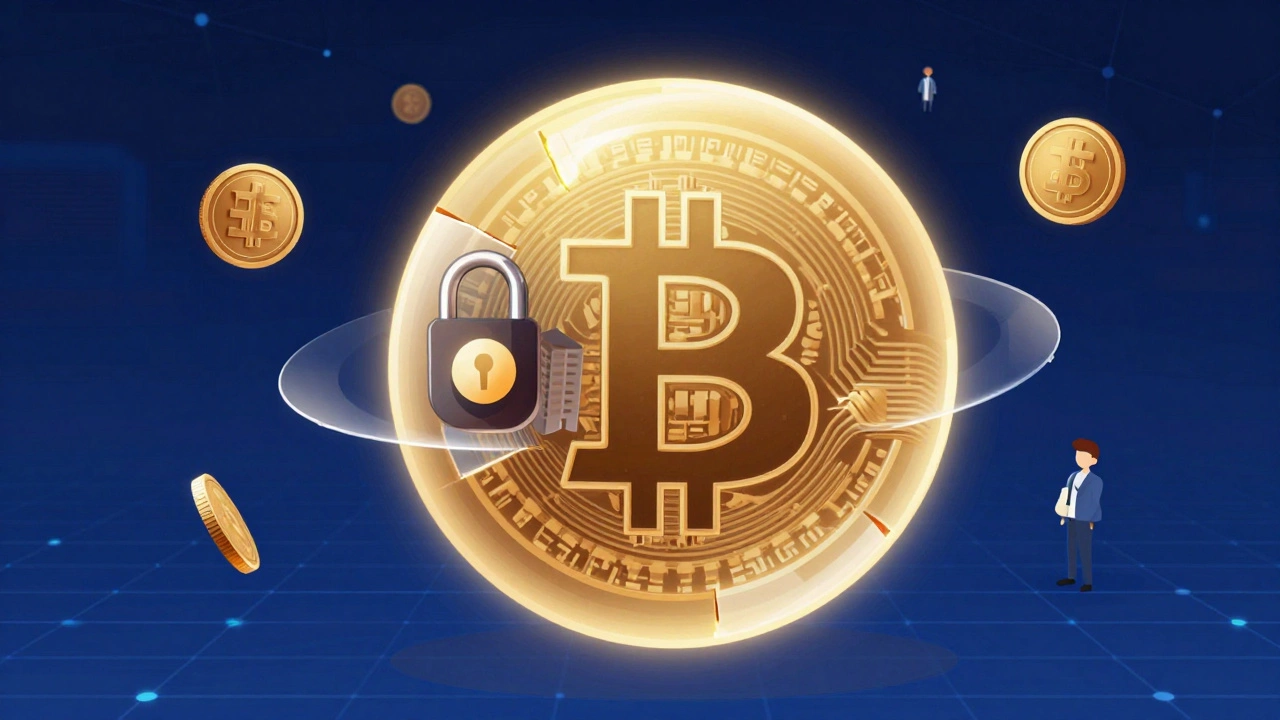
Bitcoin Supply Distribution Simulator
Select different holder categories below to see how they contribute to the total Bitcoin supply. Toggle them on or off to simulate which coins are 'active' in the market.
Holder Categories
Market Impact Analysis
You’ve probably heard the headline: "A small group controls almost all of Bitcoin." It sounds like a conspiracy theory waiting to happen. If just a few people held 90% of the supply, wouldn’t they be able to crash or manipulate the price at will? This question keeps new investors up at night. But the reality is far more nuanced-and much less sinister-than the myth suggests.
The short answer is that no single entity owns 90% of Bitcoin. In fact, it’s mathematically impossible for any one person or organization to control that much without triggering immediate market collapse. However, there is a kernel of truth in the claim: a significant portion of Bitcoin is either locked away, held by long-term investors known as "whales," or sitting on exchange cold wallets. Understanding where these coins actually sit helps you navigate the market with your eyes open.
The Myth of the 90% Holder
To understand why this rumor persists, we need to look at how Bitcoin distribution works. Unlike fiat currency, which central banks can print endlessly, Bitcoin has a hard cap of 21 million coins. This fixed supply creates a unique dynamic. As time passes, fewer new coins are created through mining rewards. By 2024, the annual issuance rate dropped below 0.5%. This scarcity means that early adopters who bought or mined Bitcoin years ago still hold a disproportionate share of the total supply.
However, "ownership" in crypto isn't always straightforward. Many addresses are dormant. Some belong to deceased users whose private keys were lost forever. Others are part of large institutional holdings. When analysts say "90% is concentrated," they often fail to distinguish between active traders and static, non-moving funds. A coin sitting in a hardware wallet for ten years doesn't exert selling pressure on the market today.
Where Are the Coins Actually Held?
If we break down the actual distribution, several major categories emerge. These groups represent the bulk of the circulating and non-circulating supply.
- Satoshi Nakamoto: The anonymous creator of Bitcoin mined approximately 1 million coins during the genesis block and early blocks. These coins have never moved. Most experts believe they will never move, effectively removing them from circulation permanently.
- Early Adopters (Pre-2013): Individuals who bought Bitcoin when it was worth pennies or low dollars. Many of these holders are "HODLers"-a term originating from a famous forum post meaning "Hold On for Dear Life." They rarely sell because their cost basis is so low that even a modest price represents life-changing gains.
- Exchanges: Platforms like Binance, Coinbase, and Kraken hold billions of dollars worth of Bitcoin in hot and cold wallets to facilitate user trading. While technically owned by the exchanges, these coins are liabilities backed by user deposits. They are not freely spendable by the exchange owners.
- Institutions and ETFs: Since the approval of Spot Bitcoin ETFs in the United States in January 2024, traditional finance giants like BlackRock and Fidelity have accumulated hundreds of thousands of BTC. This represents a shift from retail speculation to institutional adoption.
- Lost Coins: Estimates suggest that between 3% and 5% of all Bitcoin is lost forever due to forgotten passwords, lost hard drives, or deceased owners without heirs. This is essentially deflationary pressure built into the network.
The Role of Bitcoin Whales
When people talk about concentration, they usually mean "whales." In crypto slang, a whale is an address holding more than 1,000 BTC. At current prices, that’s tens of millions of dollars. Do whales control the market? To some extent, yes. Large sell orders from whales can cause temporary price dips, known as "flash crashes."
However, whales don’t operate in a vacuum. They face significant risks if they try to dump too much too quickly. Selling 10,000 BTC at once would likely crash the order book, causing slippage and reducing the value of their remaining holdings. Smart whales use algorithmic trading bots to distribute sales over weeks or months, minimizing impact. Moreover, many whale addresses are not single individuals but corporate treasuries or hedge funds with strict risk management protocols.
| Holder Type | Estimated % of Supply | Activity Level | Market Impact |
|---|---|---|---|
| Satoshi Nakamoto | ~4.7% | Dormant | None (unless moved) |
| Early Adopters | ~15-20% | Very Low | Low (rare sells) |
| Exchanges | ~10-15% | High | Medium (liquidity provider) |
| Institutions/ETFs | ~8-10% | Medium | High (price discovery) |
| Retail Investors | ~40-50% | Variable | High (volatility driver) |
| Lost/Unrecoverable | ~3-5% | Dormant | None |
Why Concentration Isn’t a Conspiracy
Critics often argue that Bitcoin’s distribution is unfair because early miners got rich while latecomers pay high prices. This is true, but it’s also how every asset class works. Early shareholders in Apple or Amazon gained massive wealth compared to those who bought in during the dot-com bubble. Bitcoin’s transparency actually makes it *more* fair than traditional markets. You can see every transaction on the blockchain. There are no hidden accounts or secret bank vaults.
Furthermore, the network effect protects against manipulation. Even if a whale tried to attack the network, they would need to control 51% of the hashing power, not just the coins. Mining pools like Foundry USA and AntPool compete fiercely for block rewards. No single miner has ever controlled more than 40% of the hash rate for extended periods. This decentralization of security ensures that coin ownership alone cannot dictate protocol changes or transaction validation.
How to Track Real Ownership Data
If you want to verify these claims yourself, you don’t need to trust headlines. Blockchain explorers provide real-time data. Tools like Glassnode, CryptoQuant, and Whale Alert track large movements. For example, Whale Alert uses Twitter bots to notify users when addresses move over 100 BTC. This transparency allows anyone to monitor potential sell-offs before they hit the broader market.
One key metric to watch is "Exchange Net Flow." When large amounts of Bitcoin leave exchanges and move to private wallets, it signals accumulation and reduced selling pressure. Conversely, inflows to exchanges often precede sell events. By monitoring these flows, you can gauge whether the "whales" are preparing to buy or sell.

What This Means for Your Investment Strategy
Understanding ownership distribution changes how you approach buying and selling. Here are practical takeaways:
- Ignore Noise: Don’t panic when news headlines scream about whale dominance. Most large holdings are static. Focus on active supply metrics instead.
- DCA is King: Dollar-Cost Averaging (buying fixed amounts regularly) smooths out volatility caused by whale movements. You avoid trying to time the market against entities with superior information.
- Self-Custody Matters: Remember that exchange-held Bitcoin isn’t truly yours until you withdraw it. Use hardware wallets like Ledger or Trezor to secure your own stake. This reduces counterparty risk.
- Watch Institutional Flows: With ETFs now dominant, follow fund flows rather than individual trader sentiment. BlackRock’s weekly purchases indicate strong institutional demand regardless of retail hype.
The Future of Bitcoin Distribution
As we move further into the 2020s, the distribution landscape is shifting. The 2024 halving reduced miner rewards to 3.125 BTC per block. Miners must now rely more on transaction fees or sell existing reserves to cover costs. This could increase short-term selling pressure from mining companies. However, institutional adoption continues to absorb this supply. The net result is a tightening supply curve, which historically supports price appreciation over multi-year cycles.
Ultimately, Bitcoin’s strength lies in its mathematical certainty. No one can create more coins. No one can freeze your account. And while a few thousand addresses hold most of the visible supply, the majority of those coins are not actively traded. The real power belongs to the network itself-a decentralized ledger secured by millions of participants worldwide.
Does Satoshi Nakamoto still own 1 million Bitcoin?
Yes, blockchain analysis confirms that approximately 1 million BTC mined by Satoshi Nakamoto remains untouched since 2010. These coins are considered "lost" or dormant and do not participate in current market activity.
Can a single person control the Bitcoin price?
No. While large holders (whales) can influence short-term volatility, controlling the entire market requires immense capital and faces significant resistance from other market participants. The decentralized nature of Bitcoin prevents any single entity from dictating long-term price trends.
How much Bitcoin is held on exchanges vs. private wallets?
Approximately 10-15% of the total supply is held on centralized exchanges. The rest is distributed among private wallets, including hardware wallets, paper wallets, and corporate treasuries. Private holdings are generally considered safer and less prone to sudden liquidation.
Are institutional investors buying more Bitcoin than retail users?
Since 2024, institutional investors via Spot ETFs have become major buyers. Funds managed by BlackRock, Fidelity, and Grayscale now hold over 10% of the circulating supply. Retail investors still make up a large portion of the base, but institutional volume drives significant price discovery.
What happens if a whale dumps their Bitcoin?
A large sell-off can cause temporary price drops due to limited liquidity. However, automated trading systems and market makers typically absorb such shocks within hours or days. Long-term holders often view these dips as buying opportunities, stabilizing the price over time.