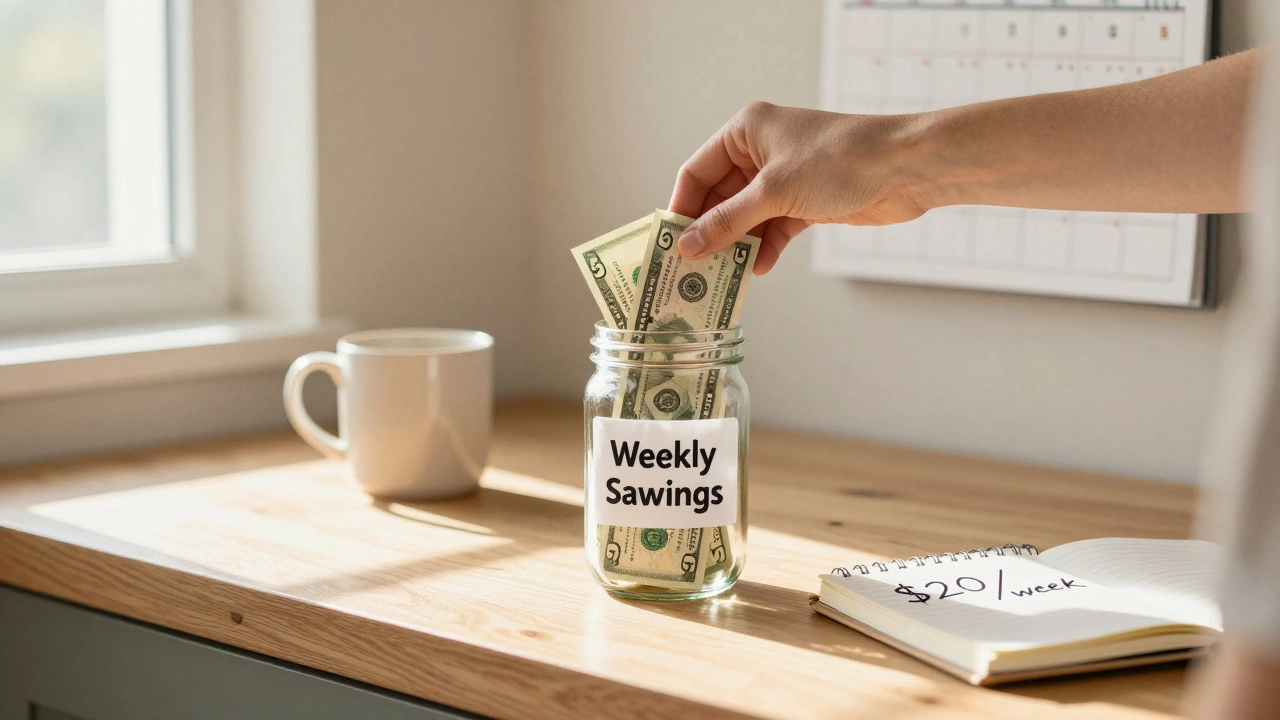
Weekly Savings Calculator
How much will you have?
See how your $20-a-week habit grows over 1 year with and without interest
Your Savings After 1 Year
52 weeks × your weekly amount. Interest compounds monthly.
If you save $20 every week, you might think it’s not much. But over a year, that little habit adds up in a way that surprises most people. Let’s break it down-no fancy math, no jargon, just real numbers you can see and use.
What $20 a Week Turns Into in a Year
Simple math first: $20 times 52 weeks equals $1,040. That’s it. No interest, no fancy returns. Just putting cash aside, week after week, like clockwork. You’ll have $1,040 by the end of the year. That’s enough to cover a full month’s rent in some parts of Dublin, or pay off a big credit card bill, or fund a solid vacation without going into debt.
But here’s the thing: most people don’t just stuff cash under a mattress. They put it somewhere that works for them. If you put that $20 into a savings account, even a basic one, you’ll earn a little extra. Right now, in Ireland, the average savings account pays about 3.5% annual interest. Not huge, but it’s free money.
Interest Makes a Difference-Even With Small Amounts
Let’s say you deposit $20 every Monday into a savings account with a 3.5% annual interest rate, compounded monthly. After 52 weeks, you won’t just have $1,040. You’ll have $1,058. That’s $18 extra, just for leaving your money in the bank.
Why? Because each deposit starts earning interest as soon as it lands. The first $20 earns interest for nearly a year. The last $20 earns for just a week. But together, they add up. That’s the power of compound interest-even when you’re not saving big.
Some high-yield savings accounts in Ireland offer up to 4.5% for new customers or on balances under €5,000. If you land one of those, your $20-a-week habit could grow to $1,065 by year’s end. That’s $25 more than the basic account. It’s not life-changing, but it’s the kind of win that keeps you motivated.
Where to Put Your $20 a Week
Not all savings accounts are the same. Here’s what to look for:
- Access: Can you get your money out fast if you need it? Some accounts lock funds for 30 or 60 days. Avoid those if you’re saving for emergencies.
- Interest rate: Compare the AER (Annual Equivalent Rate). That’s the real rate you’ll earn after compounding.
- Fees: No monthly fees. Ever. If a bank charges for savings, walk away.
- Automatic transfers: Set up a direct debit from your checking account. Make it invisible. Out of sight, out of mind-until you see the balance grow.
Popular options in Ireland include Bank of Ireland’s MySavings account, AIB’s eSavings, and credit union accounts, which often offer competitive rates and local support. Credit unions in Dublin, like the Dublin City Credit Union, sometimes pay 4%+ and don’t charge fees. They’re not flashy, but they’re reliable.
What You Can Do With ,040
That’s the real question, isn’t it? What’s the point of saving if you don’t know what it’s for?
Here are a few realistic uses for $1,040:
- Emergency fund starter: Most financial experts say you need 3-6 months of expenses saved. $1,040 is a solid first step. It covers a broken fridge, a sudden medical bill, or a car repair.
- Debt payoff: If you have a credit card with a 15% APR, paying off $1,040 means you save over $150 in interest over the next year.
- Home essentials: New bedding, a vacuum, a water filter, or a smart thermostat-all these things improve daily life without breaking the bank.
- Self-investment: A cooking class, a book on budgeting, a subscription to a financial app-spending $1,040 on yourself can pay back tenfold.
One person I know saved $20 a week for a year and used the $1,040 to replace her 12-year-old washing machine. She didn’t have to borrow money. She didn’t feel guilty. She just did it, one week at a time.
What Happens If You Keep Going?
What if you don’t stop after a year? What if you keep saving $20 a week for five years?
Without interest: $5,200
With 3.5% interest compounded monthly: $5,530
With 4.5% interest: $5,670
That’s not a luxury car. But it’s enough to cover a major home repair, fund a small business idea, or give you breathing room when your income dips. The longer you wait, the more the interest works for you.
And here’s the secret: most people who save this way don’t just stick with $20. They increase it. After a year, they feel confident. They see what they’re capable of. So they bump it to $25. Then $30. Then $50. That’s how real financial change happens-not with windfalls, but with consistency.
Why This Works Better Than Big One-Time Saves
People think they need a bonus, a tax refund, or a raise to save. But those are unpredictable. Saving $20 a week? That’s controllable. It’s a habit. You don’t need motivation-you need a system.
Think of it like brushing your teeth. You don’t wait until your mouth feels dirty. You do it because it’s part of your routine. Saving $20 a week is the same. You don’t wait until you feel rich. You do it because you’re building a life where money doesn’t control you.
Studies show that people who save small amounts regularly are more likely to reach long-term goals than those who wait to save large sums. The psychology is simple: small wins build confidence. Confidence builds momentum. Momentum builds wealth.

Common Mistakes to Avoid
Even good habits can go wrong. Here’s what trips people up:
- Skipping weeks: Life happens. Miss a week? Don’t quit. Just add $20 to next week. No guilt.
- Putting it in the wrong place: Don’t keep it in a checking account. You’ll spend it. Use a separate savings account you can’t easily touch.
- Waiting for the "perfect" time: There’s no perfect time. Start now. Even if you can only save $10 this week. Start.
- Comparing yourself to others: Someone else saves $100 a week? Great for them. Your journey is yours. Progress, not perfection.
How to Make It Stick
Here’s how to turn $20 a week into a lifelong habit:
- Open a separate savings account-ideally one with automatic transfers.
- Set up the transfer for the day after payday. Make it automatic.
- Label the account something meaningful: "Emergency Fund," "New Bike Fund," "No More Debt."
- Check the balance once a month. Celebrate the growth.
- When you hit $1,040, don’t spend it all. Roll it into the next year. Keep going.
That’s it. No apps to download. No complex rules. Just $20. Every week. No exceptions.
Final Thought: Small Habits, Big Results
Saving $20 a week won’t make you rich overnight. But it will make you different. You’ll start thinking like someone who plans ahead. You’ll stop seeing money as something that just disappears. You’ll see it as something you control.
By the end of the year, you’ll have $1,040. And more than that-you’ll have proof that you can do hard things, one small step at a time.
How much will I have if I save $20 a week for a year without interest?
You’ll have exactly $1,040. That’s $20 multiplied by 52 weeks. No interest, no extra growth-just pure savings.
Can I save $20 a week if I’m on a tight budget?
Yes. $20 a week is about $2.85 a day. That’s less than the cost of one takeaway coffee or a single impulse buy. Look at your spending for a week. You’ll likely find at least $20 you can redirect-maybe by skipping one takeout meal, cutting a subscription, or making coffee at home. It’s not about having more money. It’s about choosing where your money goes.
Is it better to save $20 a week or $80 a month?
They’re the same amount-$1,040 a year. But saving weekly works better psychologically. It’s easier to think of $20 than $80. Weekly saves feel smaller, so they’re less intimidating. Plus, automatic weekly transfers align better with pay cycles, making it easier to stick to.
What if I miss a week? Do I need to make it up?
No. Missing a week doesn’t break your streak. Just add the $20 to the next week. Don’t stress. The goal isn’t perfection-it’s consistency over time. One missed week won’t undo a year of saving. But quitting because of one miss will.
Should I put my weekly savings in a high-interest account?
Yes-if you can find one with no fees and easy access. Even a 0.5% difference adds up. For $1,040 saved, a 4% account earns you $18 more than a 3% account. That’s a free coffee every month for a year. Look for accounts from credit unions or online banks in Ireland that offer bonus rates for new savers.
Can I save $20 a week and still have fun?
Absolutely. Saving doesn’t mean giving up everything you enjoy. It means being intentional. You can still go out, buy a movie ticket, or treat yourself-just not every week. Pick one thing you’ll cut back on, and use that money to save. You’ll still have fun. You’ll just have less regret later.