Savings Strategy & Growth Calculator
Your Financial Parameters
Projected Earnings
Net Return: €0| Total Balance (Gross) | €0.00 |
| Tax Deducted (DIRT) | - €0.00 |
| Total Balance (Net) | €0.00 |
| Effective Net Rate | 0.00% |
Safety Check: Deposit Guarantee Scheme
Your deposit is fully covered.
Account Type Comparison
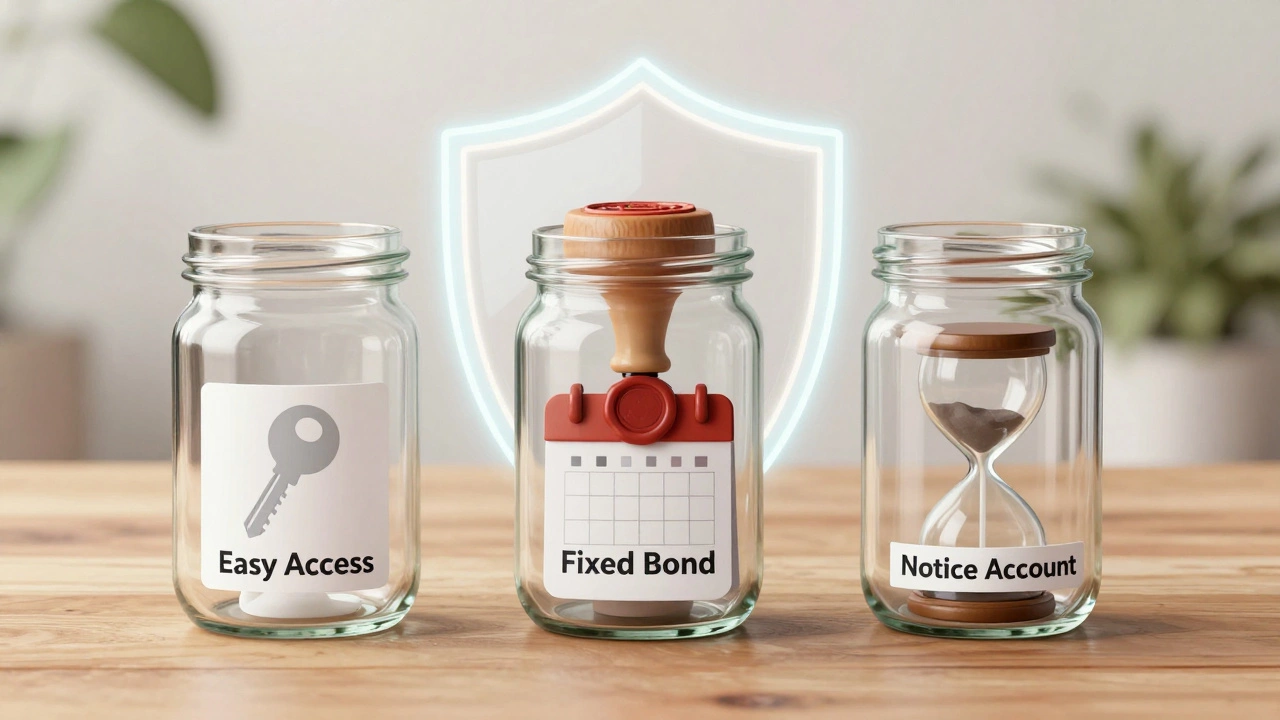
Easy Access
Best for Emergency Funds. Instant liquidity, variable rates.
Fixed Bond
Best for specific goals. Locked term, guaranteed return.
Notice Account
Middle ground. Requires notice (30-90 days) to withdraw.
You have a pile of cash sitting in your current account. It’s safe, sure. But it’s also doing absolutely nothing. In fact, with inflation ticking along, that money is quietly losing value every single day you leave it idle. The question isn’t just *where* to put your savings-it’s how to make those euros work for you without locking them away forever or risking them on volatile investments.
Choosing the right bank account for your savings is less about picking a brand and more about matching the account type to your financial goals. Are you building an emergency fund? Saving for a house deposit? Or just trying to beat inflation while keeping access to your cash? Each goal requires a different vehicle. Let’s break down the options available to you in 2026, so you can stop guessing and start earning.
The Hierarchy of Safety: Where Does Your Money Actually Live?
Before we talk rates, we need to talk risk. Most people assume all banks are equal. They aren’t. When you deposit money into a Savings Account is a banking product that pays interest on deposited funds while maintaining liquidity, you are essentially lending your money to the institution. If that institution fails, who gets paid back?
In Ireland and across the European Union, this is governed by the Deposit Guarantee Scheme. This legal framework ensures that if a bank collapses, your deposits are protected up to €100,000 per person, per bank. This is non-negotiable. If you have €150,000 to save, do not put it all in one place. Split it between two institutions. This safety net applies to traditional banks like AIB, Bank of Ireland, and Ulster Bank, as well as many digital-first challengers.
However, not all "savings" products are covered equally. Some investment platforms offer high yields but are technically brokerage accounts, not deposit accounts. Always check if the provider holds a banking license or if they are an investment firm. For pure capital preservation, stick to regulated deposit accounts.
Type 1: The Standard Savings Account (For Easy Access)
This is the bread and butter of personal finance. You deposit money, you get a variable interest rate, and you can withdraw whenever you want. It’s perfect for your Emergency Fund-that three-to-six months of living expenses you keep handy for job loss or car repairs.
Here is the catch: traditional high-street banks often pay peanuts. You might see rates hovering around 0.5% to 1.5%. Meanwhile, online-only banks and challenger banks are fighting for your business by offering significantly higher rates, often between 3% and 4.5% in the current 2026 climate. Why? Because they don’t have expensive branch networks to maintain. Those savings are passed on to you.
- Pros: Instant access, no lock-in periods, FDIC/EGS protection.
- Cons: Rates fluctuate with central bank policy; temptation to spend.
- Best For: Short-term goals (under 2 years) and emergency reserves.
Type 2: Fixed-Rate Bonds (For Predictability)
If you know you won’t need a chunk of money for exactly twelve months, a fixed-rate bond is your friend. You lock your money away for a set term-usually 6, 12, or 24 months-and the bank guarantees a specific interest rate. Even if market rates drop next month, your rate stays the same.
Think of this like renting out your money. You give the bank exclusive use of your cash for a year, and they pay you a premium for that inconvenience. In 2026, with interest rates stabilizing after the volatility of previous years, fixed bonds offer peace of mind. You know exactly what you will earn at the end of the term.
- Pros: Guaranteed return, protects against falling interest rates.
- Cons: Early withdrawal penalties can be steep (sometimes wiping out all earned interest).
- Best For: Known future expenses (e.g., a holiday in 12 months, a tax bill).
Type 3: Notice Accounts (The Middle Ground)
Some savers find standard accounts too tempting and fixed bonds too restrictive. Enter the notice account. To withdraw money, you must give the bank advance warning-typically 30, 60, or 90 days. This friction discourages impulsive spending. In exchange for promising not to touch your cash on a whim, the bank pays a slightly higher rate than a standard easy-access account.
This structure works psychologically. Knowing you have to wait a month to get your money stops you from buying that new gadget on impulse. It’s a behavioral tool disguised as a financial product.
Comparing the Options: What Should You Choose?
| Account Type | Liquidity | Interest Rate Potential | Risk Level | Ideal Use Case |
|---|---|---|---|---|
| Easy-Access Savings | High (Instant) | Medium (Variable) | Low | Emergency Funds |
| Fixed-Rate Bond | Low (Locked) | High (Guaranteed) | Low | Specific Future Goals |
| Notice Account | Medium (Delayed) | Medium-High | Low | Behavioral Discipline |
| Investment Account | Variable | Very High (Potential) | High | Long-Term Wealth Building |
The Digital Disruptors: Online Banks vs. Traditional Branches
In 2026, the gap between brick-and-mortar banks and digital-only lenders has widened. Traditional banks like AIB or Bank of Ireland offer convenience and physical presence. But their overhead costs are massive. Salaries for branch staff, rent for buildings, and maintenance eat into profits.
Digital banks like Revolut, N26, or specialized Irish online savings providers operate with leaner structures. They pass these efficiencies to you in the form of better rates. However, you trade physical support for app-based customer service. If you are comfortable troubleshooting issues via chat or email, the digital route usually wins on yield.
Also, watch out for "teaser rates." Some banks advertise a 5% rate that only applies to the first three months or only to new customers. After that, it drops to 1%. Read the fine print. Look for the "ongoing rate" or "standard variable rate," not just the headline number.
Tax Implications: Do You Pay Tax on Interest?
This is where location matters immensely. If you are a tax resident in Ireland, interest earned on savings accounts is subject to Deposit Interest Retention Tax (DIRT). As of 2026, the standard rate is 33%. The bank deducts this automatically before crediting your account. You generally do not need to report this on your tax return unless you have other unreported income.
However, if you are in the UK, you might utilize your Personal Savings Allowance, which allows basic rate taxpayers to earn £1,000 in interest tax-free. In the US, interest is taxable as ordinary income. Always understand your local tax rules. A 4% gross rate becomes roughly 2.7% net in Ireland. That difference changes which account looks "best."

Strategic Allocation: How to Split Your Savings
Don’t put all your eggs in one basket, even if that basket is a high-interest account. Here is a practical framework for allocating your savings in 2026:
- The Emergency Core (3-6 Months Expenses): Keep this in a highly liquid, easy-access account. Prioritize speed of access over maximum yield. You need this money now if your boiler breaks, not in 30 days.
- The Goal-Based Bucket (House Deposit, Car, Wedding): If you know when you need the money, lock it in a fixed-rate bond or a notice account. This prevents you from dipping into it for non-essentials.
- The Long-Term Growth Pot (5+ Years): Savings accounts lose to inflation over long periods. Once your emergency fund is full and short-term goals are funded, consider moving excess cash into investment vehicles like ETFs or ISAs. Savings accounts are for preserving capital, not growing wealth exponentially.
Common Pitfalls to Avoid
Chasing the Highest Rate Blindly: The highest rate often comes with strings attached. Minimum deposit requirements, monthly fees, or restrictions on withdrawals can negate the benefit. Calculate the net gain after fees.
Ignoring Inflation: If inflation is at 3% and your savings account pays 2%, you are losing purchasing power. Ensure your real return (interest minus inflation) is positive. In 2026, aim for rates that at least match or exceed the consumer price index.
Forgetting About Compound Interest: Make sure your account compounds interest daily or monthly, not annually. Daily compounding means you earn interest on your interest more frequently. Over time, this adds up. An account paying 4% compounded daily yields more than one paying 4% compounded annually.
Next Steps: Actionable Advice
Start by auditing your current savings. Check the last statement. What rate did you actually receive? If it’s below 2%, it’s time to move. Open a comparison site or check directly with digital banks. Transfer your emergency fund to a high-yield easy-access account. Lock away any known future expenses in a fixed bond. And remember, the best savings account is the one you actually use consistently. Automate transfers from your current account to your savings account on payday. Out of sight, out of mind, working harder for you.
Is it safe to keep all my savings in one bank?
Only if the total amount is under €100,000. Due to the Deposit Guarantee Scheme limit, any amount above this threshold is unprotected if the bank fails. If you have more than €100,000, split it between two different banks to ensure full coverage.
What is the difference between a savings account and a current account?
A current account (checking account) is designed for daily transactions like paying bills and receiving salary, typically paying little to no interest. A savings account is designed to store money you don't need immediately, paying interest on the balance. Using a current account for long-term storage results in lost earnings.
Can I withdraw money from a fixed-rate bond early?
Technically yes, but there is usually a penalty. Most banks require a notice period (e.g., 30 days) and may deduct several months' worth of interest as a fee. In some cases, the penalty can wipe out all the interest you've earned. Treat fixed bonds as locked money.
Do online banks hold my money safely?
Yes, provided they are regulated by the Central Bank of Ireland or the relevant EU authority. Reputable digital banks like N26 or Revolut (in certain jurisdictions) are fully licensed. Always verify the bank's regulatory status before depositing large sums. The lack of physical branches does not mean a lack of security.
How does compound interest help my savings grow?
Compound interest means you earn interest on both your initial deposit and the accumulated interest from previous periods. For example, if you earn interest in January, February's interest calculation includes that January interest. The more frequent the compounding (daily vs. monthly), the faster your money grows over time.
Should I invest instead of saving?
It depends on your timeline. Savings accounts are for money you need within 1-3 years or for emergencies, as they protect your principal. Investments (stocks, bonds, funds) carry risk but offer higher potential returns over 5+ years. Never invest money you might need soon, as market downturns could force you to sell at a loss.