Retirement Savings Calculator
Your Retirement Calculator
See how your pension contributions could grow over time
What This Calculator Shows
This tool estimates your retirement savings based on:
- Your current contributions (including employer contributions)
- State Pension (€288.30/week as of 2026)
- Expected investment growth
- Compounding over time
Did you know? Starting 10 years earlier can more than double your retirement savings!
Your Retirement Savings Estimate
Your current monthly contribution:
Total contributions over time:
Expected State Pension: €288.30 per week
Total retirement savings:
Monthly retirement income:
Most people don’t think about pensions until they’re close to 50. By then, it’s too late to fix mistakes. A pension plan isn’t just something your employer offers-it’s your safety net for when you stop working. And if you don’t understand how it works, you could end up with less than you expected.
What exactly is a pension plan?
A pension plan is a way to save money for your retirement. It’s not a savings account you can withdraw from anytime. It’s locked away until you reach a certain age-usually 60 or 66 in Ireland-so the money grows over time without being touched. The goal? To give you a steady income when you’re no longer earning a salary.
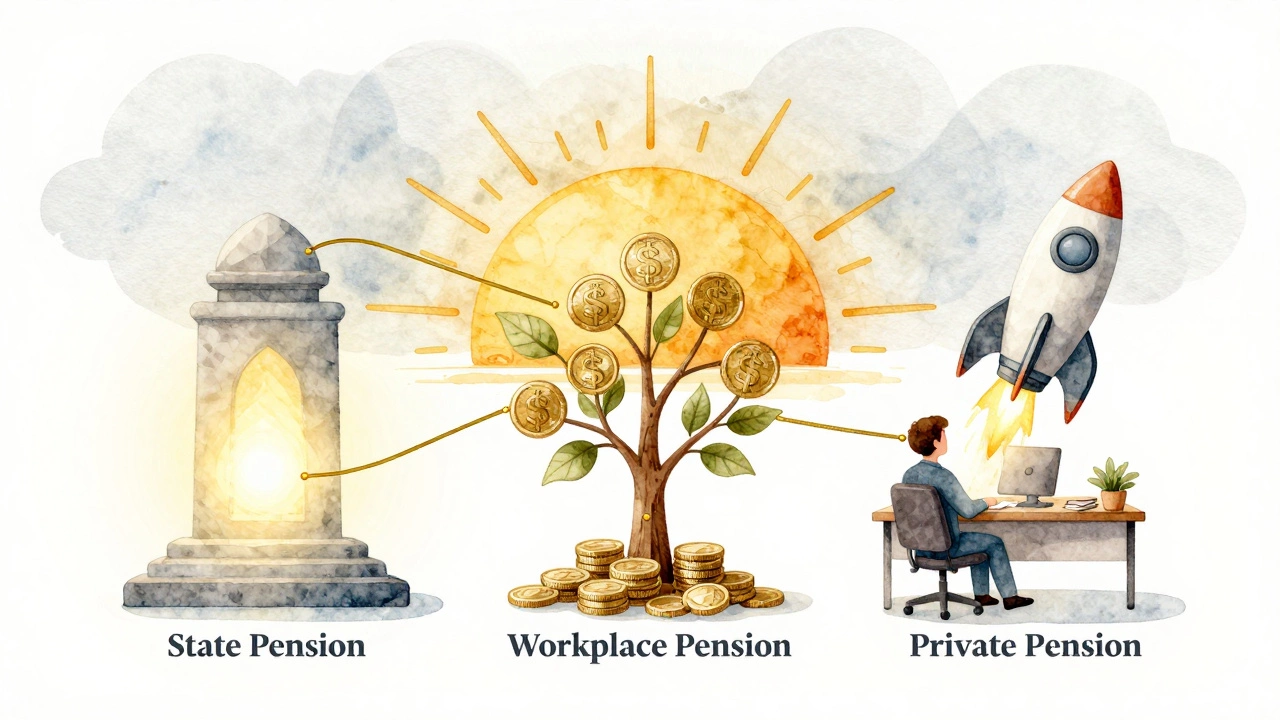
There are three main types in Ireland: the State Pension, workplace pensions, and private pensions. The State Pension comes from the government. Workplace pensions are set up by your employer. Private pensions are ones you arrange yourself, like through a bank or financial provider.
Here’s how it works: you and often your employer put money into the plan every month. That money gets invested-usually in funds made up of stocks, bonds, or property. Over decades, those investments grow. When you retire, you can take the money as a lump sum, a regular income, or a mix of both.
How does a workplace pension work in Ireland?
If you’re employed in Ireland, you’re automatically enrolled in a workplace pension under the Auto-Enrolment scheme that started in 2024. You don’t have to sign up-your employer does it for you. But you can opt out if you want.
Here’s the breakdown of contributions:
- You pay 6% of your gross salary
- Your employer pays 6% of your gross salary
- The government adds 1% through tax relief
That’s 13% of your salary going into your pension every month. If you earn €40,000 a year, that’s €520 per month saved for your retirement. That’s more than most people realize.
And here’s the kicker: your employer’s contribution is free money. If you leave your job, the money stays in your pension pot. You don’t lose it. You can even combine it with pensions from past jobs into one account later.
What about the State Pension?
The State Pension (Contributory) is what most people think of as ‘the pension’. It’s paid by the government, but you don’t get it just because you’re old. You need to have paid enough Pay Related Social Insurance (PRSI) contributions over your working life.
To qualify for the full State Pension in 2026, you need at least 2,080 weekly PRSI contributions-roughly 40 years of work. If you have fewer, you get a reduced amount. Some people get the State Pension (Non-Contributory) if they didn’t pay enough PRSI but have low income. That’s means-tested.
As of January 2026, the full State Pension is €288.30 per week. That’s €15,000 a year. Sounds okay? Maybe. But inflation, healthcare costs, and rising bills mean that won’t stretch far if you’re living alone in Dublin.
Why private pensions matter
Most people will need more than the State Pension to live comfortably. That’s where private pensions come in. These are plans you set up yourself-through providers like Irish Life, Zurich, or even online platforms like PensionBee.
Private pensions give you control. You choose how much to contribute, where the money goes, and when you want to retire. You also get tax relief on your contributions. For example, if you’re a standard-rate taxpayer and put in €1,000, the government adds €200. If you’re a higher-rate taxpayer, they add €400.
And unlike workplace pensions, you can start one even if you’re self-employed, a freelancer, or work part-time. There’s no employer involved. You’re the boss of your own retirement savings.
Common mistakes people make
People think they have time. They say, ‘I’ll start saving when I’m 35.’ But compound growth doesn’t wait. If you start saving €200 a month at 25, you could have over €300,000 by 65-even with modest returns. Wait until 40? You’d need to save €500 a month to get close.
Another mistake? Leaving pensions behind when you change jobs. Hundreds of people in Ireland have five or six old pension pots scattered across different providers. They forget about them. They don’t know how much they’re worth. They don’t consolidate. That’s money lost to fees and confusion.
And then there’s the myth: ‘I’ll just rely on my house.’ But selling your home in retirement isn’t easy. You might need to downsize, move to a cheaper area, or pay care costs. Your home isn’t cash unless you turn it into cash-and even then, you lose your roof.

How much do you really need?
A good rule of thumb: you’ll need about 70% of your pre-retirement income to live comfortably. So if you earn €50,000 now, aim for €35,000 a year in retirement.
Break that down: €35,000 = €2,916 per month. The State Pension gives you €288.30 a week-that’s €1,250 a month. So you’re missing €1,666. That’s what your workplace and private pensions need to cover.
That’s why starting early and contributing consistently matters. Even €100 a month from your 20s can turn into tens of thousands by retirement. You don’t need to be rich. You just need to start.
What happens if you don’t have a pension plan?
If you don’t save for retirement, you’ll either keep working longer-maybe past 70-or rely on family support, state assistance, or downsizing. Neither is ideal.
In Ireland, over 30% of retirees depend on the State Pension alone. That’s not a lifestyle. That’s survival. And with more people living into their 80s and 90s, the pressure on public systems will only grow.
Without a pension plan, you’re betting your future on luck. And luck doesn’t pay bills.
Where to start today
You don’t need to be an expert. Just take one step.
- Check if you’re enrolled in a workplace pension. Look at your payslip-there should be a deduction labeled ‘pension’.
- Log in to your pension provider’s website. See how much you’ve saved and what it’s invested in.
- Use the Pension Board’s free online calculator to see how much you’ll have at retirement.
- Set up a direct debit to add €50 or €100 extra per month to your pension-even if you’re not required to.
- If you’re self-employed, sign up for a private pension with a provider like Irish Life or NEST.
Don’t wait for the perfect moment. There isn’t one. The best time to start was 10 years ago. The second-best time is today.
Is a pension plan the same as a savings account?
No. A savings account lets you withdraw money anytime, usually with low interest. A pension plan locks your money until retirement age, but it grows faster because of tax relief, employer contributions, and long-term investing. You can’t access it early without heavy penalties.
Can I have more than one pension plan?
Yes. Many people have a workplace pension, a private pension, and the State Pension. You can even combine old pensions from previous jobs into one account to make it easier to manage. There’s no limit on how many you can have.
What happens to my pension if I die before retirement?
Most pension plans let you name beneficiaries. If you die before drawing your pension, the money usually goes to your spouse, children, or another person you’ve chosen. It can be paid as a lump sum or as an income stream. Check your plan’s rules-some have limits on who can inherit.
Do I pay tax on my pension when I retire?
Yes, but not on everything. When you retire, you can usually take 25% of your pension pot as a tax-free lump sum. The rest is taxed as income. If your total income (including State Pension) is below the tax threshold, you may pay little or no tax. The tax rate depends on your total income in retirement.
Can I retire early with a pension plan?
Most pension plans let you access your money from age 60, but some allow earlier access under special circumstances-like serious illness. You can’t just retire at 50 and take your pension unless your plan allows it and you meet strict conditions. Early access often means smaller payments over time.