
Loan Payment Estimator
Payment Summary
The reality is that a 20,000 loan monthly payment is a combination of principal (the original $20k) and interest (the fee the bank charges). Depending on your terms, you could be paying $350 a month or over $600. The goal here is to figure out which scenario fits your current budget without leaving you "house poor" or unable to afford your morning coffee.
Key Takeaways for Your Budget
- Term Length: Shorter loans mean higher monthly payments but less money wasted on interest.
- Interest Rates: A difference of 5% can cost you thousands of dollars over the life of the loan.
- Credit Impact: Your credit score is the primary lever that determines your APR.
- Fees: Watch out for origination fees that can be deducted from your $20,000 before it even hits your account.
The Core Mechanics: How Monthly Payments Are Calculated
To understand the cost, we have to look at Amortization, which is the process of spreading out a loan into a series of fixed payments over time. In the beginning, a larger chunk of your monthly payment goes toward the interest. As the balance drops, more of your money starts hitting the principal.
Lenders use a specific formula to ensure they get their money back with interest. They take your annual percentage rate, divide it by 12 months, and apply it to the remaining balance. This is why paying extra toward your principal early on is a massive win-it stops the interest from compounding on that portion of the debt.
Let's look at a real-world scenario. If you have a credit score of 720, you might land an APR of around 10%. If your score is closer to 600, you might be looking at 18% or higher. That gap represents the "risk premium" the bank charges for lending to someone with a spotty payment history.
Breakdown of Monthly Costs by Term Length
The biggest decision you'll make is how many years you'll take to pay the money back. A Personal Loan usually ranges from 2 to 7 years. Here is how the monthly cost shifts for a $20,000 loan at a moderate 10% interest rate.
| Loan Term | Monthly Payment | Total Interest Paid | Total Repayment |
|---|---|---|---|
| 2 Years (24 months) | $922.76 | $2,146.24 | $22,146.24 |
| 3 Years (36 months) | $645.35 | $3,232.60 | $23,232.60 |
| 5 Years (60 months) | $424.94 | $5,496.40 | $25,496.40 |
| 7 Years (84 months) | $332.17 | $7,906.28 | $27,906.28 |
Notice the trade-off here. By choosing a 7-year term instead of a 2-year term, you lower your monthly bill by nearly $600, but you end up paying nearly $6,000 more in total interest. It's the classic struggle between monthly cash flow and long-term wealth.
The Impact of Interest Rates (APR)
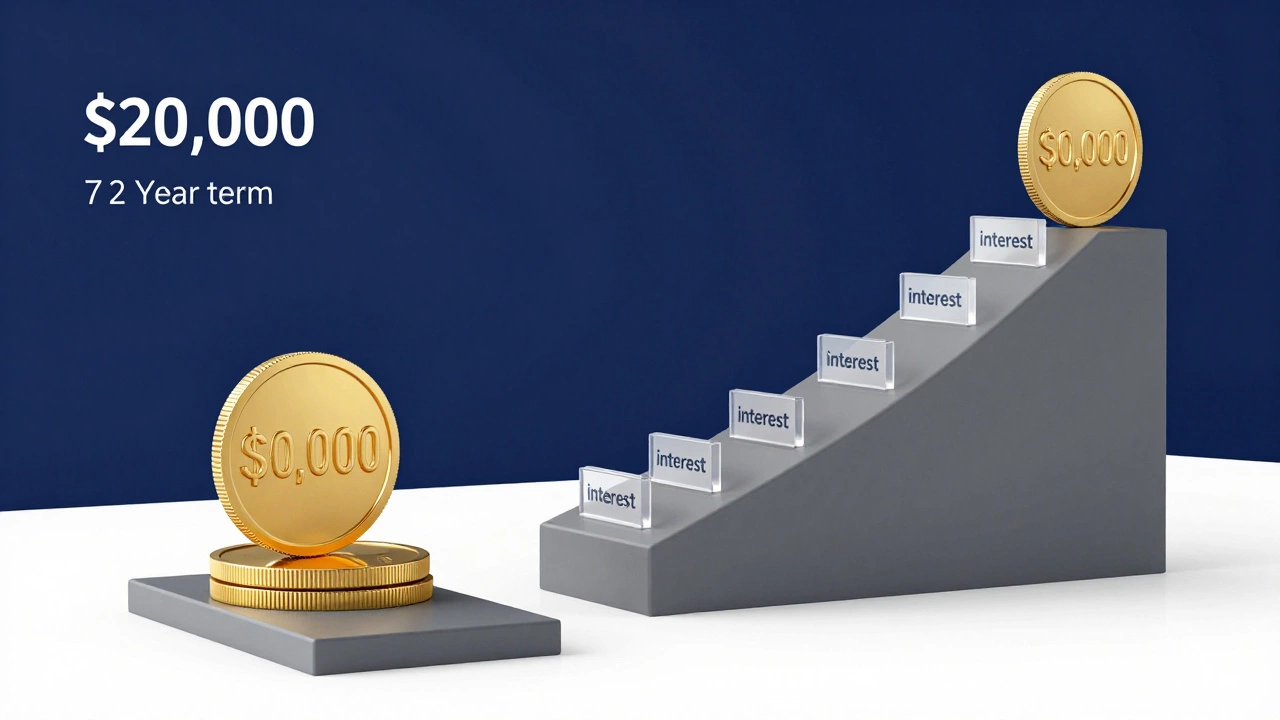
The APR (Annual Percentage Rate) is the most important number in your loan contract. Unlike a simple interest rate, the APR includes other costs like Origination Fees, which are upfront charges lenders use to process the loan. If a lender charges a 3% origination fee on $20,000, they will take $600 off the top, and you'll only receive $19,400, but you'll still owe interest on the full $20,000.
Let's see how different APRs affect a standard 5-year (60-month) loan for $20,000:
- Excellent Credit (6% APR): Your monthly payment would be roughly $386.
- Good Credit (12% APR): Your monthly payment jumps to $444.
- Average Credit (18% APR): You're now paying $507 per month.
- Poor Credit (25% APR): The payment climbs to $585 per month.
When you're paying $585 instead of $386, you're losing $199 every single month to interest. Over five years, that's nearly $12,000 in extra costs just because of a lower credit score. This is why it's often smarter to spend three months improving your score before applying for a large loan.
Comparing Loan Types for $20,000
You don't have to stick to a traditional bank loan. Depending on what you need the money for, other options might be cheaper or more flexible. For instance, a Credit Union often offers lower rates than a big national bank because they are member-owned nonprofits.
If you have a home with equity, a Home Equity Line of Credit (HELOC) might provide a significantly lower rate than a personal loan. However, the risk is much higher because your home serves as collateral. If you can't pay, you risk losing your property. A personal loan is usually "unsecured," meaning the bank can't take your house if you miss a payment, though they will absolutely tank your credit score.
Then there are Online Lenders. These fintech companies use algorithms to approve loans in minutes. They are convenient, but their "starting at" rates are often teasers. Always look at the actual offer, not the advertisement.

Avoiding Common Loan Pitfalls
It's easy to get blinded by a "low monthly payment" and sign a contract that traps you in debt for seven years. One of the biggest mistakes people make is ignoring the Prepayment Penalty. Some lenders make money from the interest you pay over time. If you suddenly get a bonus at work and want to pay off your $20,000 loan early, a lender with a prepayment penalty will actually charge you a fee for doing so. Always ensure your loan has "no prepayment penalties."
Another trap is the "deferred payment" or "interest-only" period. Some loans let you pay only the interest for the first six months. This feels great at first, but your principal balance doesn't budge. Once the full payments kick in, you'll realize you've made zero progress on the actual debt.
Lastly, beware of "predatory lending." If a lender offers you $20,000 with a 30% APR or higher, you aren't getting a loan; you're getting a financial anchor. At that rate, you could end up paying back nearly double what you borrowed.
Strategies to Lower Your Monthly Cost
If the numbers above look too high, you have a few options to bring those costs down. First, consider a co-signer. If you have a family member with a 800 credit score who is willing to sign the loan, the bank views the loan as much safer and will drop the APR significantly.
Second, look into Debt Consolidation. If you're taking this $20,000 loan to pay off five different credit cards that charge 24% interest, moving that debt into a 12% personal loan will instantly lower your total monthly output and help you get out of debt faster.
Third, try to increase your down payment if the loan is for a specific purchase, like a car or a home renovation. Borrowing $15,000 instead of $20,000 reduces your monthly payment and the total interest you'll pay over the life of the loan. Even a $5,000 difference can save you over $1,000 in interest on a 5-year term.
Can I pay off my $20,000 loan early to save money?
Yes, as long as your loan doesn't have a prepayment penalty. Making extra payments directly toward the principal reduces the balance that the lender can charge interest on, which significantly lowers the total cost of the loan and shortens the repayment term.
What is the difference between a fixed and variable rate for a personal loan?
A fixed rate stays the same for the entire life of the loan, meaning your monthly payment never changes. A variable rate fluctuates based on market indices. While variable rates might start lower, they can increase over time, making your monthly payments unpredictable.
How does my credit score affect my $20,000 loan payment?
Your credit score determines the APR a lender offers you. A higher score indicates lower risk, leading to a lower interest rate. For a $20,000 loan, the difference between an "excellent" and "poor" score can result in a monthly payment difference of $200 or more.
Will a $20,000 loan affect my debt-to-income ratio?
Yes. Lenders calculate your debt-to-income (DTI) ratio by dividing your monthly debt payments by your gross monthly income. Adding a new monthly payment of $400-$600 will increase your DTI, which could make it harder to qualify for other loans, like a mortgage, in the near future.
What happens if I can't make the monthly payment on a $20,000 loan?
Missing a payment usually results in a late fee and a negative report to credit bureaus, which drops your credit score. If you're struggling, it's best to contact your lender immediately to ask for a "deferment" or a "loan modification" before the loan goes into default.
Next Steps Based on Your Situation
If you're just starting your search, don't apply to five different lenders in one week. Every "hard inquiry" on your credit report can dip your score slightly. Instead, use "pre-qualification" tools that only perform a "soft pull" to see what rates you might qualify for.
For those who already have a loan and want to lower their payments, look into refinancing. If your credit score has improved since you first took out the loan, you can take out a new loan at a lower rate to pay off the old, expensive one. This can potentially save you hundreds of dollars a month.