ISA vs Roth IRA Eligibility & Strategy Checker
Select your current situation below to see which accounts you can use and how much tax-free growth you could achieve.
UK Resident
Living in the UK, earning GBP.
US Resident
Living in the US, earning USD.
The Expat / Mover
Moving between UK and US.
Calculate Your Potential
Projected Outcome
It is a question that trips up many people moving between the United Kingdom and the United States. You hear "ISA" and "Roth IRA" in the same breath, see the similar acronyms, and assume they are basically the same thing. They are not. While both accounts share a core philosophy-tax-efficient saving-they operate under completely different legal systems, have distinct contribution limits, and serve different populations.
If you are living in Dublin, London, or New York, understanding this difference is crucial for your financial future. Confusing the two could lead to missed opportunities or, worse, unexpected tax bills. Let’s break down exactly what each account is, who can use them, and why they are often compared despite being worlds apart.
The Core Similarity: Tax-Free Growth
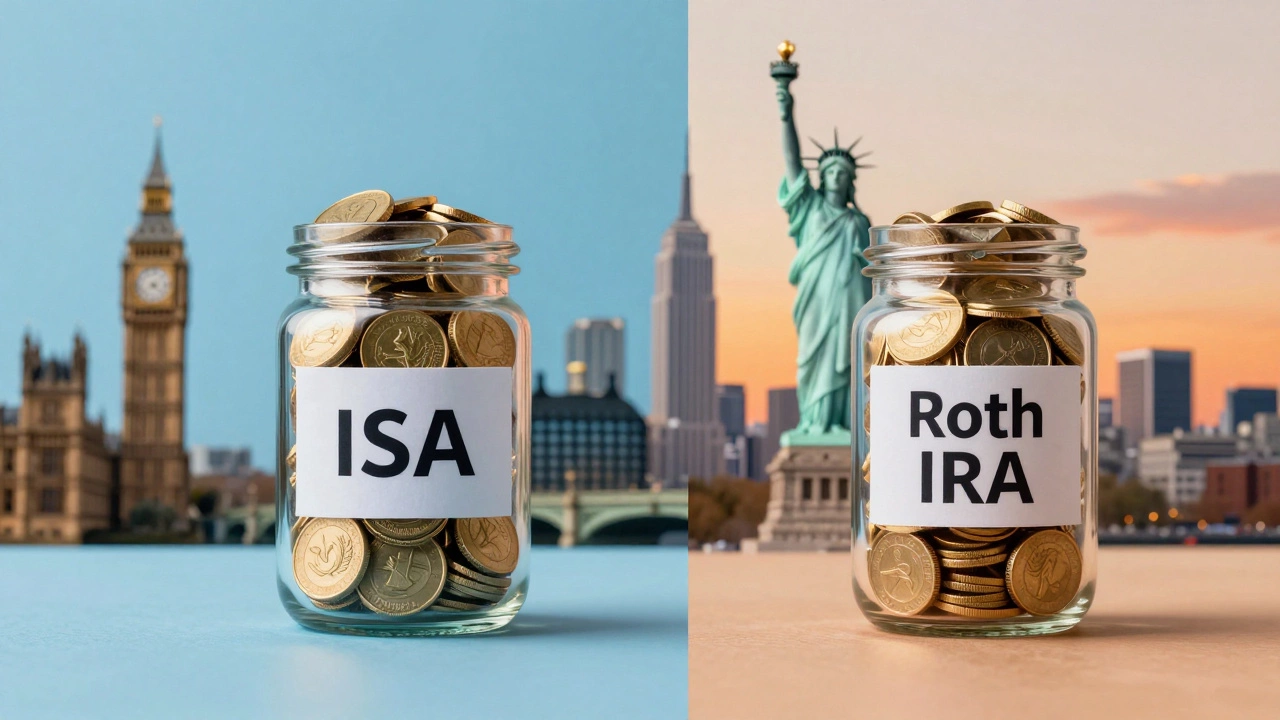
Before diving into the differences, it helps to understand why these two accounts are linked in people’s minds. Both the Individual Savings Account (ISA) is a UK-based tax-advantaged savings vehicle that allows individuals to earn interest, dividends, and capital gains without paying income tax or capital gains tax and the Roth IRA is a US retirement account that allows contributions with after-tax dollars, enabling tax-free growth and tax-free withdrawals in retirement offer a golden promise: tax-free growth.
In an ISA, you pay tax on your money before you put it in. When that money grows through interest, dividends, or investment profits, you do not pay any further tax on those gains. You can withdraw the money at any time without penalty, and it remains tax-free.
A Roth IRA works similarly regarding taxes. You contribute money that has already been taxed. The investments grow tax-free. If you follow the rules, you can withdraw both your contributions and the earnings tax-free in retirement.
This shared benefit makes them natural counterparts for expats. If you move from the UK to the US, you might look for an equivalent to your ISA. The Roth IRA is the closest functional match, even if the mechanics differ.
Key Differences: Geography, Rules, and Access
The similarities end quickly when you look at the details. Here is where the confusion usually clears up.
| Feature | ISA (UK) | Roth IRA (US) |
|---|---|---|
| Origin & Eligibility | UK residents only | US citizens/residents with earned income |
| Contribution Limit (2025/2026) | £20,000 per year | $7,000 ($8,000 if age 50+) |
| Withdrawal Flexibility | High (Cash/Stocks & Shares ISAs) | Restricted (Penalties for early earnings withdrawal) |
| Primary Purpose | Saving, investing, home buying, retirement | Retirement savings |
| Tax Treatment | Tax-free interest, dividends, gains | Tax-free qualified distributions |
1. Who Can Open Them?
This is the biggest hurdle. An ISA is strictly for UK residents. To open one, you must be resident in the UK for tax purposes. If you live in Ireland, the US, or anywhere else outside the UK, you generally cannot open a new ISA. Existing ISAs can often be kept open while abroad, but you cannot add new funds once you lose residency status.
A Roth IRA, on the other hand, requires US source income. You must be a US citizen, green card holder, or meet certain residency tests. Even then, there are income limits. High earners may find their ability to contribute phased out entirely. For example, in 2025, single filers making over $146,000 face restrictions on direct contributions.
2. Contribution Limits
The amounts you can save annually differ significantly. The UK government allows you to contribute up to £20,000 to an ISA each tax year. This is a generous limit that encourages substantial long-term saving. You can split this amount across different types of ISAs (like Cash, Stocks and Shares, Lifetime, and Innovative Finance) as long as the total does not exceed £20,000.
The US limit for a Roth IRA is much lower. For the 2025 tax year, the standard limit is $7,000. If you are 50 or older, you can contribute an additional $1,000 as a catch-up contribution. While this is less than the ISA limit, it is still a powerful tool for building wealth over decades due to compound interest.
3. Withdrawal Rules
ISAs are incredibly flexible. With a Cash ISA or Stocks and Shares ISA, you can withdraw your money at any time. There are no penalties for accessing your funds. This makes ISAs suitable for short-term goals like buying a car, saving for a holiday, or building an emergency fund, in addition to long-term investing.
Roth IRAs are more restrictive. While you can always withdraw your contributions (the money you put in) tax-free and penalty-free at any time, withdrawing earnings before age 59½ usually triggers a 10% penalty plus income tax. There are exceptions, such as using the funds for a first-time home purchase (up to $10,000 lifetime limit) or higher education costs, but the default rule is that this is a retirement account, not a piggy bank.

Types of ISAs: More Than Just One Bucket
When people say "ISA," they often mean the general concept, but the UK actually offers four main types. Understanding these helps clarify why the Roth IRA comparison is sometimes imperfect.
- Cash ISA: Works like a high-interest savings account. Your money is safe, and the interest is tax-free. Ideal for risk-averse savers.
- Stocks and Shares ISA: Allows you to invest in stocks, bonds, and funds. This is the closest equivalent to a Roth IRA in terms of investment potential. However, your capital is at risk.
- Lifetime ISA (LISA): Designed for first-time home buyers or retirement. The government adds a 25% bonus to your contributions. Withdrawals for non-approved reasons incur a 25% charge, which recovers the bonus plus some of your own money.
- Innovative Finance ISA: Covers peer-to-peer lending and crowd-lending. Higher risk, potentially higher returns, all tax-free.
The Roth IRA does not have these sub-categories. It is a single type of account where you choose your investments within the platform (brokerage, bank, etc.).
What Should Expats Do?
If you are a UK expat living in the US, you likely cannot contribute to an ISA anymore. Your focus should shift to maximizing your Roth IRA (if eligible) or a Traditional IRA. These accounts provide similar tax advantages within the US system.
If you are a US expat living in the UK, you generally cannot contribute to a Roth IRA because you lack US source income. In this case, exploring UK-specific options like a Stocks and Shares ISA (if you become a UK tax resident) or private pension schemes is advisable.
For those living in neither country, such as in Ireland, the landscape is different again. Ireland offers Personal Retirement Savings Accounts (PRSAs) and Approved Minus Funds, which serve similar roles but with different tax treatments. Always consult a cross-border tax advisor to navigate the complexities of double taxation treaties.
Financial planning is about choosing the right tools for your specific location and status. Don’t let similar acronyms fool you. Know the rules of the game you are playing.
While managing finances is serious business, life also involves balancing work with personal interests and travel. For those exploring global cities and seeking unique experiences, resources like this directory can offer insights into local services in destinations like Dubai, ensuring you stay informed about various aspects of international living beyond just banking.

Common Mistakes to Avoid
Many people make costly errors when dealing with these accounts. Here are three pitfalls to watch out for:
- Ignoring Residency Status: Continuing to contribute to an ISA after losing UK residency can invalidate the tax benefits. HMRC may reclaim the tax relief, leading to a bill.
- Exceeding Income Limits: Trying to force money into a Roth IRA when your income is too high results in excess contributions, which are penalized by the IRS.
- Mixing Up Withdrawal Rules: Treating a Roth IRA like a Cash ISA and withdrawing earnings early can trigger significant tax penalties. Always check the five-year rule and age requirements before touching retirement funds.
Final Thoughts on Tax-Efficient Saving
The ISA and Roth IRA are not the same, but they are cousins in the world of tax-advantaged investing. Both reward disciplined saving with tax-free growth. The key is to align your strategy with your current residence and income source. Whether you are saving for a house in Manchester, retirement in Miami, or a future abroad, using the correct account structure ensures you keep more of what you earn.
Can I have both an ISA and a Roth IRA?
Generally, no. Because eligibility is based on residency and income source, you would need to be a tax resident of both the UK and the US simultaneously, which is rare and complex. Most people qualify for one or the other based on where they live and work. If you move countries, you typically transition from one system to the other.
What happens to my ISA if I move to the US?
You can usually keep your existing ISA open and let it continue to grow. However, you cannot make new contributions once you are no longer a UK tax resident. The assets remain tax-free within the UK wrapper, but you may need to report them to the IRS depending on your overall foreign asset holdings.
Is a Roth IRA better than a Traditional IRA?
It depends on your current and expected future tax bracket. A Roth IRA is better if you expect your taxes to be higher in retirement, as you pay taxes now. A Traditional IRA offers a tax deduction now, which is beneficial if you want to lower your current taxable income. For younger investors, the Roth is often preferred due to longer tax-free growth periods.
Can I withdraw money from an ISA without penalty?
Yes, for most ISAs (Cash, Stocks and Shares), you can withdraw funds at any time without penalty or tax implications. However, with a Lifetime ISA (LISA), withdrawing for non-approved reasons (like buying a first home or retirement) incurs a 25% charge.
What is the annual contribution limit for a Roth IRA in 2026?
The exact limit for 2026 will be confirmed by the IRS closer to the start of the year, but it is typically adjusted for inflation. Based on recent trends, expect the limit to remain around $7,000-$7,500 for those under 50, and $8,000-$8,500 for those 50 and older. Always check the latest IRS guidelines for the current tax year.