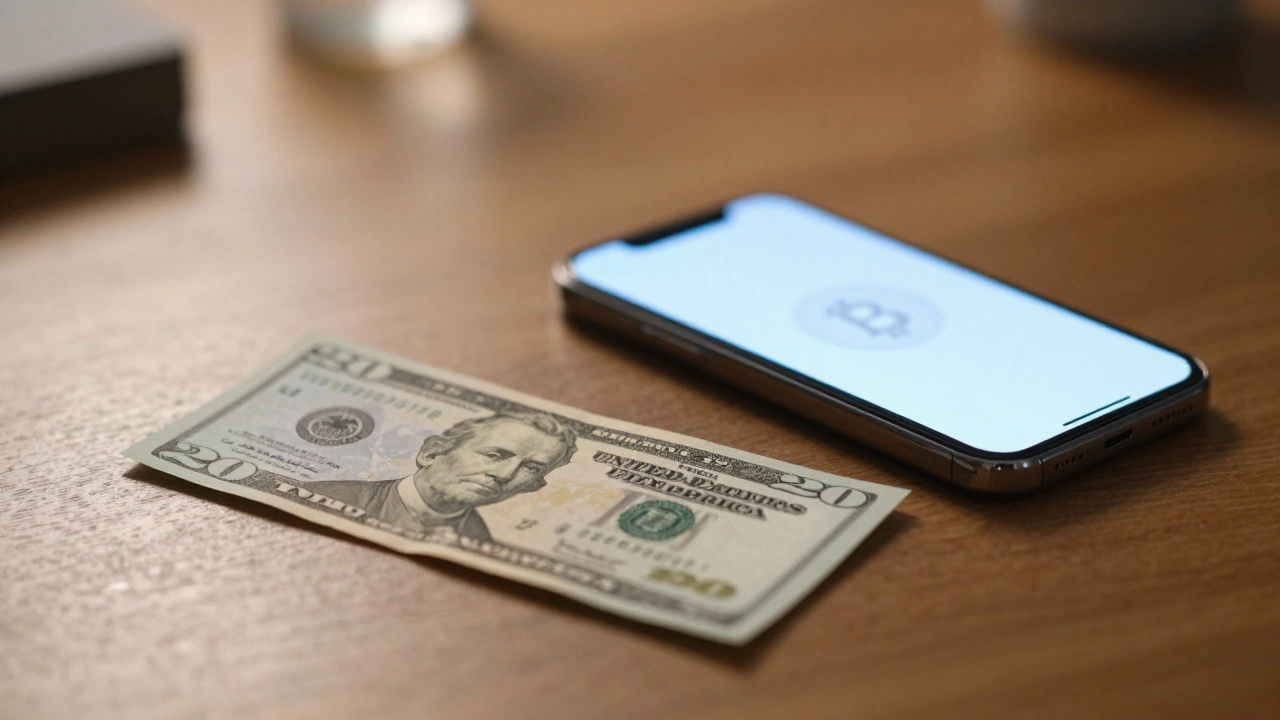
Bitcoin Micro-Investment Simulator
Investment Parameters
Purchase Breakdown
Growth Projection
Enter your investment details and click Calculate Potential to see how $20 works for you.
You have twenty dollars burning a hole in your pocket. Maybe it’s change from a grocery run, or maybe you just sold an old jacket online. The thought crosses your mind: Should I throw this at Bitcoin? It feels like such a tiny amount compared to the millions of dollars often discussed in crypto news. But does size matter when you are starting out? The short answer is yes, but not for the reasons you might think.
Investing $20 in Bitcoin isn’t about getting rich overnight. It is about buying your way into the game with zero risk of ruin. If you treat that $20 as tuition rather than a lottery ticket, it becomes one of the smartest financial moves you can make right now. Let’s break down why putting that specific amount to work makes sense, how to do it without losing half your money to fees, and what realistic expectations look like in mid-2026.
Can you actually buy Bitcoin with just $20?
Yes. You do not need to buy a whole coin. Bitcoin is divisible down to eight decimal places (one satoshi). With $20, you will own a fraction of a Bitcoin, which gains value exactly as if you owned the full coin.
The Psychology of the First Step
We often fall into the trap of thinking we need a large sum to start investing. This is called "analysis paralysis." You wait for the perfect moment, the perfect price, or the perfect amount of savings. Meanwhile, time passes. In the world of Bitcoin is a decentralized digital currency that operates on a peer-to-peer network without a central bank., time in the market usually beats timing the market.
When you invest $20, you remove the emotional weight from the decision. If the price drops tomorrow, you haven’t lost your rent money. You’ve lost less than the cost of a nice dinner. This low-stakes environment allows you to learn how exchanges work, how wallets function, and how your emotions react to volatility. Most people blow up their first crypto portfolio because they went in too heavy, too fast. Starting small protects you from panic selling when the red candles appear.
Think of it like learning to swim. You don’t jump into the deep end on day one. You stand in the shallow water, get used to the feeling, and practice breathing. That $20 is your shallow end.
Fees Are the Silent Killer of Small Investments
Here is where most beginners trip up. You want to invest $20, but the exchange charges a $5 trading fee. Suddenly, you are down 25% before you even click "buy." That is unacceptable. To make a $20 investment worthwhile, you must choose the right platform.
In 2026, the landscape has shifted significantly. Legacy banks and traditional brokerages still charge high minimums or steep fees for crypto. You need platforms designed for micro-investing. Look for services that offer:
- Zero-commission trades: Many modern apps absorb the spread instead of charging a flat fee.
- No minimum deposit: Ensure the app lets you fund your account with exactly $20 via debit card or instant bank transfer.
- Low spreads: The difference between the buy and sell price should be minimal (under 1%).
If you use a platform that charges a flat $1 fee per trade, your $20 investment needs to gain 5% just to break even. If you find a platform with no explicit fees, you only need a 0.1% move to see green. Do the math before you sign up. The tool you use matters more than the asset you buy when the capital is this small.
Understanding Fractional Ownership
Newcomers often believe they must buy one whole Bitcoin. This is a myth rooted in early crypto culture. Today, fractional ownership is the standard. When you buy $20 worth of Bitcoin, you receive a precise fraction of a coin based on the current market price.
Let’s say Bitcoin is trading at $70,000. Your $20 buys you approximately 0.00028571 BTC. Does that sound insignificant? It doesn’t matter. If Bitcoin doubles to $140,000, your holding doubles to $40. The percentage gain is identical whether you hold 0.00000001 BTC or 100 BTC. The mechanics of blockchain technology ensure that every satoshi (the smallest unit of Bitcoin) has equal value relative to the whole.
This divisibility is a feature, not a bug. It allows everyday people to participate in a store of value that was previously inaccessible due to its high nominal price per unit. You are not buying a "piece" of Bitcoin; you are buying Bitcoin, just in a smaller quantity.
Why Is Better Than Why $20 Is Better Than $0
There is a concept in behavioral finance called "skin in the game." When you have zero invested, you are a spectator. You watch charts, read headlines, and feel FOMO (fear of missing out) or relief when prices drop. But you are detached. Once you put $20 in, you become a participant. You start paying attention to fundamentals, security best practices, and long-term trends rather than daily noise.
Furthermore, $20 is the perfect seed for Dollar-Cost Averaging (DCA). DCA is a strategy where you invest a fixed amount at regular intervals, regardless of price. If you commit to adding $20 every week, you smooth out the volatility. You buy more Bitcoin when prices are low and less when they are high. Over a year, that $20 weekly habit turns into $1,040 invested. Combined with potential appreciation, this builds a meaningful position over time.
Starting with $20 today establishes the habit. Habits compound faster than interest. The discipline of showing up every month with $20 is far more valuable than waiting until you have $2,000 to dump in all at once.
Security Basics for Small Holdings
You might hear experts scream, "Not your keys, not your coins!" They advise moving crypto off exchanges and into hardware wallets. For a $20 investment, this advice is impractical. Hardware wallets cost $50-$150. You would be spending three times your investment to secure it.
For small amounts, keeping Bitcoin on a reputable, insured exchange is acceptable. These platforms have robust security teams and insurance funds to cover potential breaches. However, you must still take basic precautions:
- Enable Two-Factor Authentication (2FA): Use an authenticator app, not SMS text messages, which can be intercepted.
- Use a strong, unique password: Never reuse passwords from other sites.
- Verify email confirmations: Always check your email after making changes to your account settings.
As your holdings grow past $500 or $1,000, revisit the conversation about self-custody. But for now, convenience and security on a major exchange strike the right balance for a $20 stake.
Realistic Expectations: What Can $20 Do?
Let’s keep our feet on the ground. $20 will not buy you a Lamborghini. Even if Bitcoin goes to the moon, $20 might turn into $200 or $500 over several years. That is great for a coffee fund or a new gadget, but it is not retirement money.
However, consider the alternative. If you leave that $20 under your mattress, inflation eats it away. If you spend it on impulse buys, it’s gone. If you invest it in Bitcoin, you have exposure to a growing asset class. More importantly, you have built a track record of investing. That psychological win is priceless. You prove to yourself that you can save, you can allocate, and you can stick with a plan.
Many successful investors started with spare change. The key is consistency. The $20 is the spark. The fuel is your future contributions.

Comparison: Where Should You Put That ?
| Option | Risk Level | Potential Return | Liquidity | Best For |
|---|---|---|---|---|
| Bitcoin | High | Very High | Instant | Growth & Learning |
| Savings Account | None | Low (~4-5%) | Instant | Emergency Fund |
| Stock ETF | Medium | Medium | 1-2 Days | Stable Growth |
| Coffee/Impulse Buy | N/A | Negative | N/A | Immediate Gratification |
As the table shows, Bitcoin offers the highest potential return but comes with higher volatility. For a $20 bet, the downside is capped at $20, while the upside is theoretically unlimited. This asymmetry makes it an attractive option for disposable income.
Common Mistakes to Avoid
Even with $20, you can make mistakes that hurt your journey. Here is what to skip:
- Chasing memecoins: Stick to Bitcoin for your first purchase. Memecoins are gambling, not investing.
- Ignoring taxes: While $20 won’t trigger a tax bill, understand that crypto transactions are taxable events in many jurisdictions. Keep records from day one.
- Emotional trading: Don’t sell because the price dropped 5% in a day. Don’t buy more because it jumped 10%. Stick to your plan.
- Using credit cards: Never borrow money to invest in crypto. Only use cash you can afford to lose.
Next Steps After Your First $20
Once you’ve bought your first slice of Bitcoin, don’t stop there. Set a reminder for next month. Aim to add another $20. Research how to set up a self-custody wallet like Ledger is a hardware wallet brand that stores private keys offline for enhanced security. or Trezor is another popular hardware wallet manufacturer known for open-source firmware.. Read whitepapers. Join educational communities, not hype groups.
The goal is to transform that initial $20 experiment into a lifelong financial strategy. You are not just buying a coin; you are buying education, discipline, and a foothold in the digital economy. So, go ahead. Pull out that $20. Open an account. Make the purchase. You’ll sleep better knowing you took action instead of waiting for permission.
Is it safe to keep $20 of Bitcoin on an exchange?
Yes. For small amounts, the cost and complexity of hardware wallets outweigh the benefits. Reputable exchanges insure user funds against hacks. Enable 2FA and use a strong password to maximize safety.
Will I owe taxes on my $20 Bitcoin investment?
Buying Bitcoin is not a taxable event. You only owe taxes when you sell for a profit or trade it for another asset. With a $20 investment, any profit will likely be negligible, but you should still keep records for accuracy.
What happens if Bitcoin crashes after I buy $20?
You lose value on paper, but since you only invested $20, the financial impact is minimal. Use this as a learning experience about volatility. If you believe in the long-term potential, hold or buy more when prices are lower.
Can I withdraw my $20 anytime?
Yes, Bitcoin is highly liquid. You can sell your fraction back to the exchange and withdraw the cash to your bank account within minutes or hours, depending on the platform.
Should I invest $20 in Bitcoin or Ethereum?
For a first-time investor, Bitcoin is generally recommended due to its status as digital gold and lower relative risk compared to altcoins. Once you understand the basics, you can diversify into Ethereum or other assets.