
$500,000 Whole Life vs. Term Insurance Calculator
You want to leave behind a solid financial safety net for your family. A $500,000 whole life insurance policy is a permanent coverage option that pays out a death benefit while building cash value over time. It sounds like the perfect solution: guaranteed protection forever, plus an investment component that grows tax-deferred. But here is the hard truth most people miss before they sign on the dotted line. The monthly bill can shock you.
If you are healthy and young, you might expect to pay around $150 to $200 a month. In reality, for many adults in their 30s or 40s, that same $500,000 policy often costs between $300 and $600 per month. For older applicants or those with health issues, it can easily exceed $1,000 a month. That is not a typo. Permanent insurance is expensive because it never expires, and the insurer has to guarantee that payout regardless of how long you live.
Understanding exactly what drives this cost up-or down-is crucial. You need to know if the premium fits your budget without straining your other financial goals. This guide breaks down the real numbers, the hidden fees, and whether whole life is actually the right tool for your specific situation in 2026.
The Real Price Tag: Premium Estimates by Age and Health
To give you a concrete idea, let’s look at estimated annual premiums for a standard $500,000 whole life policy. These figures assume a non-smoker in average good health. If you smoke or have pre-existing conditions, add 50% to 100% to these numbers.
| Age | Annual Premium | Monthly Equivalent |
|---|---|---|
| 25 | $1,800 - $2,400 | $150 - $200 |
| 35 | $2,800 - $3,800 | $233 - $316 |
| 45 | $4,500 - $6,000 | $375 - $500 |
| 55 | $7,500 - $10,000 | $625 - $833 |
| 65 | $12,000 - $16,000+ | $1,000 - $1,333+ |
Notice the steep climb after age 45. This happens because the risk of mortality increases significantly. Insurers lock in your rate when you buy the policy, but that locked-in rate reflects your age at purchase. Waiting ten years to buy the same coverage could double your cost.
Gender also plays a role. Statistically, women live longer than men, so insurers often charge women slightly less-sometimes 10% to 15% less-for the exact same policy. However, the gap has narrowed in recent years as life expectancy differences shrink.
Why Is Whole Life So Expensive?
You might wonder why term life insurance, which offers the same $500,000 death benefit, costs only $20 to $40 a month for a healthy 35-year-old. The difference lies in the structure of the product.
Whole life insurance is a type of permanent life insurance that combines a death benefit with a savings component known as cash value. When you pay your premium, the money doesn’t just go toward covering the risk of your death. A significant portion goes into a cash value account that grows at a guaranteed rate set by the insurance company.
This creates three main cost drivers:
- Mortality Charges: The actual cost of insuring your life. This stays relatively flat compared to term insurance, where it spikes as you age.
- Administrative Fees: Insurers charge high upfront fees to cover commissions for agents and operational costs. In the first few years, most of your premium pays these fees, not the cash value.
- Guaranteed Growth: The insurer promises a fixed interest rate on your cash value. To fulfill this promise, they invest your money conservatively. You are paying for the certainty of that growth, even if market returns are higher elsewhere.
In short, you are buying two products in one: insurance and a forced savings plan. Term insurance only buys the protection. That is why it is cheaper. With whole life, you are paying for the privilege of having a guaranteed payout no matter when you die, plus a bank account that grows inside the policy.
Hidden Costs and Fees That Eat Into Your Value
The premium is just the start. Many buyers don’t realize that whole life policies come with layers of fees that can slow down the growth of your cash value. Understanding these is critical to knowing if the policy makes sense for you.
Commission Structures: Agents selling whole life insurance typically earn much higher commissions than those selling term life. First-year commissions can range from 50% to 100% of the first year’s premium. This means if you pay $4,000 in the first year, half of that might go straight to the agent. This is why surrendering a policy early is a terrible idea-you lose the money paid in commissions.
Policy Loans Interest Rates: One of the main attractions of whole life is the ability to borrow against the cash value. However, these loans aren’t free. Interest rates on policy loans usually range from 5% to 8%. If you don’t pay the interest back, it capitalizes, meaning it gets added to the loan balance. Over decades, this compound interest can eat up a huge chunk of your death benefit.
Surrender Charges: If you decide to cancel the policy within the first 10 to 15 years, you will face hefty surrender charges. These can be as high as 10% to 20% of the cash value in the early years, dropping gradually to zero. This locks you in for the long haul.

Cash Value Growth: How Fast Does It Build?
Let’s talk about the investment side. How much money does your policy actually accumulate? This varies wildly depending on the insurer and the specific policy design (traditional whole life vs. indexed universal life).
For a traditional $500,000 whole life policy purchased at age 35 with a $3,000 annual premium:
- Year 5: Cash value might be around $2,500. Most of your payments went to fees and commissions.
- Year 10: Cash value could reach $10,000 - $12,000.
- Year 20: Cash value might grow to $30,000 - $40,000.
- Year 30: Cash value could approach $60,000 - $80,000.
The growth is slow at first. This is called the "break-even point." It often takes 10 to 15 years for the total cash value to equal the total premiums you have paid. Before that point, you are essentially renting the insurance. After that point, the policy starts working harder for you.
It is important to compare this to other investments. If you took that $3,000 annual premium and invested it in a low-cost S&P 500 index fund instead, assuming a historical average return of 7-10%, you would likely have significantly more money after 20 or 30 years. However, you would not have the guaranteed death benefit or the tax-advantaged borrowing features. Whole life trades potential high returns for safety and guarantees.
Who Should Actually Buy Whole Life Insurance?
Given the high cost, whole life insurance is not for everyone. It is a niche product that serves specific financial strategies. Here is who typically benefits:
- High-Net-Worth Individuals: People who have maxed out all other tax-advantaged accounts (401k, IRA) and need a place to park excess cash for estate planning or tax diversification.
- Parents of Special Needs Children: Families who need a permanent source of income to care for a dependent who cannot support themselves indefinitely. Term insurance expires; whole life does not.
- Business Owners: Those using life insurance for key person insurance or buy-sell agreements where the coverage needs to last as long as the business exists.
- Estate Tax Planners: Individuals with estates large enough to trigger federal or state estate taxes. The death benefit can provide liquidity to pay those taxes without forcing heirs to sell assets.
If you are a typical middle-income family trying to protect your mortgage or replace your income for 20 years while your kids are growing up, whole life is likely too expensive. You are paying for coverage you probably won’t need in your 80s. For most people, Term life insurance is temporary coverage that lasts for a set period, such as 10, 20, or 30 years. is the smarter choice. It provides massive coverage for a fraction of the cost.
Alternatives to Consider Before Committing
Before you sign up for a $500,000 whole life policy, consider these alternatives. They might offer better value for your specific goals.
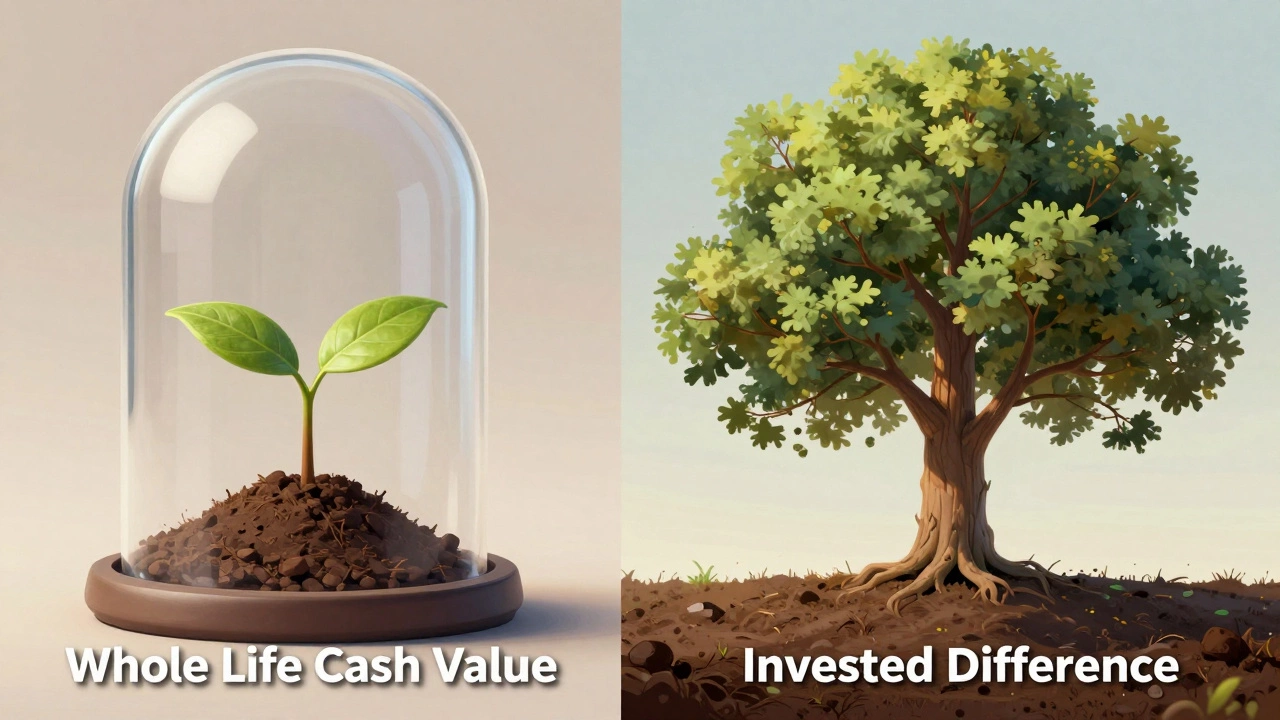
- Buy Term and Invest the Difference: Buy a 20-year term policy for $500,000 (costing ~$25/month). Take the remaining $275/month (from our $300 whole life example) and invest it in a brokerage account. Historically, this strategy yields higher returns, though it requires discipline.
- Indexed Universal Life (IUL): A type of permanent insurance where cash value growth is tied to a stock market index. It offers capped upside but protects against downside loss. It can be more flexible and potentially cheaper than traditional whole life, but it is also more complex and risky if caps are low.
- Variable Universal Life (VUL): Allows you to invest cash value in sub-accounts similar to mutual funds. Higher potential returns, but you bear the investment risk. If the markets crash, your cash value and even your death benefit can drop.
How to Lower Your Premium
If you are determined to get whole life coverage, there are ways to make it more affordable:
- Get Healthy: Losing weight, quitting smoking, and managing blood pressure can move you into a preferred health class, saving you thousands over the life of the policy.
- Reduce the Face Amount: Do you really need $500,000? Run the numbers. Maybe $250,000 covers your immediate liabilities and future needs. Half the coverage often means less than half the premium due to lower administrative overhead.
- Choose a Paid-Up Period: Instead of paying level premiums for life, opt to pay higher premiums for 10 or 20 years to "pay up" the policy. Once paid up, you owe nothing more, and the cash value grows faster.
- Shop Around: Not all insurers price whole life the same. Some focus on dividends (mutual companies), while others focus on low initial premiums. Get quotes from at least three different carriers.
Frequently Asked Questions
Is a $500,000 whole life policy worth the cost?
It depends on your financial situation. If you have already maximized retirement accounts and need permanent coverage for estate planning or special needs dependents, it can be worth it. For most people seeking basic income replacement, term life is a far more cost-effective solution.
Can I get a refund if I cancel my whole life policy?
Yes, but only after the cash value has built up, which typically takes 10-15 years. If you cancel early, you may receive little to nothing back due to high surrender charges and initial fees.
Does the cash value grow tax-free?
The cash value grows tax-deferred. You do not pay taxes on the growth as long as the money stays in the policy. Withdrawals up to your basis (premiums paid) are generally tax-free. Loans against the cash value are also tax-free, provided the policy remains in force.
What is the difference between whole life and universal life?
Whole life has fixed premiums and guaranteed cash value growth. Universal life offers flexible premiums and variable cash value growth based on interest rates or market indices. Universal life is more customizable but carries more risk if not managed properly.
Will my premiums ever increase?
With traditional whole life insurance, premiums are guaranteed to stay level for life. This is one of its main advantages over term insurance, where rates jump significantly as you renew or convert.
How much coverage do I really need?
A common rule of thumb is 10-15 times your annual income. However, a more accurate method is to calculate your debts (mortgage, loans), final expenses, and the number of years you need to replace your income for your dependents. Subtract any existing assets or savings from this total.