
Home Equity Cost Calculator
Your Financial Details
Option 1: Cash-Out Refinance
Fixed Rate- Est. New Rate: -
- Closing Costs (High): -
- Total Est. Interest (30yr): -
Best if you plan to stay long-term and can secure a lower rate than your current one.
Option 2: HELOC
Variable Rate- Est. Variable Rate: -
- Closing Costs (Low): -
- Interest (10yr term): -
Best for low upfront costs. Risk: Rates fluctuate with the Prime Rate.
Option 3: Home Equity Loan
Fixed Rate- Est. Fixed Rate: -
- Closing Costs (Med): -
- Total Est. Interest (15yr): -
Best for predictable budgeting and locking in a rate without refinancing the primary mortgage.
You’ve built up wealth in your home, but that money is stuck inside the walls. You need it for a renovation, to pay off high-interest debt, or maybe just to cover an unexpected bill. The big question isn’t just how to get it out-it’s how to do so without paying a fortune in fees and interest. Getting equity out of a house can be expensive if you pick the wrong tool. But with the right strategy, you can access those funds at a lower cost than a personal loan or credit card.
The "cheapest" method depends entirely on your current mortgage rate, your credit score, and how quickly you need the cash. There is no single silver bullet. However, by comparing the three main avenues-cash-out refinancing, Home Equity Lines of Credit (HELOCs), and Home Equity Loans-you can find the path that minimizes your total cost.
Understanding Your Home Equity First
Before looking at products, you need to know exactly what you’re working with. Home equity is the difference between your home’s current market value and what you still owe on your mortgage. If your house is worth $400,000 and you owe $250,000, you have $150,000 in equity.
Lenders rarely let you borrow against 100% of that amount. Most lenders cap the Loan-to-Value (LTV) ratio at 80% to 90%. This means they want you to keep some skin in the game. If your lender allows an 80% LTV, your maximum borrowing limit would be based on 80% of the home’s value ($320,000). Subtract your existing mortgage balance ($250,000), and you can only access $70,000. Knowing this hard number prevents you from falling in love with a product that won’t actually give you the cash you need.
How much equity do I need to borrow?
Most lenders require you to have at least 15% to 20% equity in your home after the new loan is taken out. This protects them if home values drop. Check with specific lenders, as requirements vary by credit score and loan type.
Option 1: Cash-Out Refinance
A cash-out refinance replaces your current mortgage with a new, larger one. You take the difference in cash. For example, if you owe $250,000, you might refinance for $320,000 and receive $70,000 in cash at closing.
Cash-Out Refinance is a mortgage product that allows homeowners to replace their existing mortgage with a new loan for a higher amount, receiving the difference in cash. It is often the cheapest option if interest rates are low relative to your current mortgage rate.This is usually the most cost-effective route if you can secure a lower interest rate than you currently pay. Why? Because you’re spreading the cost of the new loan over 15 or 30 years, which keeps monthly payments manageable. Plus, mortgage interest is often tax-deductible (consult a tax professional, as rules change).
The Catch: Closing costs. Refinancing comes with fees similar to buying a home-appraisal, title insurance, origination fees, and more. These typically range from 2% to 5% of the loan amount. On a $300,000 loan, that’s $6,000 to $15,000 upfront. To make this the "cheapest" option, you need to stay in the home long enough for the interest savings to outweigh these closing costs. If you plan to move in three years, this is likely not the best deal.
Option 2: Home Equity Line of Credit (HELOC)
A HELOC works like a credit card secured by your home. You get a credit limit, draw funds as needed during a "draw period" (usually 5-10 years), and then repay them during a "repayment period."
HELOC is a revolving line of credit secured by home equity, allowing borrowers to draw funds as needed up to a set limit. Interest rates are typically variable, tied to the prime rate.HELOCs are incredibly cheap in terms of upfront costs. Many lenders charge little to no closing fees. You also only pay interest on the money you actually use, not the full credit limit. If you have a $50,000 limit but only withdraw $5,000 for a kitchen repair, you pay interest on $5,000.
The Risk: Variable rates. When the Federal Reserve raises rates, your payment goes up. In the volatile rate environment of 2026, this uncertainty can be stressful. A HELOC is cheapest if you have good financial discipline, use the funds for a short term, and pay down the balance quickly before rates spike. It’s ideal for ongoing expenses or emergency buffers, not large, one-time purchases where you’ll carry the debt for decades.
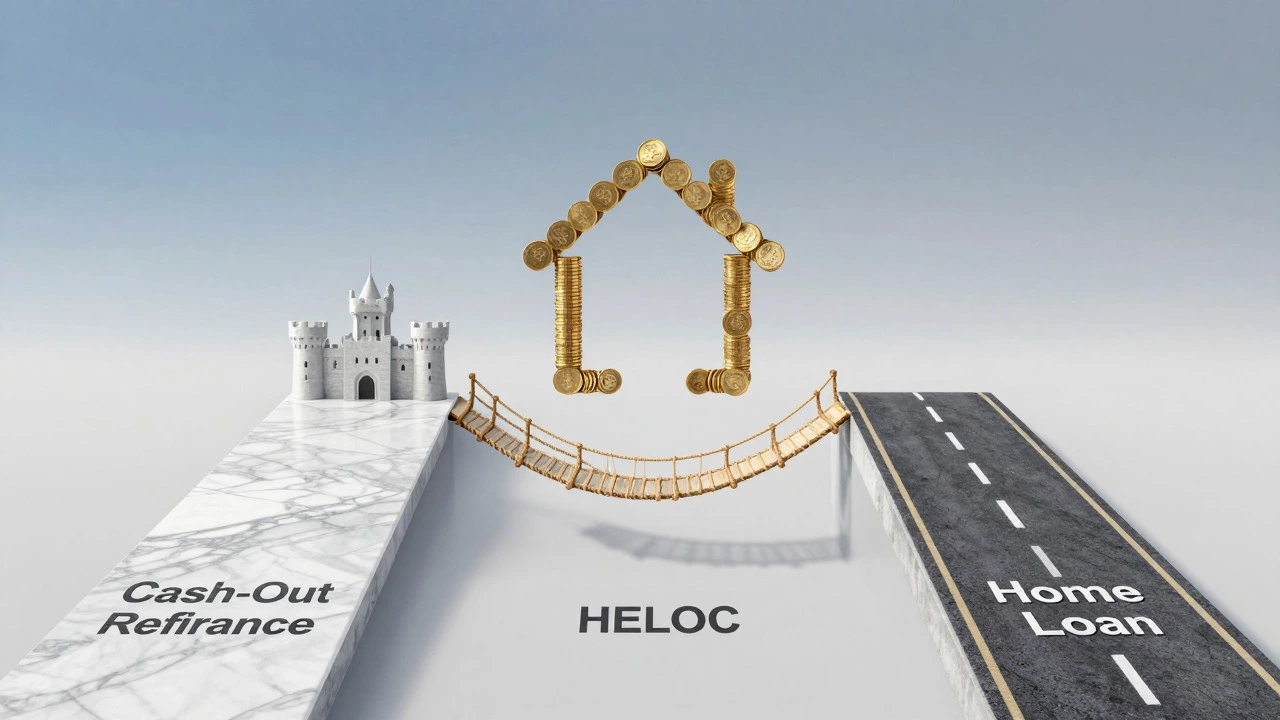
Option 3: Home Equity Loan
If you hate the unpredictability of variable rates, a Home Equity Loan gives you a lump sum with a fixed interest rate and fixed monthly payments. It’s straightforward.
Home Equity Loan is a second mortgage that provides a lump-sum payout with a fixed interest rate and set repayment schedule. It offers budgeting certainty compared to HELOCs.These loans often have moderate closing costs-higher than a HELOC but lower than a full refinance. The interest rate will be higher than your primary mortgage because it’s considered riskier for the lender (they’re second in line to get paid if you default).
When it wins: This is the cheapest option when you need a specific amount for a known expense (like debt consolidation) and want to lock in a rate. If you think rates will rise significantly, locking in a fixed rate now saves you money in the long run compared to a HELOC.
Comparing the Costs: A Real-World Scenario
Let’s look at the numbers. Imagine you owe $200,000 on your primary mortgage. Your home is worth $400,000. You need $50,000 for renovations. Here is how the costs break down in a typical 2026 market scenario:
| Feature | Cash-Out Refinance | HELOC | Home Equity Loan |
|---|---|---|---|
| Upfront Closing Costs | $6,000 - $10,000 | $0 - $500 | $1,000 - $3,000 |
| Interest Rate Type | Fixed (usually lowest) | Variable (Prime + Margin) | Fixed (Higher than mortgage) |
| Repayment Term | 15-30 Years | 5-10 Year Draw, 10-20 Year Repay | 5-20 Years |
| Best For | Long-term stays, low current rates | Flexible spending, short-term needs | Predictable budgeting, lump sums |
In this scenario, if your current mortgage rate is 7%, and new mortgage rates are 6.5%, the refinance saves you money on the entire $200,000 balance, making the high closing costs worth it. But if rates are flat or rising, the HELOC’s near-zero upfront cost makes it the winner for immediate cash flow.

Hidden Costs That Kill Savings
Don’t just look at the interest rate. Watch out for these hidden fees that can turn a "cheap" loan into an expensive one:
- Origination Fees: Some lenders charge 1% of the loan amount just to process it. On a $50,000 loan, that’s $500 gone before you see a dime.
- Annual Maintenance Fees: Common with HELOCs. Some lenders charge $50-$100 per year just to keep the account open. Over 10 years, that’s $500-$1,000 in pure waste.
- Prepayment Penalties: Rare today, but still exist. If you plan to pay off the loan early, ensure there’s no penalty.
- Inactivity Fees: Some HELOCs charge you if you don’t use the line for six months. If you’re keeping it as an emergency backup, check this fine print.
Alternatives to Consider
Sometimes, touching your home equity is too risky. If you only need a small amount (under $10,000), a personal loan might actually be cheaper once you factor in the hassle and potential appraisal costs of a home-based loan. Personal loans have higher interest rates, but zero closing costs and no risk to your house.
Another option is a 401(k) loan. If you have a traditional 401(k), you can borrow from it. Interest goes back into your own account. However, this reduces your retirement growth and can be complicated if you change jobs. Use this only if you’re confident you’ll repay it quickly.
How to Choose the Cheapest Path for You
To decide, ask yourself three questions:
- How long will I stay in this home? If less than 5 years, avoid refinancing due to closing costs. Look at HELOCs or personal loans.
- What is my current mortgage rate? If it’s significantly lower than current market rates, don’t refinance. Protect that low rate. Use a HELOC or Home Equity Loan instead.
- Do I need all the cash now? If yes, a Home Equity Loan or Refinance is better. If you might need more later, a HELOC gives you flexibility.
Finally, shop around. Get quotes from at least three lenders-a big bank, a local credit union, and an online lender. Credit unions often offer lower fees and more flexible terms for HELOCs and equity loans. Compare the Annual Percentage Rate (APR), not just the interest rate. The APR includes fees, giving you the true cost of borrowing.
Is it better to refinance or get a HELOC?
Refinancing is better if you can get a significantly lower interest rate on your entire mortgage and plan to stay in the home for many years. HELOCs are better if you want low upfront costs, flexible access to funds, or if your current mortgage rate is already very low.
Can I use home equity to consolidate debt?
Yes, this is a common strategy. Since home equity loans and HELOCs have lower interest rates than credit cards, you can save money on interest. However, you are converting unsecured debt into secured debt, meaning your home is at risk if you fail to make payments.
Does using home equity affect my credit score?
Applying for any new loan involves a hard credit inquiry, which may temporarily lower your score by a few points. Once established, responsible usage can help your score by improving your credit mix and lowering overall utilization if used to pay off other debts.
What happens if home values drop after I take out equity?
You still owe the full amount of the loan. If you fall behind on payments, the lender can foreclose. Being "underwater" (owing more than the home is worth) makes it harder to sell or refinance later, so borrow conservatively.
Are home equity loan interests tax deductible?
Under current US tax laws, interest on home equity debt is deductible only if the funds are used to buy, build, or substantially improve the home that secures the loan. Using it for debt consolidation or vacations generally does not qualify. Always consult a tax advisor.