Savings Interest & Tax Calculator
Enter Your Details
Your Annual Breakdown
Comparison Scenario
| Scenario | Annual Gross | Annual Net |
|---|---|---|
| High Street Bank (1.5%) | - | - |
| Standard Online (4.0%) | - | - |
| Best Rate (7.0%) | - | - |
You have been watching your money sit idle in a traditional high street bank account, earning barely enough to cover inflation. Then you see an advertisement promising 7% interest. It sounds too good to be true, especially when the base rate has stabilized or even dipped slightly from its peak. You are right to be skeptical. In June 2026, finding a genuine, sustainable 7% Annual Percentage Rate (APR) on a standard savings account is challenging but not impossible if you know where to look and what trade-offs you are willing to make.
The landscape of personal finance has shifted dramatically over the last few years. High interest rates became the norm during the inflationary surge, forcing banks to compete for deposits. While some rates have cooled, certain institutions-particularly digital-first challengers and specialized building societies-still offer competitive returns that hover around or exceed the 6-7% mark for specific types of savers. This guide cuts through the marketing noise to show you exactly which banks are offering these rates, how they work, and whether you should actually move your money there.
The Reality of 7% Rates in 2026
First, let’s manage expectations. A flat 7% interest rate on an unlimited, instant-access account from a major high street bank like HSBC, Barclays, or Lloyds is virtually non-existent in mid-2026. These legacy banks typically offer between 1.5% and 3% on their basic current accounts because they rely on cheap funding to lend out at higher margins. To get close to 7%, you usually need to look at two specific categories: Online-only Banks with low overheads, or specialized fixed-term or bonus-rate products.
Why do some banks pay more? It comes down to operational costs. Digital banks do not spend millions on maintaining physical branches, staffing tellers, or printing paper statements. Those savings are passed on to you in the form of higher interest. However, this also means you must be comfortable managing everything via an app. If you value face-to-face service, you will likely sacrifice yield for convenience.
Top Contenders Offering Near-7% Returns
As of June 2026, several institutions are leading the pack. While exact rates fluctuate monthly based on central bank policy, the following providers consistently offer rates in the 6.5% to 7.2% range for eligible customers.
| Provider | Account Type | Interest Rate (APR) | Key Conditions | FSCS Protected? |
|---|---|---|---|---|
| Atom Bank | Easy Access Saver | Up to 7.0% | Must receive £250+ monthly income; first £10k earns full rate | Yes |
| Paragon Bank | Saver Account | Up to 6.8% | Variable rate; no monthly limits on withdrawals | Yes |
| Shawbrook Bank | Flexi-Saver | Up to 6.9% | Rate drops if you withdraw funds frequently | Yes |
| Tide | easy accessUp to 4.0% - 6.5% | Primarily for freelancers/small businesses; tiered rates | Yes (via partner banks) | |
| Coventry Building Society | Fixed Term Bond | Up to 7.1% | Money locked for 12 months; early withdrawal penalties apply | Yes |
Note that Atom Bank and Paragon are currently the most aggressive in the retail market. Atom’s model is unique: they reward regular income deposits. If you direct your salary into their account, you earn the top rate on the first £10,000. This is a clever way for them to secure steady cash flow while giving you a premium return. Paragon, conversely, offers a straightforward variable rate that adjusts with the market but remains highly competitive without strict deposit requirements.
Easy Access vs. Fixed Term: The Trade-Off
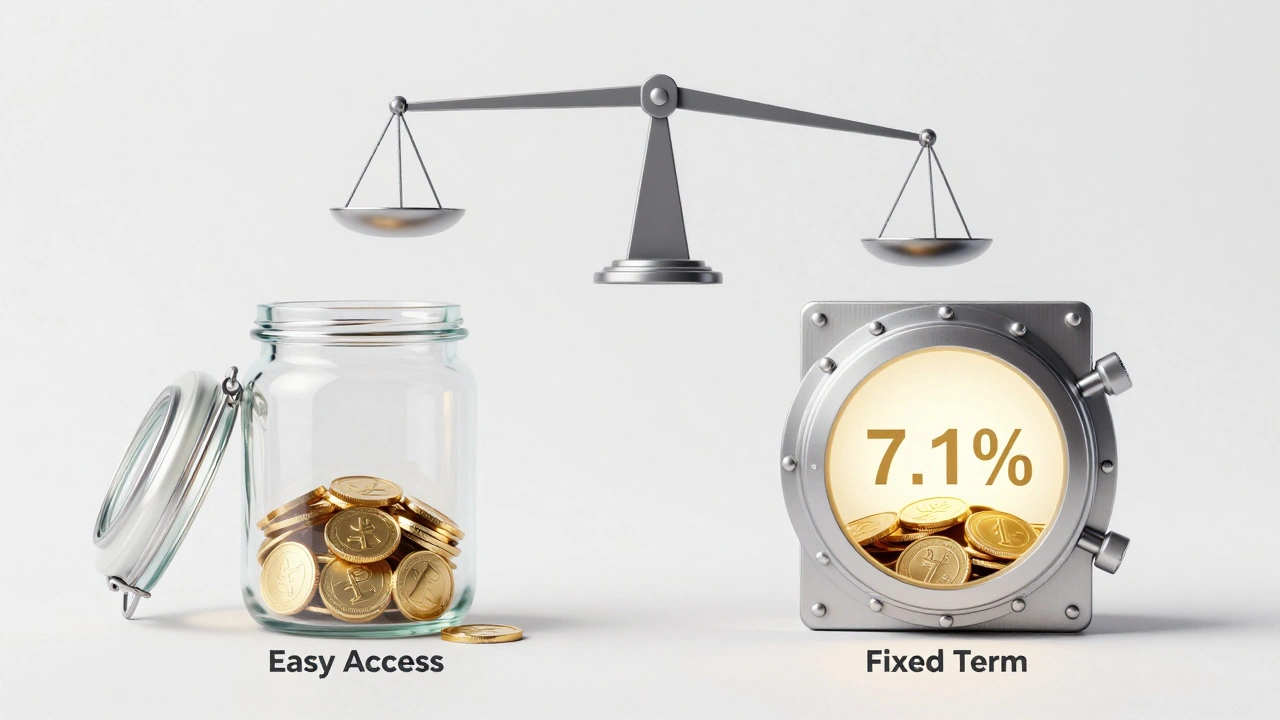
To get that 7% figure, you often have to choose between liquidity and lock-in periods. An Easy Access Account allows you to withdraw money whenever you want. This is ideal for emergency funds. However, banks charge less for this flexibility. Currently, the best easy access rates cap around 6.5% to 7.0%.
If you can afford to leave your money untouched, a Fixed Term Bond (or Notice Account) often yields slightly higher returns, sometimes pushing past 7.1%. Coventry Building Society and Leeds Building Society are frequent leaders here. The catch? If you pull your money out early, you lose all accrued interest or face a hefty penalty fee. Ask yourself: Do I really need this money in the next six months? If the answer is no, locking it in secures the rate against future drops.
Is Your Money Safe? Understanding FSCS Protection
Before moving thousands of pounds to a lesser-known online bank, safety is paramount. In the UK, the Financial Services Compensation Scheme (FSCS) protects savers up to £85,000 per person, per authorized firm. This means if Atom Bank or Paragon were to collapse tomorrow, the government would reimburse your deposit up to that limit.
However, be careful with "partner" networks. Some fintech apps do not hold your money directly; they use third-party banks. Ensure the provider clearly states who holds the funds and confirm that entity is FSCS protected. Always check the official register before transferring large sums. Never assume just because an app looks professional that it is fully regulated.
Hidden Costs and Tax Implications
A 7% headline rate is not always 7% in your pocket. First, consider taxes. In the UK, savings interest is taxable. Basic rate taxpayers (earning up to £50,270) have a Personal Savings Allowance of £1,000. This means you can earn £1,000 in interest tax-free. Higher rate taxpayers get £500. If your total interest across all accounts exceeds this allowance, HMRC will take a cut, reducing your effective yield. For example, if you earn £2,000 in interest as a basic rate taxpayer, you pay £200 in tax, bringing your net return closer to 6.3%.
Second, watch out for fees. Most high-yield savings accounts are free, but some business-focused accounts or premium services may charge monthly maintenance fees if balances drop below a certain threshold. Read the small print. A 7% rate is meaningless if you are paying £5 a month in admin fees on a small balance.
How to Maximize Your Yield: A Step-by-Step Strategy
Don’t just pick one account and forget it. Use a multi-bank strategy to optimize both safety and returns.
- Split Your Deposits: If you have more than £85,000, split it across multiple FSCS-protected banks to ensure full coverage.
- Ladder Your Bonds: Instead of locking all money into one 12-month bond, open three separate 4-month bonds. As each matures, reinvest it at the current rate. This protects you if rates rise and gives you quarterly access to cash.
- Automate Transfers: Set up standing orders to move money from your main current account to your high-yield saver automatically. This ensures you never miss a chance to earn interest and helps with budgeting.
- Review Quarterly: Rates change. What was 7% in January might be 6% by July. Check your rates every quarter and switch if a better deal emerges. Just remember to factor in any notice periods required to withdraw funds.
Common Pitfalls to Avoid
One major mistake people make is chasing the highest rate without checking the terms. Some accounts offer a "bonus" rate for the first three months, then drop significantly. Make sure the 7% is sustainable for as long as you plan to keep the money there. Another pitfall is ignoring inflation. If inflation is running at 4%, a 7% nominal return gives you only a 3% real return. While still positive, it’s crucial to understand that your purchasing power isn’t growing as fast as the headline number suggests.
Also, beware of complex investment products disguised as savings. Stocks and shares ISAs or peer-to-peer lending platforms might promise higher returns, but they carry capital risk. True savings accounts guarantee your principal. If you cannot afford to lose your initial deposit, stick to FSCS-protected savings accounts.
Can I get 7% interest on a current account?
It is extremely rare to find a standard current account paying 7% interest. Current accounts are designed for daily spending, not saving. Most high-yield options are dedicated savings accounts. Some challenger banks like Monzo or Starling offer small interest on current accounts, but these rates are typically below 2%. To get 7%, you must move your money to a separate savings product.
Are online banks safer than high street banks?
Yes, provided they are authorized by the Prudential Regulation Authority (PRA) and regulated by the Financial Conduct Authority (FCA). Online banks like Atom and Paragon are subject to the same strict regulations as HSBC or Barclays. Your money is protected by the FSCS up to £85,000. The lack of physical branches does not equate to financial instability.
What happens if interest rates fall?
If you have a variable rate account, your interest earnings will decrease as the base rate falls. If you have a fixed-term bond, your rate remains locked in for the duration of the term, protecting you from drops. This is why fixed-term products are popular when rates are expected to decline.
Do I need to pay tax on my savings interest?
Yes, but you may not owe anything immediately. Basic rate taxpayers can earn up to £1,000 in interest tax-free (Personal Savings Allowance). Higher rate taxpayers can earn £500 tax-free. Additional rate taxpayers have no allowance. If you exceed these limits, you must declare the interest on your Self Assessment tax return.
How quickly can I withdraw money from a high-yield savings account?
It depends on the account type. Easy access accounts usually allow withdrawals within 1-3 working days. Notice accounts require you to give 30-90 days' warning before withdrawing. Fixed-term bonds do not allow withdrawals until the end of the term without losing interest. Always check the specific withdrawal timescales before choosing an account.