
$5,000 Personal Loan Payment Calculator
Loan Details
Monthly Payment
$0.00
Total Interest Paid
$0.00
Comparison by Term Length
| Term | Monthly Pmt | Total Interest |
|---|
Imagine you need $5,000 to cover an unexpected car repair or consolidate high-interest credit card debt. You apply for a loan, get approved, and the money hits your account. But then comes the question that keeps many borrowers up at night: "How much do I actually have to pay back each month?" It’s not just about the principal; it’s about interest rates, loan terms, and hidden fees. If you’re in the US market (given the dollar sign), understanding these variables is crucial before signing on the dotted line.
The Math Behind Your Monthly Bill
Your monthly payment isn’t random. It’s calculated using a standard amortization formula that lenders use worldwide. This formula balances two things: paying down the principal (the original $5,000) and covering the cost of borrowing (interest). The shorter your loan term, the higher your monthly payment will be, but you’ll pay less interest overall. Conversely, stretching the loan over five years lowers your monthly bill but increases the total cost significantly.
Let’s look at real-world scenarios based on current average rates in October 2026. Assume a fixed-rate personal loan with no origination fees for simplicity first:
| APR (Interest Rate) | 12-Month Term | 24-Month Term | 36-Month Term | Total Interest Paid (36 Months) |
|---|---|---|---|---|
| 6% (Excellent Credit) | $430.33 | $221.60 | $152.11 | $475.96 |
| 10% (Good Credit) | $442.48 | $230.72 | $161.57 | $816.52 |
| 15% (Fair Credit) | $454.63 | $240.10 | $171.47 | $1,172.92 |
| 20% (Poor Credit) | $466.99 | $249.70 | $181.61 | $1,537.96 |
Notice how the difference between a 6% APR and a 20% APR on a three-year loan adds over $1,000 to your total cost. That’s why checking your credit score before applying matters so much. A single point increase in your credit score can sometimes drop your rate by half a percentage point, saving you hundreds of dollars.
Why Origination Fees Change Everything
Most online lenders charge an origination fee an upfront percentage deducted from the loan amount before funds are disbursed. This is often overlooked in basic calculators. If a lender offers a 10% APR but charges a 5% origination fee, you don’t receive the full $5,000. Instead, they deduct $250, and you receive $4,750. However, you still owe interest on the full $5,000.
This effectively raises your Annual Percentage Rate (APR) the true cost of borrowing including fees. In our example, that 10% nominal rate might feel like 11-12% once you factor in the fee. Always ask: "Is this fee deducted from my payout or added to my balance?" If it’s added to the balance, your principal becomes $5,250, increasing every subsequent payment.
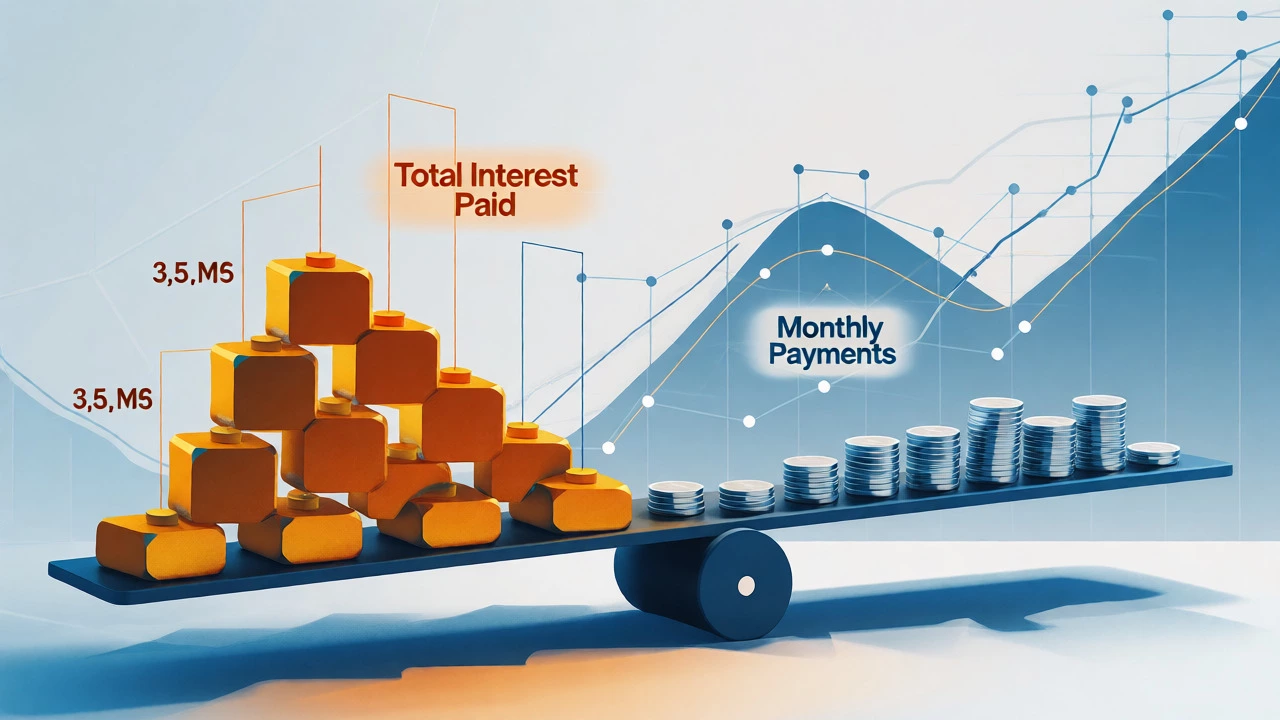
Loan Terms: Short vs. Long
Choosing the right term length is a balancing act between cash flow and total cost. Here is how different terms impact your financial health:
- Short-term (12-24 months): Best if you have stable income and want to be debt-free quickly. High monthly payments ($220-$440) require strict budgeting, but you save massive amounts on interest.
- Medium-term (36-48 months): The sweet spot for most borrowers. Payments become manageable ($150-$180 range), allowing room for emergencies while keeping interest costs reasonable.
- Long-term (60+ months): Rarely offered for small loans like $5,000 because the administrative cost doesn’t justify the risk for lenders. If available, expect lower payments but significantly higher total interest paid.
Pro tip: Use the "debt-to-income" rule. Lenders typically prefer your total monthly debt payments (including rent/mortgage) to stay below 36-43% of your gross monthly income. If a $5,000 loan pushes you past this threshold, consider a longer term or a smaller loan amount.
Credit Score Impact on Rates
Your FICO score a numerical expression based on a level analysis of a person's credit files dictates your eligibility and pricing. In 2026, lenders use more sophisticated models, but the core tiers remain similar:
| Credit Tier | Score Range | Typical APR | Approval Odds |
|---|---|---|---|
| Exceptional | 780+ | 5.99% - 8.5% | Very High |
| Good | 700 - 779 | 8.5% - 12.5% | High |
| Fair | 650 - 699 | 12.5% - 18.0% | Moderate |
| Poor | Below 650 | 18.0% - 36.0% | Low / Secured Only |
If you fall into the "Fair" category, consider adding a co-signer with excellent credit. This can slash your rate by 5-8%, turning a $171 payment into a $152 payment. Just remember: if you miss a payment, their credit suffers too.
Alternatives to Traditional Personal Loans
Before committing to a fixed installment loan, weigh these options depending on your situation:
- Credit Card Balance Transfer: If you have good credit, look for cards offering 0% APR for 12-18 months. You’ll pay a 3-5% transfer fee, but zero interest if paid off within the promo period. For $5,000, this could mean paying only $150-$250 in fees versus $800+ in interest.
- Home Equity Line of Credit (HELOC): If you own a home, borrowing against equity often yields lower rates (7-9%). However, your house is collateral. Defaulting puts your home at risk.
- Buy Now, Pay Later (BNPL): Good for specific purchases under $1,000, but rarely suitable for a lump sum $5,000 need due to fragmented payments and potential late fees.
How to Lower Your Payment
You can’t always control the interest rate, but you can control the structure. Refinancing is one option. If your credit improves six months after taking the loan, you might qualify for a lower rate. Another strategy is making bi-weekly payments instead of monthly ones. By paying half your monthly amount every two weeks, you make 26 half-payments per year (equivalent to 13 monthly payments). This shaves months off your loan term and saves interest without straining your monthly budget.
Can I pay off a $5,000 personal loan early?
Yes, most reputable lenders allow prepayment without penalties. Check your agreement for "prepayment penalty" clauses. Paying early reduces the principal faster, meaning less interest accrues over time. Even adding $20 extra to your monthly payment can cut months off your loan term.
Does a personal loan affect my credit score?
Applying triggers a hard inquiry, which may temporarily drop your score by 5-10 points. Once approved, the new account lowers your average account age. However, consistent on-time payments improve your payment history, which accounts for 35% of your FICO score, eventually boosting it.
What happens if I miss a payment?
Late fees usually range from $15 to $40. More importantly, missing a payment by 30+ days gets reported to credit bureaus, hurting your score. Some lenders also trigger a default clause, demanding immediate repayment of the entire balance.
Are online lenders safer than banks?
Generally, yes, provided they are FDIC-insured partners or registered with state regulators. Online lenders like SoFi or LightStream offer transparency and speed. Always verify the lender’s physical address and check reviews on the Better Business Bureau before sending sensitive data.
Do I need collateral for a $5,000 loan?
No, most $5,000 personal loans are unsecured, meaning no assets are pledged. If you have poor credit, a secured loan (using a car title or savings account as collateral) might be required, but this carries the risk of losing the asset if you default.