
Credit Card Cost & Rewards Calculator
Your Financial Profile
Card Details
Annual Breakdown
| Interest Cost (Est.) | $0.00 |
| Annual Fee | $0.00 |
| Rewards Earned | +$0.00 |
| Net Annual Value | $0.00 |
Walking into a bank branch or scrolling through endless offers online can feel like trying to pick a needle from a haystack. You see flashy promises of "unlimited points," "zero percent interest," and "travel perks," but none of that matters if the card doesn't fit your actual spending habits. Comparing credit cards isn't just about finding the lowest number; it's about matching the card's mechanics to your financial behavior.
If you carry a balance every month, a high-reward travel card is a trap. If you pay in full, an annual fee might be worth every penny. The right comparison process saves you money immediately and builds your credit score over time. Here is how you cut through the marketing noise and find the card that actually works for you.
The Quick Summary
- Prioritize APR vs. Rewards: If you carry a balance, look for low interest rates. If you pay in full, chase rewards.
- Read the Fee Structure: Annual fees, late fees, and foreign transaction costs can erase benefits quickly.
- Match Spending Categories: Look for cards that boost cash back or points in categories where you spend the most (e.g., groceries, fuel).
- Check Introductory Offers: Balance transfer and 0% APR periods are powerful tools for short-term debt management.
- Verify Eligibility: Ensure your credit profile matches the card's requirements to avoid hard inquiries that hurt your score.
Step 1: Define Your Primary Goal
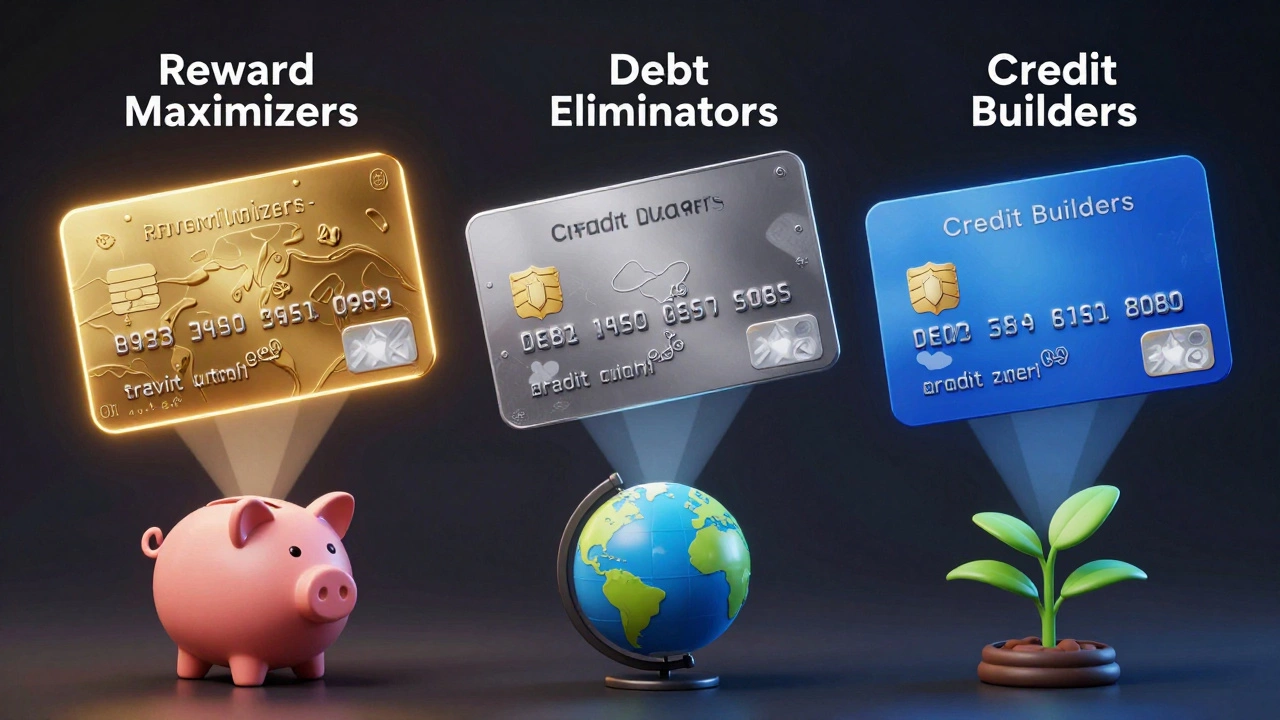
Before you look at a single percentage point, ask yourself what problem this card needs to solve. Most people fall into one of three buckets. Knowing which one you are narrows down thousands of options to a manageable list.
The Debt Eliminator: You have existing credit card debt and want to stop paying interest. For you, the Balance Transfer feature is king. You need a card with a long introductory period of 0% APR on transfers, ideally 15 to 21 months. The length of this period matters more than the transfer fee. A 3% fee is standard, but if it gives you 18 months of interest-free breathing room, it’s often cheaper than paying 20%+ interest for two years.
The Reward Maximizer: You pay your bill in full every month. Interest rates don't matter because you never accrue them. Instead, you want maximum return on spend. This could mean Cash Back cards that give you 1-5% back on purchases, or Travel Points cards that offer multipliers on flights and hotels. Your goal here is yield optimization.
The Credit Builder: You are new to credit or repairing a damaged score. You need a secured card or a student card with lenient approval criteria. Features like automatic credit line increases and no annual fee are critical here. You aren't looking for perks; you're looking for a tool to build history.
Step 2: Decode the APR (Annual Percentage Rate)
APR is the cost of borrowing money. It varies wildly between cards and even within the same card based on what you are doing. When comparing, break the APR down into these specific components:
- Purchase APR: The rate charged on everyday buys if you don't pay the full statement balance. In 2026, average purchase APRs hover around 22-24%. If you carry a balance, a difference of 2% can save you hundreds annually.
- Balance Transfer APR: Usually 0% for a promotional period, then reverts to the purchase APR. Check the fine print: does the 0% apply only to transfers, or also to new purchases? Some cards exclude new purchases from the promo rate.
- Cash Advance APR: The rate for withdrawing cash. This is almost always higher than purchase APR and starts accruing interest immediately-no grace period. Avoid using credit cards for cash unless it's an emergency.
- Penalty APR: Triggered by late payments. This can spike to 29.99% or higher. Understand the threshold for triggering this penalty so you can avoid it.
Variable APRs change with the Prime Rate. If the central bank raises rates, your card's APR goes up too. Fixed-rate cards are rare but exist; they offer stability but often come with lower limits.
Step 3: Analyze Fees Beyond the Annual Charge
Many consumers focus solely on the annual fee, ignoring other charges that bleed value. A card with a $95 annual fee might be cheaper than a "free" card if the free card has high foreign transaction fees or late payment penalties that you frequently incur.
| Fee Type | Typical Range (2026) | Who Should Care? |
|---|---|---|
| Annual Fee | $0 - $695+ | Reward maximizers should weigh this against potential earnings. |
| Foreign Transaction Fee | 0% - 3% | Travelers and online shoppers buying from international sites. |
| Late Payment Fee | $25 - $40 | Everyone. One missed payment hurts your score and costs cash. |
| Balance Transfer Fee | 3% - 5% | Debt eliminators moving balances to lower-rate cards. |
| Cash Advance Fee | 3% - 5% (min $10) | Emergency users. High cost makes this a last resort. |
If you travel abroad, a card with a 3% foreign transaction fee will cost you $30 on every $1,000 spent. No amount of hotel points offsets that unless you stay at luxury properties. Look for cards explicitly labeled "No Foreign Transaction Fees."
Step 4: Evaluate Reward Structures
Rewards are not created equal. A point is not a dollar until you redeem it. When comparing reward cards, calculate the effective return rate based on your spending habits.
Cash Back: The simplest structure. You earn a percentage of your spend back as cash. Flat-rate cards offer 1-2% on everything. Category-specific cards might offer 5% on groceries but only 1% elsewhere. Do the math: if you spend $500 on groceries and $1,500 on other things, a 5%/1% card earns you $25 + $15 = $40. A flat 2% card earns you $40. They tie. But if you spend more on general goods, the flat rate wins.
Points and Miles: These require more effort. Points often lose value when redeemed for statement credits or gift cards. To get the best value (often 1.5 to 2 cents per point), you usually need to book travel through the card issuer's portal. Compare the redemption flexibility. Can you transfer points to airline partners? If yes, the value can jump significantly. If no, the value is capped.
Sign-Up Bonuses: These are lucrative but come with strings attached. You typically need to spend a certain amount (e.g., $3,000) within three months. Only chase these if you would naturally make those purchases. Don't overspend just to hit a threshold; the interest charges will outweigh the bonus.
Step 5: Check Perks and Protections
Some cards offer insurance and services that add tangible value. These are often overlooked but can save you thousands in unexpected events.
- Travel Insurance: Trip cancellation, interruption, and delay coverage. If you book expensive trips, this alone can justify an annual fee.
- Purchase Protection: Covers theft or damage to items bought with the card for a limited time (usually 90-120 days).
- Extended Warranty: Adds one year to the manufacturer's warranty on eligible purchases.
- Cell Phone Protection: Some premium cards cover accidental damage or theft of your phone if you pay the monthly bill with the card.
- Concierge Services: Access to help booking restaurants, events, or travel. Useful for busy professionals who value time over money.
If you rarely travel and buy durable goods infrequently, these perks are dead weight. Focus on cards that enhance your daily life, not hypothetical scenarios.
Step 6: Assess Credit Score Impact
Applying for a credit card triggers a hard inquiry, which can drop your score by 5-10 points temporarily. More importantly, adding a new card affects your Credit Utilization Ratio.
Credit utilization is the amount of credit you use compared to your total limit. Lower is better. Ideally, keep it below 30%, and even lower (under 10%) for optimal scoring. Adding a new card increases your total available credit, which can lower your utilization ratio and boost your score-if you don't max out the new card.
However, applying for multiple cards in a short period signals risk to lenders. Space out applications. Use pre-qualification tools offered by banks. These use soft inquiries and tell you if you’re likely to be approved without hurting your score.
Step 7: Read the Fine Print on Terms Changes
Card issuers can change terms, including APR and fees, with 45 days' notice. While they cannot change terms retroactively on existing balances, they can affect future purchases. Look for cards with a history of stable terms. Customer reviews often highlight issuers known for frequent changes or poor customer service.
Also, check the dispute resolution process. If you have a billing error or unauthorized charge, how easy is it to resolve? Some issuers have robust digital tools for disputing charges; others require phone calls and paperwork. Convenience matters when problems arise.
Practical Comparison Checklist
Use this checklist when evaluating any two cards side-by-side:
- Does the card match my primary goal? (Debt payoff, rewards, or credit building)
- Is the APR competitive? (For my usage pattern)
- Are there hidden fees? (Foreign transactions, late fees, balance transfer fees)
- Do I qualify? (Based on income and credit history)
- What is the net value? (Rewards minus fees and potential interest costs)
- Is the app/user experience good? (Ease of managing payments and tracking rewards)
FAQ
Should I choose a card with a high annual fee if it offers great rewards?
Only if your spending habits guarantee that the rewards value exceeds the fee. For example, if a card costs $95 annually but you earn $150 in cash back and travel credits, it’s a net gain. Calculate your expected annual spend and multiply it by the reward rate. If the result is less than the annual fee, choose a no-fee card instead.
How long does a balance transfer take to post?
Typically, a balance transfer takes 5 to 7 business days to process. During this time, continue making minimum payments on your old card to avoid late fees. Once the transfer posts, confirm the amount with both issuers to ensure accuracy.
Can I use a balance transfer card for new purchases during the 0% period?
Yes, but be cautious. Many cards apply payments to the lowest-interest balance first (the transferred balance), meaning new purchases accrue interest immediately. If you miss a payment, you may lose the 0% promotional rate entirely. Treat the card as a tool for transferring existing debt, not for new spending.
What is the best credit card for someone with bad credit?
Secured credit cards are the best option. You provide a cash deposit (e.g., $200) which becomes your credit limit. This reduces risk for the issuer and helps you rebuild credit. Look for secured cards that report to all three major bureaus and offer a path to upgrading to an unsecured card after 6-12 months of on-time payments.
Does closing an old credit card hurt my credit score?
It can. Closing a card reduces your total available credit, which increases your credit utilization ratio. It also shortens your average account age. Keep old cards open and active, even if you only use them once a year for a small purchase. If you must close a card due to fees, do so only after opening a new card to offset the credit limit loss.