
Annuity Payment Calculator
Annuity Payment Estimator
Estimate your monthly income from a $300,000 annuity based on your age, gender, and payment structure. Results are based on current 2026 annuity rates.
Estimated Monthly Payout
Based on current 2026 rates
If you’re wondering how much a $300,000 annuity will pay you each month, the answer isn’t simple. It depends on your age, gender, when you start payments, interest rates, and whether you want payments to last your whole life-or just a set number of years. There’s no one-size-fits-all number, but by the end of this, you’ll know exactly what to expect and how to get the best deal.
What You Can Expect Right Now (Early 2026)
As of January 2026, interest rates in the U.S. and Europe are holding steady after peaking in late 2023. That means annuity payouts are higher than they’ve been in over a decade. For a 65-year-old retiring today, a $300,000 single-life immediate annuity typically pays between $1,800 and $2,100 per month for life. If you’re 70, that jumps to $2,000-$2,350. At 75, you could see $2,300-$2,700 monthly.
Why does age matter? Because annuity companies use life expectancy to calculate payments. The older you are when you buy, the shorter your expected payout period, so each payment is larger. A 65-year-old woman might get slightly less than a man of the same age-because women live longer on average. That’s just how the math works.
How Annuities Actually Work
An annuity is a contract between you and an insurance company. You give them a lump sum-like $300,000-and in return, they promise to pay you regular income. It’s not an investment that grows. It’s a guaranteed paycheck, backed by the insurer’s financial strength.
There are two main types: immediate and deferred. If you’re retiring now and want payments to start next month, you want an immediate annuity. If you’re still working and plan to start payments in five or ten years, you’d choose a deferred annuity. Most people asking about $300,000 annuities are looking at immediate ones.
Some annuities pay you until you die. Others pay for a fixed time-say, 10 or 20 years-no matter what. If you die early, your heirs might get the rest. That’s called a period certain option. But it lowers your monthly payment because the insurer has to cover the possibility of paying out longer.
Key Factors That Change Your Monthly Payment
- Age at purchase: The older you are, the higher the payout. A 70-year-old gets about 15-20% more per month than a 65-year-old with the same $300,000.
- Gender: Women typically get lower monthly payments than men due to longer life expectancy. In 2026, the difference is around 5-8%.
- Payment structure: A lifetime-only payout gives you the highest monthly amount. Add a 10-year guarantee? That drops your payment by 10-15%. Add a cost-of-living adjustment (COLA)? It can cut your payment by 20-30%.
- Interest rates: Higher rates mean higher payouts. In 2024, rates were near 5%, and annuity payments rose sharply. In 2026, they’re still near 4.75-5.25% for top-rated insurers, keeping payouts strong.
- Insurance company: Not all insurers offer the same rates. A small, well-rated company might pay 5-10% more than a big national brand.
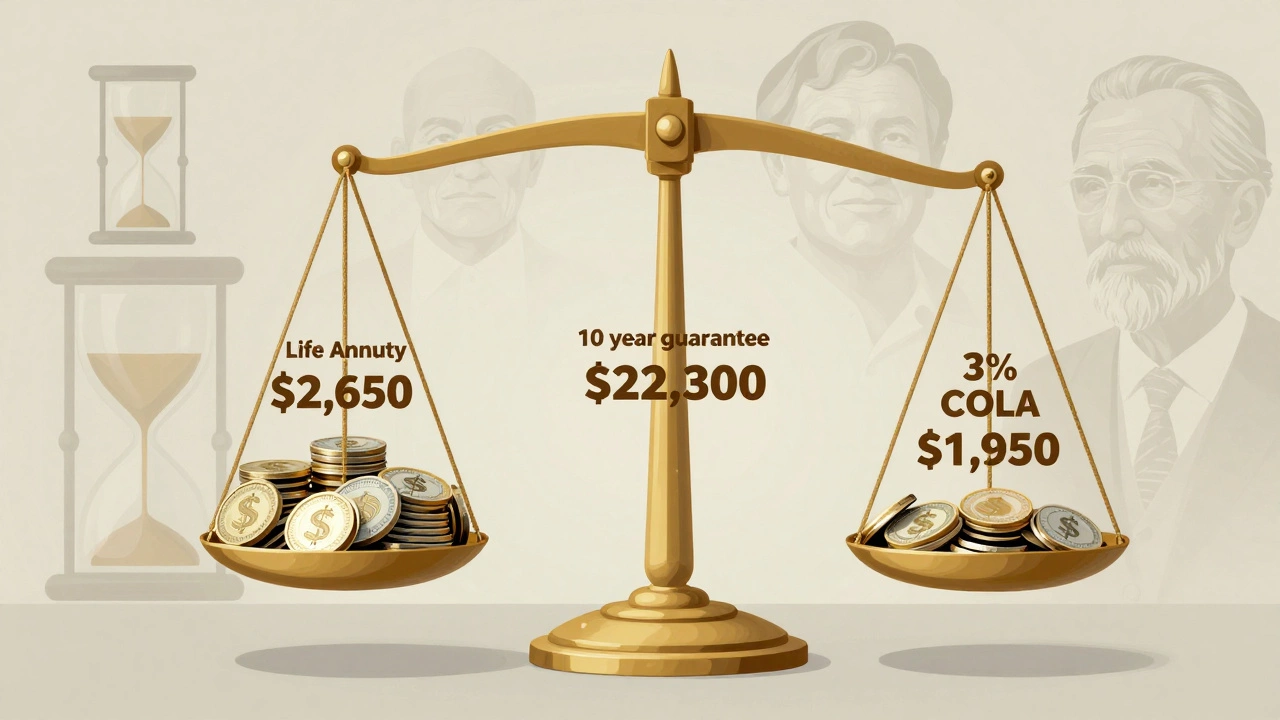
Real Examples: What 0,000 Buys in 2026
Here’s what actual quotes look like from top-rated insurers in early 2026:
| Age | Gender | Lifetime Only | Lifetime + 10-Year Guarantee | Lifetime + 3% COLA |
|---|---|---|---|---|
| 65 | Male | $2,050 | $1,850 | $1,550 |
| 65 | Female | $1,950 | $1,770 | $1,480 |
| 70 | Male | $2,300 | $2,080 | $1,720 |
| 70 | Female | $2,200 | $1,980 | $1,640 |
| 75 | Male | $2,650 | $2,380 | $1,950 |
| 75 | Female | $2,550 | $2,290 | $1,860 |
Notice how the 3% COLA option reduces your starting payment by nearly 25%. But over time, it catches up. After 15 years, someone with a 3% COLA will be getting more than someone with a flat payment. That’s the trade-off: lower today for more tomorrow.
What’s the Best Option for Most People?
Most retirees don’t need inflation protection right away. If you have other sources of inflation-adjusted income-like Social Security or a pension-you’re better off taking the highest possible flat payment. That way, you can cover your basic needs first.
If you’re worried about outliving your money, go with lifetime only. Don’t add a 10-year guarantee unless you have a spouse or dependent who’d need payments after your death. And avoid COLA unless you’re under 70 and expect to live past 85. It’s expensive.
Also, don’t buy from just one company. Get quotes from at least three. Companies like Prudential, New York Life, and Pacific Life are top-rated. But smaller insurers like Midland National or Fortis often pay more. Check their financial strength ratings from A.M. Best or Standard & Poor’s. You want at least an A- rating.
What Happens If the Insurance Company Fails?
This is a common fear. But annuities are protected in most countries. In the U.S., each state has a guaranty association that covers up to $250,000 in annuity value per insurer. In Ireland, the Insurance Compensation Fund covers up to €100,000 per person per insurer.
That means if you’re in the U.S. and buy a $300,000 annuity from one company, $250,000 is protected. The remaining $50,000 isn’t. To be safe, split large annuities across two insurers. Buy a $150,000 annuity from one company and another $150,000 from a different one. That way, your full amount is covered.

Alternatives to Annuities
Annuities aren’t the only way to turn $300,000 into steady income. Other options include:
- Dividend stocks: A portfolio of high-yield dividend stocks might pay 4-5% annually, or $1,000-$1,250/month. But the payments aren’t guaranteed. Stock prices can drop.
- Bonds or bond funds: A 5-year Treasury bond pays about 4.2% now. You’d get $1,050/month, but you’d need to reinvest principal as bonds mature.
- Withdrawal strategy: The 4% rule says you can withdraw $12,000/year ($1,000/month) from $300,000 without running out. But if markets crash early in retirement, you risk depleting your savings faster.
Annuities beat all of these when your goal is guaranteed income for life. They remove the risk of running out of money. That’s why they’re still the most popular choice for retirees who want peace of mind.
How to Get Your Exact Quote
To find your exact number, use an annuity calculator from a trusted source like ImmediateAnnuities.com or Annuity.org. Input your age, gender, state, and desired features. Then call three insurers directly. Ask for a quote on a single premium immediate annuity with lifetime payments.
Don’t be rushed. Annuity salespeople want you to decide fast. Take your time. Compare at least three quotes. And never sign anything without reading the contract. Look for: payout amount, payment start date, death benefit terms, and surrender charges (there shouldn’t be any for immediate annuities).
Final Thoughts
A $300,000 annuity can turn your savings into a reliable paycheck. For most retirees, that’s worth more than the potential growth of stocks or bonds. It’s not about making more money-it’s about knowing you’ll never run out.
If you’re 65-75, expect $1,800-$2,700 per month. If you’re younger, the payout will be lower. If you’re older, it’ll be higher. And if you’re married, consider a joint annuity-it pays less each month but keeps paying your spouse after you’re gone.
The key is to match the annuity to your needs. Not your fears. Not your neighbor’s plan. Your actual retirement goals. Once you do that, you’ll know exactly what your $300,000 can do for you.
Can I cash out a $300,000 annuity later if I need the money?
No, you can’t cash out a standard immediate annuity. Once you buy it, the money is locked in. That’s the trade-off for guaranteed lifetime income. If you need flexibility, consider a deferred annuity or a different retirement strategy.
Are annuity payments taxed?
Yes. If the $300,000 came from a tax-deferred account like a 401(k) or IRA, the entire payment is taxable as ordinary income. If you used after-tax money, only part of each payment is taxed-the earnings portion. The rest is a return of your original investment, which is tax-free.
How long will $300,000 last if I don’t buy an annuity?
It depends on your withdrawal rate and investment returns. Using the 4% rule, $300,000 would last about 25 years if you withdraw $12,000/year. But if you withdraw more, or if markets drop early, you could run out in 15-20 years. An annuity eliminates this uncertainty.
Is a $300,000 annuity enough for retirement?
It depends on your expenses. If you need $3,000/month to live on, $2,000 from an annuity isn’t enough. But if you have Social Security, a pension, or rental income, it can cover housing, food, and healthcare. Many retirees combine annuities with other income sources to build a full budget.
Can I buy an annuity with $300,000 if I’m under 65?
Yes, but your monthly payments will be much lower. At age 60, a $300,000 immediate annuity pays only $1,400-$1,600/month. That’s because the insurer expects to pay you for 25+ years. Most people wait until 65 or older to buy.