
Retirement Income Calculator for Ireland
How much do you need to retire with €100,000 income?
This calculator helps you determine how much you need to save for a comfortable retirement in Ireland, accounting for state pension, taxes, and inflation.
Your Retirement Savings Target
Note: This calculator uses a 3.5% withdrawal rate which is safer for Ireland's current economic conditions. Your actual needs may vary based on investment returns, taxes, and inflation rates.
How much money do you actually need in the bank to live on $100,000 a year after you stop working? It’s not as simple as multiplying that number by 25 or 30. Real life doesn’t follow rules from old financial textbooks. Inflation, taxes, healthcare, and how long you live all change the game. If you’re planning to retire in Ireland with a $100,000 annual income, you need to think beyond the 4% rule - because that rule was made for a different time, a different economy, and a different cost of living.
What $100,000 a year really buys in retirement
Let’s start with what $100,000 looks like in today’s Ireland. That’s not luxury. It’s comfort. It covers a decent home in a suburb of Dublin, private health insurance, two vacations a year, a reliable car, groceries without worrying, and maybe a small travel fund for Europe. But it doesn’t cover a second home in the south of France or a private jet. It’s the kind of income that lets you live without stress - but you still have to pay for everything yourself.
Here’s what a typical $100,000-a-year retiree in Ireland spends:
- Housing: €18,000-€25,000 (mortgage paid off or rent in Dublin)
- Healthcare: €4,000-€7,000 (private insurance, dental, prescriptions)
- Food & groceries: €8,000-€10,000
- Transport: €3,000-€5,000 (car payments, fuel, maintenance)
- Travel: €5,000-€10,000 (one international trip, one EU trip)
- Utilities, phone, internet: €4,000
- Entertainment, hobbies, dining out: €6,000-€8,000
- Home maintenance: €3,000-€5,000
- Emergency fund / unexpected costs: €3,000
That’s €54,000-€77,000 in fixed spending. The rest? That’s your buffer - for inflation, medical surprises, or helping family. So $100,000 isn’t a luxury. It’s a baseline for stability.
The real number: How much you need to save
You’ve probably heard the 4% rule: withdraw 4% of your savings each year, and it’ll last 30 years. That would mean you need $2.5 million to pull out $100,000 annually. But here’s the problem: that rule was based on U.S. market returns from 1926 to 1976. Ireland doesn’t have the same stock market, the same tax system, or the same inflation history.
In Ireland, the average annual return on a balanced portfolio (60% stocks, 40% bonds) over the last 20 years has been about 5.2%. But inflation? It’s been 2.8% on average - and it’s been higher lately. In 2023, it hit 7.5%. In 2024, it was still 4.1%. That means your money loses value faster than it used to.
So instead of 4%, a safer withdrawal rate for Ireland right now is 3.5%. That means you need:
$100,000 ÷ 0.035 = $2,857,143
You need just under €2.86 million to safely withdraw $100,000 a year, assuming no other income and no changes in your lifestyle. That’s not a typo. That’s the number.
But wait - what about your state pension?
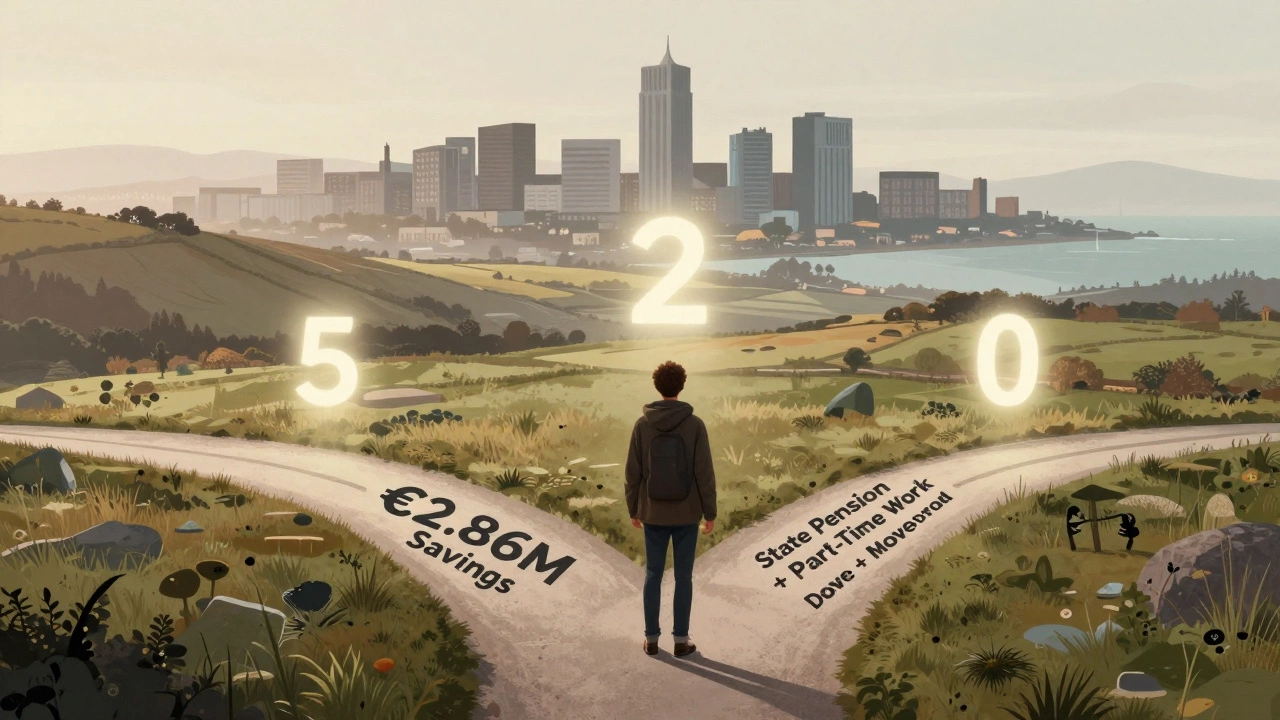
Here’s where most people get tripped up. The Irish state pension (Contributory) pays €277.30 per week in 2026. That’s €14,419 a year. If you’ve paid enough PRSI contributions, you’ll get this. It’s not much, but it’s free money. That means you don’t need to pull $100,000 from your savings - you only need $85,581 from your savings.
Now recalculate:
$85,581 ÷ 0.035 = $2,445,171
So if you get the full state pension, you need about €2.45 million saved. That’s still a huge number - but it’s 400,000 euros less than the original.
What if you don’t get the full pension?
If you’re self-employed, worked part-time, or had gaps in your PRSI record, you might get less. The minimum state pension is €130.20/week - that’s €6,770 a year. If that’s your only government income, you’d need:
$93,230 ÷ 0.035 = $2,663,714
So your savings target jumps again. This is why checking your PRSI record early matters. You can do this online at mywelfare.ie. Don’t wait until you’re 60.
Other income sources can lower your savings goal
You don’t have to rely only on savings. Rental income, part-time work, or a small business can cut your withdrawal needs. Let’s say you rent out a room in your Dublin home. That brings in €12,000 a year. Now you only need $73,581 from your savings.
$73,581 ÷ 0.035 = $2,102,314
That’s €2.1 million - still a lot, but suddenly more doable. Or maybe you plan to work part-time as a consultant after 65. Even €10,000 a year from that cuts your savings target by €285,000.
These aren’t pipe dreams. In Ireland, 37% of retirees over 65 still work part-time, according to the Central Statistics Office. That’s not because they can’t afford to stop - it’s because they want to stay active. And financially, it helps.
Taxes change everything
You’re not going to get $100,000 after tax. In Ireland, the top marginal tax rate is 40% on income over €70,000. But you also pay USC (Universal Social Charge) and PRSI. For someone withdrawing $100,000 from savings:
- State pension: tax-free
- Private pension withdrawals: taxed as income
- Investment income: taxed at 20% for dividends, 33% for capital gains
If you’re withdrawing from a pension fund, you’ll pay income tax, USC, and PRSI on every euro you take out. That means to net $100,000, you might need to withdraw $125,000-$135,000. That pushes your required savings up again.
Here’s a simple way to estimate: assume you’ll pay 25% in taxes on withdrawals. So to net $100,000, you need to withdraw $133,333. Now recalculate:
$133,333 ÷ 0.035 = $3,809,514
That’s nearly €3.8 million. Suddenly, the number feels impossible. But here’s the fix: structure your withdrawals smartly. Use tax-free allowances. Delay pensions. Use savings accounts first. Put capital gains in lower-income years. Work with a financial planner who knows Irish tax law. It’s not about how much you have - it’s about how you take it out.
The biggest risk: living too long
If you retire at 65 and live to 90, your money has to last 25 years. If you live to 95? That’s 30 years. If you live to 100? That’s 35 years. That’s why most planners use 30 years as a standard. But with life expectancy rising - especially in Ireland, where people are living longer and healthier - you should plan for 35 years.
That changes the math again. A 3% withdrawal rate is safer for a 35-year retirement:
$100,000 ÷ 0.03 = $3,333,333
So if you’re healthy, active, and have no major medical issues, plan for €3.3 million. If you have chronic conditions, plan for more - because healthcare costs rise with age.
What if you can’t save that much?
Most people can’t. That’s okay. You don’t need to hit $2.5 million to retire comfortably. You need to design a retirement that matches your savings. Maybe you downsize to a smaller home in Galway. Maybe you move to Portugal for 6 months a year. Maybe you work part-time. Maybe you live on $70,000 instead of $100,000.
Here’s the truth: retirement isn’t about a number. It’s about freedom. You can have freedom on $70,000 if you’ve paid off your house and don’t need to travel every year. You can have freedom on $50,000 if you’re happy with local walks, home-cooked meals, and quiet weekends.
But if you want $100,000 a year - and you want it without compromise - then yes, you need close to €3 million. And if you’re starting late? Start now. Even €500 a month invested at 6% return for 20 years becomes €230,000. That’s not enough for $100,000 a year - but it’s a start. And every euro you save now reduces the gap.
What you can do today
- Check your PRSI record at mywelfare.ie - know what state pension you’ll get
- Use the Revenue Pension Calculator to see how much your pension fund will be worth
- Set up automatic transfers to a separate retirement fund - even €200 a month
- Reduce debt. A mortgage-free home cuts your annual expenses by €15,000+
- Meet with a fee-only financial planner in Ireland - ask them how to structure withdrawals to minimize tax
There’s no magic number. But there is a path. It starts with knowing your costs, your income sources, and your taxes. Not with guessing. Not with hope. With numbers you can see.