
Crypto Holding Period Calculator
Enter your investment details to see results.
There’s no one-size-fits-all answer to how long you should keep your money in crypto. But if you’re asking this question, you’re already thinking like a smart investor. Most people jump into Bitcoin or Ethereum because they heard about someone making a quick profit. Then they panic-sell when the price dips. Or worse-they hold too long without a plan and watch their gains vanish. The truth? Timing the market doesn’t work. But holding strategy does.
There’s no magic number-just patterns
Some advisors say hold crypto for 5 years. Others say 10. A few even argue you should never sell. But those are guesses. Real data tells a different story. According to Chainalysis, over 70% of Bitcoin holders who bought between 2017 and 2020 still held their coins in 2024. And those who held for at least three years saw positive returns 92% of the time. That’s not luck. That’s math.
Short-term swings are noise. Bitcoin dropped 65% in 2018, then rose 300% in 2020. Ethereum fell 80% in 2022, then doubled in 2023. If you sold during those dips, you locked in losses. If you held, you rode the wave. The pattern isn’t about predicting the next spike. It’s about surviving the valleys.
Why short-term crypto trading rarely works
Trading crypto like stocks? It’s a trap. Most retail traders lose money. Why? Because crypto moves faster than any traditional market. A single tweet from Elon Musk can move Bitcoin $5,000 in minutes. A regulatory announcement from the SEC can crash an entire altcoin sector overnight.
And the fees? They add up. Every buy and sell costs you. On Coinbase, you pay around 0.5% per trade. On Binance, it’s 0.1%. Sounds small? Do 10 trades a year and you’re paying 5% to 10% just in fees. That’s money you’ll never get back.
Plus, taxes. In Ireland, crypto gains are taxed as capital gains. The rate is 33%. So if you buy $10,000 worth of Solana and sell it for $15,000, you owe €1,650 in taxes. That’s a huge chunk of your profit gone. Now imagine doing that every few months. You’re not building wealth-you’re paying to play.
What’s the minimum holding period?
There’s no rule, but most experts agree: at least 18 months. Why? Because that’s the average time it takes for most major crypto projects to move from hype to real-world use.
Take Cardano. Launched in 2017, it took until 2021 for its smart contract platform to go live. Before that, it was mostly speculation. Same with Polygon. It spent two years building infrastructure before adoption exploded. If you bought either at launch and sold after six months, you missed the real value.
Even Bitcoin, the most stable crypto, took nearly three years to recover from its 2018 crash. If you sold at the bottom, you lost. If you held, you gained over 500% by 2021.
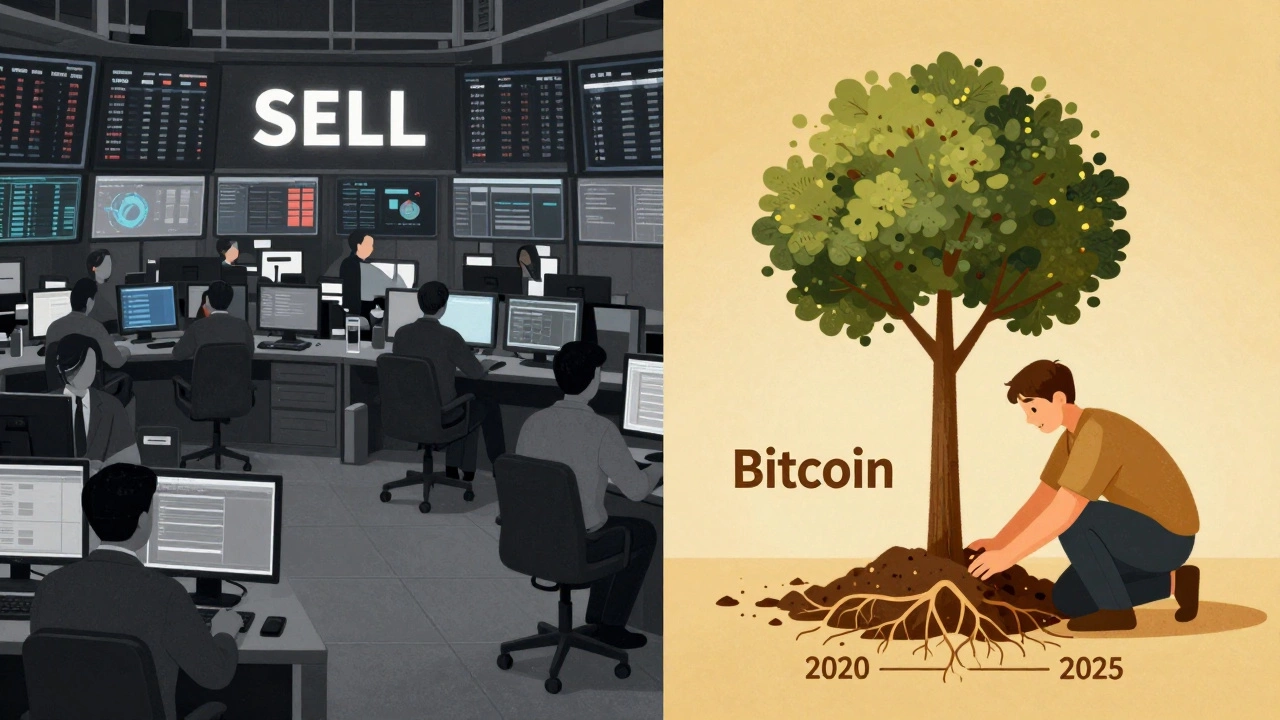
When to sell-real signs, not emotions
You shouldn’t sell just because the price went up. And you shouldn’t sell just because it dropped. You should sell based on your original reason for buying.
Ask yourself:
- Did you buy because you believed in the project’s tech? Then hold until that tech is widely adopted.
- Did you buy because you thought it would replace banks? Then wait until it’s used by millions of people for payments.
- Did you buy because you thought it was a get-rich-quick play? Then you’re already in the wrong game.
Here’s a practical rule: if a coin you own hasn’t improved its core functionality in 12 months, it’s probably stuck. No new users, no upgrades, no partnerships? That’s a red flag. Time to reassess.
Also, watch adoption. If a cryptocurrency is being used by real businesses-like Shopify accepting Dogecoin for payments, or Visa processing crypto settlements-that’s a signal. Not a price chart. Real usage beats hype every time.
How much of your portfolio should be in crypto?
Never put all your money in crypto. Ever. Even if you believe in it 100%.
Most financial planners recommend 5% to 10% of your total investment portfolio. That’s enough to benefit from growth without risking your financial stability. If you have €50,000 saved, that means €2,500 to €5,000 in crypto. Not €50,000.
Why? Because crypto is volatile. And unpredictable. Even Bitcoin, the safest crypto, can lose 40% in six months. If that’s 80% of your savings, you’re not investing-you’re gambling.
And if you lose that money, you can’t just work harder to make it back. You need time. And time is the one thing you can’t buy.

What about Bitcoin vs. altcoins?
Not all crypto is the same. Bitcoin is digital gold. It’s the oldest, most trusted, and least likely to vanish. Altcoins? They’re lottery tickets.
Bitcoin has a 15-year track record. It’s survived crashes, bans, hacks, and government crackdowns. It’s stored on more wallets than any other asset. Its network is bigger than most banks.
Altcoins? Over 20,000 have launched since 2017. Less than 10% are still active. Most have zero users. Zero utility. Zero future.
If you’re holding crypto long-term, put 80% of your crypto allocation into Bitcoin. The rest? Maybe Ethereum, if you believe in smart contracts. Or Solana, if you think speed matters. But don’t chase every new coin. You’ll lose money.
What to do if the market crashes
Crashes aren’t a reason to panic. They’re a reason to pause.
When Bitcoin dropped 70% in 2022, millions sold. But those who held? They bought more. At $15,000. At $10,000. At $8,000. By the time it hit $60,000 again, their average cost was way lower. That’s dollar-cost averaging in action.
Here’s a simple plan: if you already hold crypto, don’t touch it. If you don’t, use the dip to buy a little more-once a month, no matter what. Keep doing it for a year. You’ll end up with a lower average price and more confidence.
And remember: the best time to buy crypto was 5 years ago. The second-best time? Today.
Final rule: Don’t check your portfolio every day
Checking your crypto holdings daily is like checking the weather every hour. It doesn’t change anything. It just makes you anxious.
Set a reminder to review your portfolio once every three months. Ask: Did the project improve? Did adoption grow? Did the team deliver? If yes, hold. If no, consider selling.
And if you’re not sure? Wait. Don’t rush. The market will still be here tomorrow. And next week. And next year.
Crypto isn’t a sprint. It’s a marathon. And the winners aren’t the ones who ran the fastest. They’re the ones who didn’t quit.
Is it better to hold crypto for 1 year or 5 years?
Holding for 5 years is almost always better than 1 year. Short-term holders are more likely to sell during dips and miss the biggest gains. Data shows that investors who held Bitcoin for 5+ years had a 95% chance of profit. Those who held for just one year had only a 58% chance. The longer you hold, the more volatility smooths out.
Should I sell my crypto if it doubles in value?
Not necessarily. Doubling is a milestone, not a signal. If you believe in the project’s long-term potential, you can sell part of your position-say, 20%-to lock in profit and reduce risk. Keep the rest. Many of the biggest crypto fortunes were made by holding through multiple 2x, 5x, and 10x moves.
What happens if I hold crypto forever?
Holding forever only makes sense if you believe the asset will become essential. Bitcoin, for example, is designed to be a scarce digital store of value. If that vision holds, holding forever could mean massive long-term gains. But most altcoins have no such design. They could vanish. Always ask: Is this asset built to last? If not, don’t hold forever.
Can I lose all my money in crypto?
Yes, especially with altcoins. Many projects fail. Some are scams. Others get abandoned. Even Bitcoin has dropped over 80% in the past. But if you stick to Bitcoin and Ethereum, and only invest what you can afford to lose, the risk of total loss is low. The real danger isn’t volatility-it’s putting too much in the wrong places.
Do I need to pay tax on crypto gains in Ireland?
Yes. Ireland taxes crypto as a capital asset. If you sell for more than you paid, you owe 33% capital gains tax on the profit. You must report this to Revenue. Keep records of all buys and sells. Even if you trade one crypto for another, it’s a taxable event. Ignoring this can lead to penalties.