Credit Recovery Timeline Calculator
This calculator shows when negative marks will expire from your credit report and when your credit score may improve based on the article's timeline guidelines.
Important: This is an estimate. Credit reports vary, and recovery speed depends on your ongoing credit behavior.
When you consolidate debt, you’re not wiping the slate clean-you’re rearranging it. Many people think debt consolidation fixes their credit problems right away. It doesn’t. Your credit score won’t magically bounce back just because you paid off your credit cards with a new loan. The truth is, your credit can stay damaged for years after debt consolidation, depending on how you got there and how you handle things after.
Why Your Credit Takes a Hit
Debt consolidation often means closing old accounts. That alone can hurt your score. Credit scoring models like FICO and VantageScore care about your credit utilization ratio-how much of your available credit you’re using. When you close credit cards after paying them off with a consolidation loan, your total available credit drops. If your spending stays the same, your utilization ratio goes up, and your score drops.Another big factor is payment history. If you missed payments before consolidating, those late payments stay on your credit report for up to seven years from the original delinquency date. Consolidation doesn’t erase those. Even if you’re now paying on time, the damage from past misses is still there.
Also, applying for a new consolidation loan triggers a hard inquiry. That knocks a few points off your score right away. It’s not much-usually 5 to 10 points-but it adds to the pile.
How Long Does Negative Information Stay?
The length of time bad credit lasts after debt consolidation depends on what kind of negative marks you have. Here’s what you’re dealing with:- Late payments: Stay on your report for 7 years from the date you first missed the payment.
- Debt settlement: If you settled debts for less than you owed (common in some consolidation programs), that notation stays for 7 years from the settlement date.
- Charge-offs: When a creditor gives up on collecting, they charge it off. That stays for 7 years from the original delinquency date.
- Bankruptcy: If your consolidation plan led to Chapter 7 bankruptcy, that stays for 10 years. Chapter 13 stays for 7 years.
- Hard inquiries: These drop off after 2 years, but only affect your score for the first year.
So if you consolidated in January 2024 and had several late payments from 2022, those late payments won’t disappear until January 2029. The consolidation loan itself? That’s a new account. If you pay it on time, it can start helping your score after 6 to 12 months.
What Happens When You Pay Off the Consolidation Loan?
Paying off your consolidation loan is a win-but not an instant fix. Here’s what changes:- Your debt-to-income ratio improves. Lenders see you as less risky.
- You have one less monthly payment to juggle. That reduces stress and the chance of missing a payment.
- Your credit mix improves slightly. Having a mix of revolving credit (credit cards) and installment loans (like a consolidation loan) is good for your score.
But here’s the catch: if you close all your old credit cards after paying them off, you might lose a lot of your available credit. That can make your utilization ratio look worse-even if you’re not spending more. For example, if you had $20,000 in available credit across five cards and closed them all after paying them off with a $15,000 consolidation loan, you now have $0 in revolving credit. That’s a red flag to lenders.
Best practice? Keep at least one old credit card open and use it lightly. Pay it off in full every month. That keeps your credit history active and your utilization low.
How Fast Can Your Credit Recover?
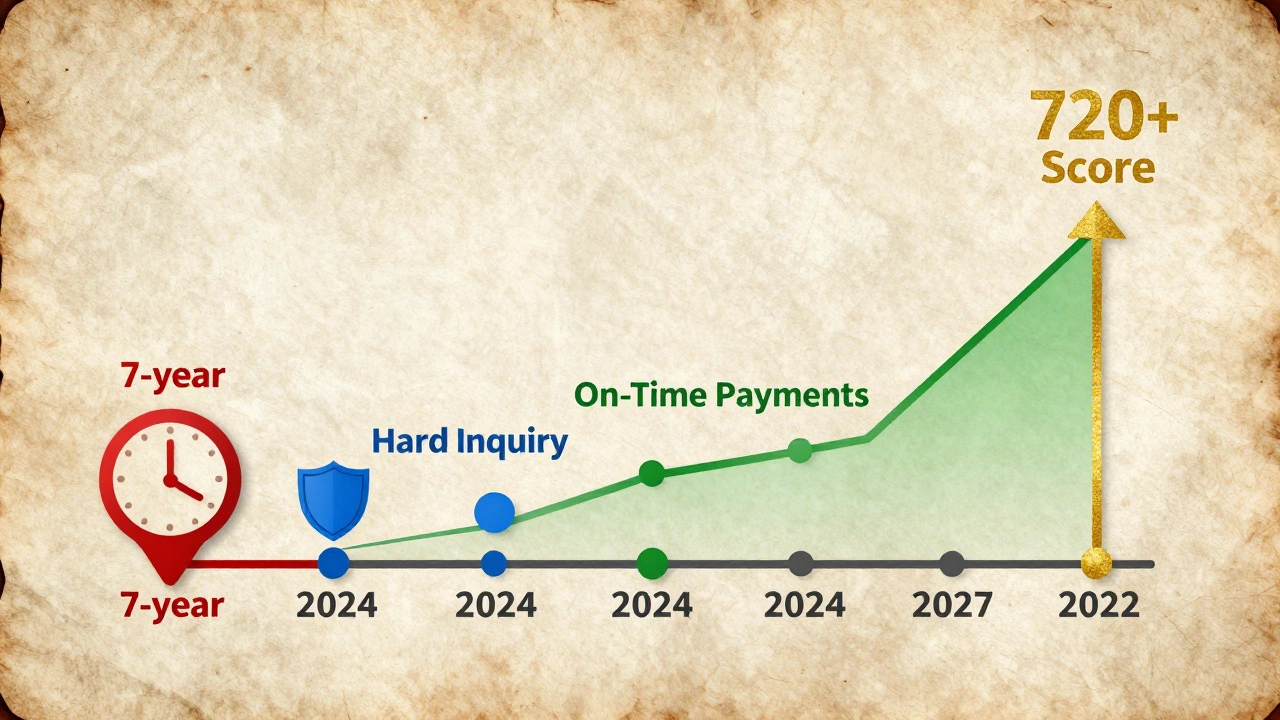
There’s no fixed timeline, but here’s what most people experience:- First 3-6 months: Score may dip further due to new loan, closed accounts, and hard inquiry.
- 6-12 months: If you pay the consolidation loan on time and don’t open new debt, your score starts to climb. You’ll see noticeable improvement if you’ve been consistent.
- 18-24 months: Most people see their score back to pre-consolidation levels-or better-if they’ve avoided new debt and kept old accounts open.
- 3+ years: Negative marks from before consolidation begin to fall off. Your score can jump again as older negatives expire.
A 2023 study by the Federal Reserve Bank of New York tracked 12,000 people who used debt consolidation loans. Those who kept one credit card open and paid on time saw their scores rise by an average of 45 points within 18 months. Those who closed all accounts and racked up new debt saw no improvement after two years.
What to Do After Consolidation
Don’t just wait for time to fix things. Take action:- Don’t open new credit cards. This is the #1 mistake. The moment you start using credit again, you risk falling back into the same cycle.
- Use one old card for small purchases. Buy groceries or gas, then pay it off. This keeps the account active and builds positive history.
- Set up payment reminders. Miss one payment on your consolidation loan and you reset the clock. Even one late payment can undo months of progress.
- Check your credit report every 4 months. In Ireland, you can get free reports from the Central Credit Register. Look for errors-old debts listed as unpaid, duplicate accounts, or wrong dates.
- Avoid payday loans or short-term credit. These come with sky-high interest and hurt your score more than they help.
When to Expect Real Improvement
If you’re trying to buy a house or get a car loan, lenders don’t just look at your score-they look at your history. A score of 650 might get you approved, but you’ll pay more in interest. A score of 720+ gets you better terms.Most people reach a solid 700+ score 2 to 3 years after consolidation if they follow the rules. That’s not fast-but it’s realistic. There’s no shortcut. The goal isn’t to erase the past. It’s to prove you’ve changed.
One client I worked with in Dublin consolidated €18,000 in credit card debt in early 2023. She kept one card open, used it for monthly fuel purchases, and paid it off every month. She didn’t touch any other credit. By late 2024, her score went from 580 to 710. She got approved for a mortgage with a 3.2% rate. She didn’t get lucky. She stayed disciplined.

What Doesn’t Work
Avoid these traps:- Debt settlement companies that promise to erase your debt. They often tell you to stop paying creditors. That leads to charge-offs and more damage.
- Applying for new credit to ‘boost’ your score. More applications = more hard inquiries. More debt = higher utilization. It backfires.
- Thinking consolidation is a free pass. It’s a tool, not a cure. You still have to manage money differently.
If you’re tempted to use your old credit cards again, ask yourself: Do I want to go through this again in five years? The answer usually stops people in their tracks.
Final Reality Check
Debt consolidation doesn’t fix bad credit. It gives you a chance to rebuild it. The clock starts ticking the day you take out the loan. Bad marks from before don’t vanish. But every on-time payment after that adds a brick to your new credit foundation.It takes patience. It takes discipline. And it takes time. But if you stick with it, your credit can recover-even after serious debt.
Does debt consolidation remove negative marks from my credit report?
No. Debt consolidation doesn’t erase late payments, charge-offs, or settlements from your credit report. Those stay for up to seven years from the original delinquency date. Consolidation only changes how your debt is structured-not what’s already on your report.
Will my credit score improve immediately after getting a consolidation loan?
Usually not. In the first few months, your score might drop due to a new hard inquiry and closed accounts. Improvement typically starts after 6 to 12 months of on-time payments and responsible credit use.
Should I close my credit cards after debt consolidation?
It’s better to keep at least one old card open. Closing cards reduces your total available credit, which can raise your credit utilization ratio and hurt your score. Use the card lightly and pay it off in full each month to keep it active and helpful.
How long until I can get a mortgage after debt consolidation?
Most lenders want to see at least 12 to 24 months of on-time payments after consolidation before approving a mortgage. Your credit score should be above 650, and you’ll need stable income and low debt-to-income ratio. Some people qualify in 18 months with strong discipline.
Can I rebuild credit while paying off a consolidation loan?
Yes-and you should. Use one old credit card for small purchases and pay it off monthly. This shows lenders you can handle multiple types of credit responsibly. On-time payments on your consolidation loan also help. Together, they build a strong credit history.
What’s the biggest mistake people make after debt consolidation?
Opening new credit cards or taking on new debt. Many people think consolidation gives them a fresh start, so they spend again. That’s how people end up with more debt than before. The real work starts after you get the loan.
Next Steps
If you’ve consolidated your debt:- Get your free credit report from the Central Credit Register.
- Check for errors-especially on old accounts.
- Keep one credit card open and use it responsibly.
- Set up automatic payments for your consolidation loan.
- Wait at least 18 months before applying for new major credit.
Rebuilding credit after debt consolidation isn’t about speed. It’s about consistency. Every month you pay on time, you’re proving you’ve changed. And that’s what lenders-and your future self-will care about most.