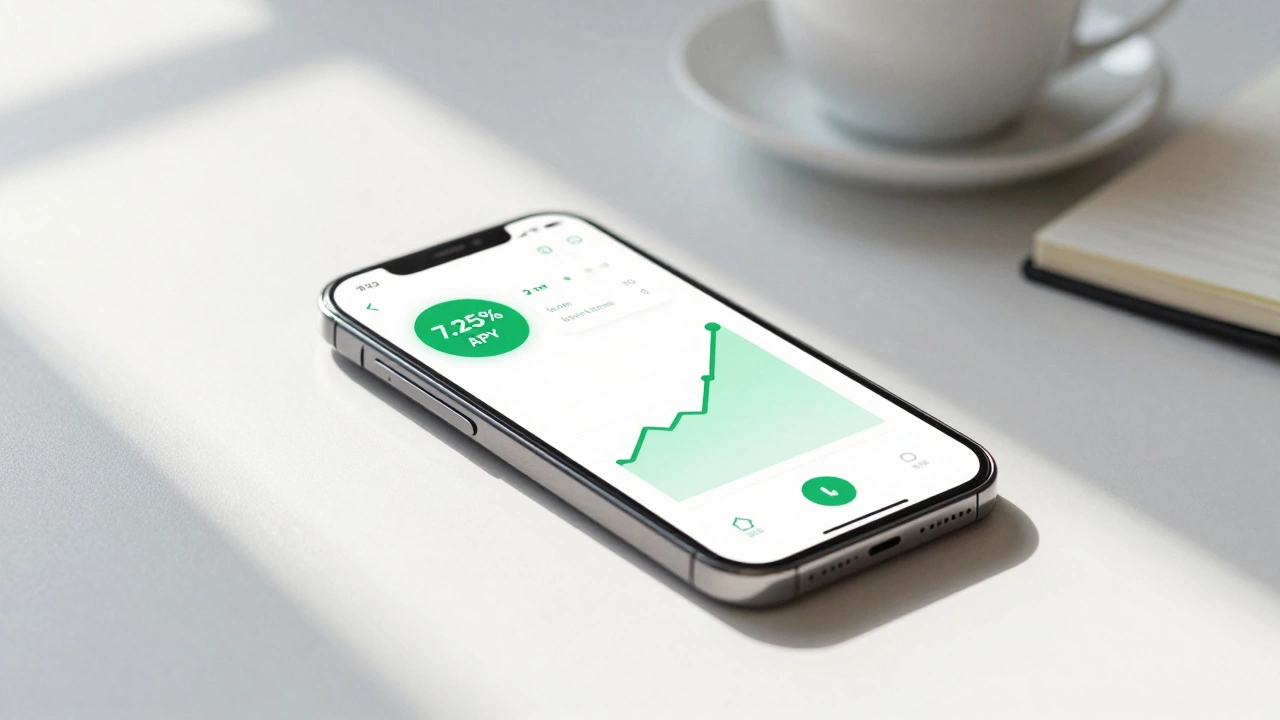
High-Yield Savings Compound Interest Calculator
Account Details
Projected Balance
Comparison: Traditional Bank (0.01%)
Seven percent. It sounds like a number from a different era, doesn't it? For years, the average savings account paid so little that you could barely buy a coffee with the interest earned in a decade. But right now, in mid-2026, that narrative has flipped completely. You are asking a very specific question: which bank is giving 7% interest on savings accounts? The short answer is that while traditional high street banks are still lagging behind, a select group of online-only banks and digital-first lenders are offering Annual Percentage Yields (APY) that hover right around or even exceed that 7% mark.
This isn't magic; it's economics. When central banks keep borrowing costs high to tame inflation, those costs ripple down to consumers. Banks pay more to borrow money from each other, so they must offer better rates to attract your deposits. If you're sitting on cash in a standard checking account at a major brick-and-mortar institution, you're likely losing purchasing power every single day. Let’s break down exactly where these rates live, how to get them, and what you need to watch out for before you move your money.
The Reality of 7% APY in 2026
First, we need to manage expectations. A flat 7% fixed rate for an unlimited amount of money is rare. Most institutions offering rates this high apply conditions. They might cap the balance eligible for the full rate, require direct deposit, or limit the number of transactions per month. However, several top-tier high-yield savings accounts are currently advertising introductory or ongoing APYs between 6.5% and 7.25%. These numbers fluctuate weekly based on Federal Reserve policy and market competition, so the exact figure changes as soon as you read this.
The key distinction here is the type of bank. Traditional national banks-think of the ones with branches on every corner-typically offer less than 0.5% APY. Why? Because their overhead is massive. They pay for real estate, staff, and physical security. Online banks don't have those costs. They pass those savings directly to you in the form of higher interest. This is why your search for 7% leads almost exclusively to digital platforms rather than local community banks or big-name retail giants.
Top Contenders Offering Near 7% Rates
While I cannot give you a live feed of today's exact decimal points, certain institutions have consistently led the pack in 2024 through 2026. Here are the types of players you should be looking at:
- Digital Neobanks: Apps-first banks that operate without physical branches. They often use variable rates that adjust monthly. Some offer tiered structures where balances under $10,000 earn significantly more than larger sums.
- Credit Unions: Member-owned nonprofits often beat commercial banks on rates because they aren't driven by shareholder profit margins. Many online credit unions offer 7%+ APY on shares (their term for savings).
- Specialty Fintech Lenders: Companies that partner with established banks to offer branded savings products. These often come with gamification features but deliver competitive yields.
To find the current leader, you need to check comparison sites daily. Look for terms like "introductory APY" versus "ongoing APY." An intro rate might hit 7.5% for three months, then drop to 3%. That’s not a long-term strategy. You want stability. Institutions like Ally, Marcus by Goldman Sachs, and various large credit unions have historically hovered in the 4-6% range, with some promotional periods pushing into the 7% zone during peak rate environments.

How High-Yield Savings Work: The Mechanics
Understanding how the bank makes money helps you understand why they can pay you 7%. It’s a simple loop. You deposit money. The bank lends that money out to borrowers-for mortgages, car loans, or business expansion-at a much higher interest rate, say 8% or 9%. The difference between what they pay you and what they charge borrowers is called the net interest margin. In a high-rate environment, this margin widens, allowing banks to be more generous with savers without hurting their own bottom line.
Your money grows through compound interest. Unlike simple interest, where you only earn on your principal, compound interest means you earn interest on your interest. At 7%, if you leave $10,000 untouched for one year, you won't just get $700. Depending on how often the bank compounds (daily is best), you’ll end up with slightly more because the interest added in January starts earning its own interest in February. Over five years, that effect becomes substantial.
Risks and Trade-Offs to Consider
Before you transfer your life savings, consider the trade-offs. The biggest risk isn't losing your money-it's losing access to it quickly. High-yield savings accounts are designed for parking cash, not spending it. They often limit withdrawals to six times per month due to federal regulations (Regulation D). While many banks have relaxed this rule recently, frequent transfers might trigger fees or account closures.
Another factor is insurance coverage. Always ensure the bank is FDIC-insured (in the US) or covered by equivalent schemes like the NCUA for credit unions. This protects your deposit up to $250,000 per depositor, per insured bank. If you see a fintech app offering 8% but it’s not backed by an FDIC-insured partner bank, walk away. The yield isn't worth the risk of uninsured exposure. Also, remember that inflation erodes purchasing power. If inflation runs at 4%, your 7% return gives you a real gain of only 3%. Still positive, but not as glorious as the headline suggests.
| Bank Type | Typical APY (2026) | Accessibility | Best For |
|---|---|---|---|
| Traditional Brick-and-Mortar | 0.01% - 0.5% | High (Branches) | In-person service needs |
| Online National Banks | 4.0% - 6.5% | Medium (App/Web) | Balance of safety & yield |
| Digital Neobanks | 6.0% - 7.5% | Low (App Only) | Maximizing returns |
| Credit Unions | 5.5% - 7.0% | Variable | Member-focused benefits |

Strategies to Maximize Your Returns
If you’re serious about hitting that 7% target, you need a strategy. Don’t just open one account and forget it. Start by separating your money. Keep your emergency fund in a highly liquid, insured high-yield account. Then, look for "rate shopping." Just like you’d compare car prices, compare APYs. Move your money every quarter if another bank offers a better deal. The hassle is worth hundreds of dollars in extra interest over time.
Consider laddering your deposits. Instead of putting all your cash in one place, split it across two or three different institutions. This diversifies your risk and ensures you’re always taking advantage of the highest available rate. Also, automate your savings. Set up a direct deposit from your paycheck to go straight into the high-yield account. This removes the temptation to spend and ensures your money starts compounding immediately.
Finally, watch for promotional periods. Some banks offer boosted rates for new customers who maintain a minimum balance for 90 days. Read the fine print. Does the rate drop after the promotion ends? Is there a penalty for early withdrawal? If the terms are punitive, skip it. You want transparency, not traps.
What Comes Next for Interest Rates?
Economic forecasts for late 2026 suggest that central banks may begin cutting rates if inflation cools sufficiently. If that happens, the 7% club will shrink. Banks will lower their APYs to protect their lending margins. This creates a window of opportunity. Right now, while rates are elevated, locking in a high-yield account is smart. Even if rates drop later, your money will have grown significantly during the peak period. Stay informed, monitor financial news, and be ready to act when the landscape shifts.
Is a 7% savings account safe?
Yes, provided the bank is FDIC-insured or NCUA-insured. The safety comes from government backing, not the interest rate itself. Always verify the insurance status on the bank's website or through official regulatory databases before depositing funds.
Why do online banks offer higher rates than local banks?
Online banks have lower overhead costs because they don't maintain physical branches, teller staff, or expensive real estate. These savings are passed on to customers in the form of higher interest rates on deposits and lower fees.
Can I lose money in a high-yield savings account?
You cannot lose your principal balance in an insured savings account unless the bank fails and exceeds insurance limits, which is extremely rare. However, you can lose purchasing power if inflation rises faster than your interest rate, resulting in a negative real return.
Are there fees associated with high-yield savings accounts?
Most reputable high-yield savings accounts have no monthly maintenance fees. However, some may charge fees for wire transfers, excessive withdrawals, or falling below a minimum balance requirement. Always read the fee schedule carefully.
How often does the interest compound?
Most high-yield savings accounts compound interest daily and pay it monthly. Daily compounding maximizes your earnings because you start earning interest on your accrued interest sooner than with monthly or annual compounding.